

A badminton session can feel completely normal until one deep lunge, awkward landing or fast change of direction makes the knee start aching. Sometimes the pain appears during the game. Sometimes it only becomes obvious when you cool down, climb the stairs later, or wake up the next morning.
If you have knee pain after badminton, the sport itself does not tell you the diagnosis. The pattern may involve the kneecap, a tendon, the joint, meniscus, ligament, surrounding muscles, or simply a temporary mismatch between what the knee was asked to do and what it currently tolerates.
The Hip, Knee, Ankle & Heel Pain guide explains how lower-limb symptoms are assessed beyond the painful spot alone. For badminton-related knee pain, useful clues include where the pain sits, whether there was a specific twist or landing, how much swelling appeared, whether the knee locks or gives way, and what changed in your recent training.
The main question is not “Is badminton bad for my knee?” It is “What happened, how is the knee behaving now, and what load can it currently tolerate?”
Quick Answer: What Can Knee Pain After Badminton Mean?
Knee pain after badminton can follow repeated lunging, landing and direction changes when the session exceeds your current tolerance. It can also start after a clear twist, collision, fall or awkward landing.
Common possibilities include:
- patellofemoral pain around or behind the kneecap
- irritation of the patellar or quadriceps tendon
- joint or meniscus-related irritation
- a ligament sprain after a twist or awkward landing
- muscle or tendon irritation around the inner, outer or back of the knee
- symptoms influenced by the hip, ankle or previous lower-limb injury
- general soreness after an unusually demanding session
The Sports Injuries guide is useful when the problem is clearly linked with training load, returning to sport or repeated flare-ups.
A mild ache that appeared after several harder games and settles over the next day is different from a knee that swelled rapidly after a twist, cannot fully straighten, feels unstable or cannot comfortably bear weight.
Badminton can expose a knee problem, but it does not automatically identify which structure is responsible.
Why Can Badminton Irritate the Knee?
Badminton combines rapid acceleration, stopping, lunging, jumping, landing and direction changes. Singles and doubles differ, but both can expose the knee to repeated bursts of force.
The knee is designed to bend, absorb force and produce force. The issue is not that these movements are inherently harmful. Problems are more likely when the demand changes faster than your present tolerance.
That can happen when you:
- return after several weeks away
- suddenly play longer matches
- add another badminton night to the week
- combine badminton with running, squats or heavy leg training
- play a tournament or multiple back-to-back games
- move from casual rallies to faster competitive play
- continue despite a knee that has not recovered from a previous session
A familiar two-hour session may also feel very different when you are sleep-deprived, recovering from illness or returning from a period of reduced activity.
Load is not the enemy. A sudden mismatch between load, recovery and current capacity is often more useful to think about.
Where Does the Knee Hurt After Badminton?
Pain location does not confirm a diagnosis, but it helps narrow the possibilities.
Pain around or behind the kneecap
Front-of-knee pain is commonly associated with patellofemoral pain. It may feel diffuse around or behind the kneecap rather than like one tiny point. Deep lunges, repeated squats, stairs, jumping and prolonged sitting may also reproduce it. A pattern that builds with repeated bending and settles as load is reduced can fit this presentation, but it does not prove the kneecap itself is damaged.
If squatting is a major trigger outside badminton too, the guide to knee pain when squatting explains that pattern in more detail. If stairs are the clearest daily-life trigger, knee pain going down stairs may be the closer comparison.
A painful kneecap does not automatically mean the kneecap is “out of place” or that cartilage is being worn away every time you lunge.
Pain below the kneecap
Pain around the patellar tendon can become noticeable with jumping, landing, repeated lunges and explosive push-offs. The area may feel more focal than general kneecap pain and may become more sensitive after repeated high-load sessions. Some players notice it most during explosive push-off or the first few jumps, while others feel it later that day or the next morning. That timing can help guide how much jumping and lunging to modify, but it still does not confirm a tendon diagnosis.
A tender tendon is not diagnosed from location alone. Similar pain can come from nearby tissues, and the training pattern matters.
Pain on the inside, outside or back of the knee
Inner knee pain after a clear twist, especially with swelling, catching or difficulty fully straightening the knee, raises different concerns from a gradual ache around nearby soft tissues. Outer knee pain may reflect local joint or soft-tissue loading. Pain behind the knee has several possible sources and should be interpreted together with swelling, range of motion and the injury mechanism. The location narrows the possibilities, but it does not identify one structure by itself.
Where it hurts is a clue. It is not the full diagnosis.
Did the Pain Build Gradually or Start With One Moment?
The onset is one of the most useful distinctions.
Gradual or load-related pain
If the knee became increasingly sore over several games, or only started hurting later that evening or the next morning, a load-related pattern becomes more plausible.
This overlaps with the general principles in the article on why knee pain keeps coming back, where the issue may be less about one damaging event and more about repeating a demand the knee has not yet rebuilt enough capacity for.
Sudden pain after a twist, landing or collision
A clear injury changes the decision.
If you planted the foot, twisted sharply and felt immediate pain, or landed awkwardly with the knee giving way, the concern for ligament, meniscus, bone or other acute injury becomes more relevant.
You do not need to hear a pop for an injury to matter. Likewise, hearing or feeling a pop does not tell you the exact diagnosis on its own.
A sudden traumatic mechanism deserves a different level of caution from gradual soreness after a hard session.
How Do Lunging, Landing and Direction Changes Matter?
Badminton knee pain often appears during the movements that demand rapid force control.
Deep lunges
A forward lunge asks the front leg to accept body weight while the knee bends and the player reaches for the shuttle. The deeper and faster the lunge, the greater the demand can become.
Pain during a lunge may reflect front-of-knee sensitivity, tendon load, joint irritation or another pattern. It does not prove that your lunge technique is “wrong”.
Jumping and landing
Smashes and fast overhead play may involve repeated jumping and landing. A comfortable landing requires the hip, knee and ankle to work together.
Fatigue, a sudden increase in jumping volume, or returning after time off can make a previously normal demand feel much harder.
Rapid direction changes
Cutting back toward the centre line or changing direction quickly can expose symptoms that are not obvious during straight-line walking.
A knee that repeatedly feels unstable or gives way during these changes needs more attention than a mild ache that remains stable.
Technique can influence load, but there is rarely one perfect lunge or landing position that every player must copy.
Can Training Volume, Footwear or Court Changes Trigger Symptoms?
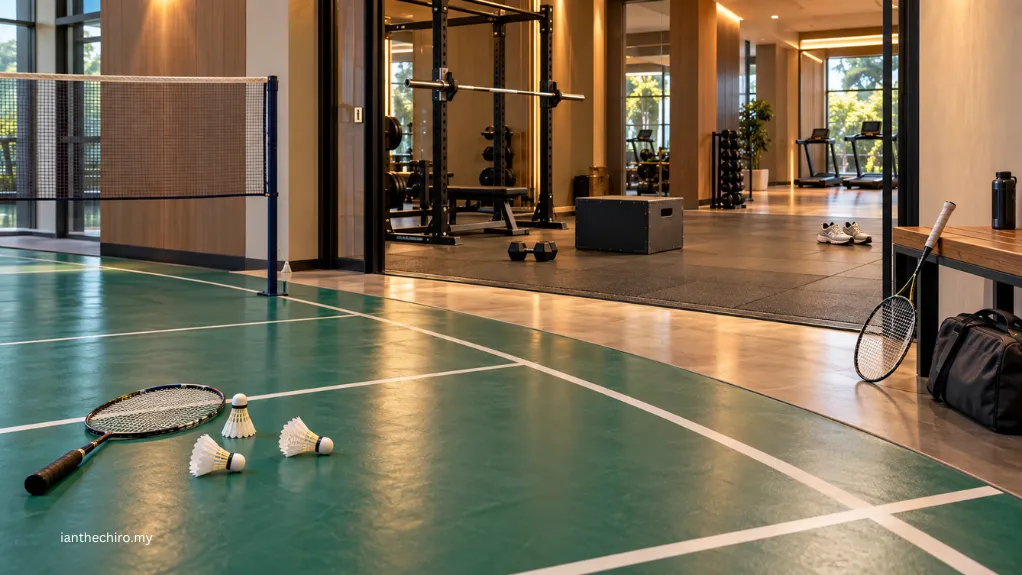
Sometimes the most useful clue is not one movement. It is what changed around the time the symptoms started.
A sudden volume increase can include:
- playing three nights instead of one
- adding singles after mostly playing doubles
- returning to matches after a long break
- joining a tournament weekend
- adding more gym leg work or running in the same week
- playing longer because the knee initially feels fine
This is similar to the pattern discussed in knee pain after running, where the total weekly demand can matter as much as one individual session.
Footwear and court surface can change comfort, grip and movement demand. Treat a recent change as a clue, not proof that one shoe or court caused the problem.
If a recent change lines up with the symptoms, treat it as one clue among many.
Do not blame the shoes simply because the knee hurts. Look at the whole change in training, recovery and movement demand.
What Do Swelling, Clicking, Locking or Giving Way Mean?
These features can change how urgently the knee should be assessed.
Swelling
A small amount of swelling after a harder session can occur with irritation, but rapid or substantial swelling after a twist or impact deserves more caution.
Persistent swelling that repeatedly returns after sport is also worth assessing rather than managing indefinitely with rest alone.
Clicking or cracking
Painless clicking is common and does not automatically mean damage.
Clicking becomes more clinically relevant when it is new and accompanied by pain, swelling, catching, reduced movement or a clear injury.
Locking
True locking means the knee becomes mechanically stuck and you cannot fully bend or straighten it as usual. That is different from pain making you reluctant to move.
A repeatedly locking knee should be assessed.
Giving way or instability
Sometimes pain causes a person to hesitate and the knee briefly feels unreliable. True instability is different. If the knee repeatedly buckles during direction changes, or you cannot trust it during normal walking, a ligament or other structural injury needs consideration.
Pain alone is one piece of information. Swelling, locking and genuine instability can change the clinical picture considerably.
Should You Keep Playing Badminton?
There is no single yes-or-no rule.
For mild, gradual symptoms with no major swelling, locking or instability, it may be reasonable to modify the session rather than stop every form of activity. That could mean reducing total games, avoiding repeated deep lunges, lowering jump volume, taking longer breaks or switching to lighter practice. Badminton-specific options include choosing doubles instead of singles, shortening the session, reducing maximal jump smashes, limiting repeated end-range lunges and stopping before fatigue clearly changes how you move. The aim is to keep some useful court exposure without turning a manageable response into a progressively worse one.
A useful test is what happens during the session and over the next 24 hours. A game that feels acceptable at the time is less reassuring if the knee becomes clearly more painful, swollen or restricted later that evening or the next morning.
Continuing may be more reasonable when:
- pain stays mild and stable
- you can move without limping
- the knee does not progressively swell
- symptoms settle reasonably after play
- the next morning is not clearly worse
- strength and confidence remain normal
Stop the session and reassess if pain escalates, movement becomes guarded, the knee gives way, swelling increases or you cannot bear weight normally.
The useful test is whether the knee stays controlled during play and settles afterwards, not whether you can force yourself through the scheduled match.
What Should You Do in the First Few Days?
The first step depends on whether this looks like mild overload or a more significant injury.
For mild, non-traumatic soreness, temporarily reduce badminton volume, keep comfortable daily movement and stop repeatedly testing the movement that clearly aggravates the knee.
Heat or cold may provide short-term comfort, but neither identifies the cause or repairs a structure. Discuss medication with a pharmacist or doctor when relevant.
If you are unsure whether what you feel is ordinary post-exercise soreness or something more focal, the muscle soreness vs injury guide provides a practical comparison.
Avoid:
- repeatedly lunging as deep as possible to “test” the knee
- forcing stretches into sharp pain
- stopping all lower-body movement for weeks without a reason
- returning straight to full matches as soon as the knee feels slightly better
- using pain relief only to hide symptoms so you can keep playing
- assuming every painful knee needs massage, dry needling or an adjustment
The aim is to calm an irritable knee without letting short-term rest become the entire recovery plan.
Which Exercises and Return-to-Badminton Steps May Help?
A return-to-badminton plan should match the movements that provoke symptoms, the knee’s current irritability and the level of play you want to regain.
For front-of-knee or patellofemoral pain, a 2024 best practice guide for patellofemoral pain supports education and knee-targeted, with or without hip-targeted, exercise as the foundation of care. Additional options should be selected according to the individual presentation.
That does not mean every player needs the same exercise programme.
A progression may include:
- comfortable knee-bending work
- quadriceps and hip strengthening
- calf and ankle capacity work
- balance and single-leg control
- slower lunges before faster lunges
- low-level jumping before repeated maximal jumping
- controlled direction changes before full-speed court movement
- shorter rallies or practice before longer matches
Return-to-badminton work should rebuild the demands of the sport. Comfortable walking is useful, but badminton requires more than ordinary walking. A practical sequence is to restore comfortable daily movement and basic strength first, then controlled lunges and single-leg work, then low-intensity court footwork, followed by jumping, landing and planned direction changes before full games. Progress when the current step is tolerated during the session and the knee settles back toward its usual baseline by the next day.
For a player whose main trigger is deep lunging, the later stages should rebuild lunge depth, speed and repetition. If symptoms are mainly linked with jumping, repeated landing and take-off capacity may matter more. Rehabilitation should eventually look more like the sport, but only after the basic loads are tolerated.
Do You Need an X-Ray or MRI?
Not every episode of knee pain after badminton needs imaging.
If the symptoms developed gradually, there was no significant trauma and the examination does not suggest a serious structural injury, assessment and conservative management may be a reasonable starting point.
Acute trauma is different. The American College of Radiology guidance on acute knee trauma notes that radiographs are usually appropriate after an acute twisting or fall-related injury when findings such as focal tenderness, joint effusion or inability to bear weight are present.
MRI may become more relevant when the examination raises concern about internal knee structures, when significant symptoms persist despite appropriate care, or when the result would change specialist or surgical management.
Imaging is useful when it changes the next decision, not simply because the knee hurts after sport.
When Should Badminton Knee Pain Be Checked Urgently?
Most badminton-related knee pain is not an emergency, but some presentations need medical assessment promptly.
⚠️ Seek urgent medical care for significant trauma or serious warning signs
Seek urgent assessment if there is major trauma, visible deformity, inability to bear weight, a rapidly enlarging swollen knee, a knee that is locked and cannot move normally, or a sudden major loss of strength or stability.
A hot, markedly swollen joint with fever or feeling systemically unwell also needs medical review.
If the leg becomes unusually cold, pale or numb after trauma, or there is severe pain that seems out of proportion to the injury, seek urgent care.
For a less dramatic injury, arrange assessment if swelling repeatedly returns, the knee keeps giving way, normal walking remains difficult or the symptoms are not showing a reasonable improving trend.
What Should a Proper Assessment Look At?
A useful badminton-knee assessment should begin with the exact story.
Important details include:
- whether the pain appeared gradually or during one specific movement
- where the pain is located
- whether there was a twist, fall, collision or awkward landing
- swelling and how quickly it appeared
- locking, catching or giving way
- pain during lunging, squatting, jumping, stairs and walking
- recent changes in badminton frequency, duration or intensity
- other training such as running or gym work
- previous knee, ankle or hip injuries
- footwear or court changes
- how the knee feels later that day and the next morning
The physical examination may include knee movement, tenderness, swelling, strength, ligament and meniscus-related tests when appropriate, single-leg control, squat or lunge tasks, and observation of how the hip and ankle contribute.
The hip and ankle matter because badminton is a whole-leg task. That does not mean every painful knee is “caused” by the hip or ankle.
The assessment should connect the symptoms, injury mechanism and sport demands rather than hunting for one imperfect movement.
How Long Can Recovery Take?
There is no single badminton-knee recovery timeline.
A mild overload flare may settle relatively quickly once the provoking dose is reduced. A tendon problem, persistent patellofemoral pain or significant ligament or meniscus injury can require a longer, more structured rehabilitation period. Recovery also varies with the injury pattern, how irritable the knee is, how long symptoms have been present and what level of badminton you need to return to. Daily activities often improve before fast lunges, repeated jumps or long matches feel normal again.
Useful signs of progress include:
- walking and stairs becoming easier
- swelling reducing and staying down
- a larger comfortable range of knee movement
- stronger single-leg tasks
- lunges becoming more confident
- better tolerance of jumping and landing
- fewer symptoms later that day or the next morning
- being able to increase badminton exposure without repeated setbacks
Return to badminton should be based on function and tolerance, not only on how many days have passed. A useful sign is being able to increase one variable at a time, such as duration, speed, lunge depth or jump volume, without a clear later-day or next-morning setback. If each attempt to progress produces the same flare, the step may be too large or the underlying pattern may need reassessment.
How Ian The Chiro Approaches Badminton-Related Knee Pain
At Ian The Chiro in Cheras, Kuala Lumpur, the first visit starts with a chiropractic consultation and assessment rather than assuming that knee pain after badminton needs an adjustment, dry needling or complete rest.
The goal is to understand whether the pattern looks more like training-load irritation, front-of-knee pain, tendon involvement, a joint or meniscus problem, an acute ligament injury, or something that needs medical investigation. The sport demands matter in that decision.
The return plan should match the badminton you actually play. Casual doubles and competitive singles can require different progressions.
If conservative care is appropriate, the plan may combine activity changes, exercise, gradual return to court and selected hands-on treatment when clinically useful. If the findings suggest imaging, medication discussion, orthopaedic review or another referral, that should be explained clearly.
When Knee Pain After Badminton Deserves Assessment
If the knee is mildly sore after an unusually hard session, is not swollen or unstable, and is improving over the next few days, sensible load modification may be enough to start.
If pain keeps returning every time you play, you are no longer confident lunging or landing, the knee repeatedly swells, or you are unsure whether you are dealing with simple overload or an injury, the next useful step is to assess the pattern properly.
A chiropractic consultation at Ian The Chiro can review the injury history, knee findings, lower-limb function and badminton demands, then decide whether conservative care, further investigation or referral makes sense.
The goal is not just to get through one pain-free session. It is to rebuild enough confidence and capacity for the badminton you actually want to play.
Knee Pain After Badminton: Frequently Asked Questions
Why does my knee hurt after badminton but not during the game?
Pain can show up later as lunges, landings and quick turns add up. That may reflect load sensitivity, but it still cannot name one exact structure. How it feels the next day also matters.
Is knee pain after badminton usually from the kneecap?
Pain at the kneecap is one option, especially if squats, stairs and deep lunges hurt too. Tendon, joint, meniscus or ligament issues may feel different. The pattern matters more when combined with the injury story, swelling, locking, instability and where the pain is actually reproduced.
Should I stop badminton completely if my knee hurts?
Not always. Mild, gradual symptoms may allow a shorter or lighter session instead of stopping completely. Stop and reassess after a twist, increasing swelling, locking, giving way or difficulty bearing weight. See rest or keep moving for a broader guide to modifying activity.
Can a bad lunge damage the meniscus?
A twisting lunge may affect a meniscus, but one sore lunge does not prove a tear. Swelling, catching, true locking and the injury story still help guide assessment.
Why does my knee feel unstable after badminton?
A painful knee can feel hesitant without being structurally unstable. Repeated true giving-way is more concerning, especially if the knee buckles during walking or direction changes after a twist or awkward landing. That pattern deserves assessment rather than simply testing it again on court.
Can a chiropractor help with knee pain after badminton?
Yes, when the presentation is suitable for conservative musculoskeletal care. A chiropractic assessment can help identify whether advice, exercise, load modification or selected hands-on treatment is appropriate. If the findings suggest a significant ligament, meniscus, bone or other medical problem, imaging or referral may be the better next step.
