
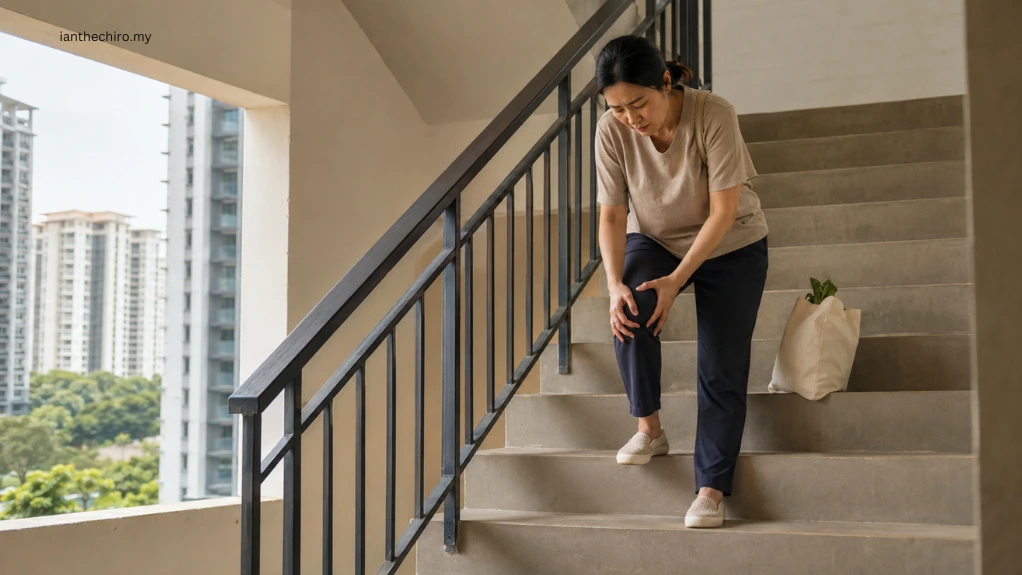
Your knee starts feeling better after rest, medication, physiotherapy, hands-on treatment, or a few easier days.
Then the pain returns when you walk farther, use the stairs, squat, run, exercise, or spend another long day on your feet.
The symptoms may settle again, only to return during the next busy or physically demanding period.
This can leave you wondering:
“Why does my knee pain keep coming back?”
Recurring knee pain does not automatically mean that the knee is becoming more damaged each time.
It may mean that the immediate irritation settled, while the activities, workload, physical capacity, recovery, or other factors repeatedly contributing to the problem have not changed enough.
The pattern may involve the kneecap, knee joint, meniscus, ligaments, muscles, tendons, or nerves. The hip, ankle, and the way the whole leg handles movement may also influence the symptoms.
At Ian The Chiro in Cheras, Kuala Lumpur, the goal is not simply to make the knee feel better temporarily. The first step is to understand what repeatedly triggers the symptoms and whether the current treatment plan is producing lasting progress.
This article is for general education and is not a diagnosis. New, severe, unusual, or worsening symptoms should be assessed appropriately.
If the pain is familiar and non-urgent but keeps returning, start with a proper consultation.
Quick Answer: Why Does My Knee Pain Keep Coming Back?
Knee pain may keep returning when short-term treatment reduces the discomfort but the knee continues to face the same movement, workload, or recovery problem.
Common contributors include:
- returning to running, sports, lifting, or repeated stairs before enough tolerance has been rebuilt
- increasing activity too quickly after rest or injury
- reduced leg strength or endurance for the task
- avoiding knee movement for so long that normal activity becomes difficult
- repeating the same movement without enough recovery
- symptoms influenced by the hip, ankle, nerves, or another nearby area
- relying only on passive treatment without addressing what causes the pain to return
The better question is not only:
“What makes my knee feel better today?”
It is also:
“What keeps exceeding its tolerance tomorrow?”
The painful area may be part of the answer, but the wider pattern usually matters too.
What Does Recurring Knee Pain Mean?
Recurring knee pain can describe several patterns.
The pain may:
- settle completely before returning
- remain mild with occasional flare-ups
- appear only during particular movements
- worsen after exercise, work, or prolonged activity
- occur around, behind, inside, or outside the knee
- return after short-term treatment relief wears off
- occur together with stiffness, clicking, swelling, or a feeling of weakness
Two people may both say their knee pain “keeps coming back” while having different contributing factors.
One person may have increased running or gym volume too quickly.
Another may spend long hours standing, walking, kneeling, or using stairs.
Someone else may have reduced leg capacity, kneecap-related pain, arthritis, a previous injury, or symptoms influenced by the hip or ankle.
The pattern needs to be assessed rather than assumed.
Why Does Knee Pain Return After It Feels Better?
Feeling less pain does not always mean that the knee is ready for its original workload.
Pain may improve before:
- leg strength or endurance has recovered
- walking, running, or stair tolerance has improved
- training volume has been rebuilt gradually
- movement confidence has returned
- sleep and recovery have normalised
- the main contributing factor has been identified
This can create a repeated cycle:
- The knee becomes painful.
- You rest or receive treatment.
- The symptoms settle.
- You return immediately to the same activity level.
- The knee becomes irritated again.
- You repeat the same short-term solution.
The relief was not necessarily false.
It may simply have addressed one part of the problem without preparing the knee for what it still needs to do.
The question is not only what makes your knee feel better today. It is what keeps exceeding its tolerance tomorrow.
Can Doing Too Much Make Knee Pain Return?
Yes.
The knee may become painful when activity increases faster than the body can adapt.
This may happen when you:
- suddenly increase running distance or speed
- add more sports sessions
- increase gym volume or load
- return to exercise after a long break
- add repeated jumping or direction changes
- spend unusually long hours walking or standing
- continue through progressively worsening symptoms
Exercise is not automatically harmful.
The issue may be the amount, frequency, intensity, repetition, technique, or recovery surrounding it.
An activity that was previously manageable may also become irritating when the knee is already tired, sensitive, or recovering from another aggravation.
Can Doing Too Little Make Knee Pain Keep Returning?
Yes.
After knee pain begins, some people stop almost all lower-body activity.
Short-term modification may help when a movement is clearly aggravating.
However, avoiding the knee for too long may reduce confidence, movement tolerance, strength, and endurance.
The cycle may become:
- The knee hurts.
- You avoid walking, stairs, bending, or exercise.
- The symptoms settle.
- You suddenly return to normal activity.
- The knee is no longer prepared for the demand.
- The pain returns.
Modification is different from permanent avoidance.
The longer-term goal is usually to restore useful movement and gradually rebuild capacity where appropriate.
Can Weakness or Low Endurance Cause Recurring Knee Pain?
Strength is not the only factor, but physical capacity may matter.
The muscles around the hips, thighs, knees, and calves help the leg tolerate activities such as:
- walking
- climbing stairs
- standing up from a chair
- carrying
- running
- jumping
- gym training
- changing direction during sport
The knee may become painful, or the surrounding muscles may fatigue, when these demands repeatedly exceed the leg’s current tolerance.
This does not necessarily mean that your muscles are dangerously weak.
It may mean:
- endurance is limited
- activity increased too quickly
- the leg tires before the task is finished
- recovery between sessions is inadequate
- exercise does not match the movement that causes the symptoms
A useful programme should gradually prepare the leg for the person’s actual work, sport, and daily activities.
Can Repeated Stairs, Walking, or Standing Reload the Knee?

Yes.
Repeated daily activities can contribute when their total demand exceeds what the knee currently tolerates.
The problem may involve:
- unusually long walking distances
- repeated stairs
- prolonged standing
- frequent kneeling
- carrying loads
- walking on slopes or uneven surfaces
- insufficient recovery between demanding days
The movement itself is not automatically damaging.
The problem may be the total amount, how quickly the workload increased, and whether the knee has enough capacity for the task.
A practical plan may involve temporarily reducing the most aggravating demand while maintaining comfortable movement elsewhere.
Why Does Knee Pain Return During Exercise?
Exercise-related knee pain may appear because of:
- a recent increase in training volume
- insufficient recovery
- unfamiliar movements
- repeated jumping or landing
- changes in running distance or terrain
- fatigue affecting movement control
- returning to sport before capacity has been rebuilt
- an existing sensitive area being repeatedly loaded
The painful exercise does not identify one exact injured structure by itself.
The assessment should consider when the pain occurs, where it is felt, whether swelling develops, how the knee responds afterward, and whether strength or confidence has changed.
Can Knee Pain Come From the Kneecap?
Yes.
Pain around or behind the kneecap is common, particularly during activities that repeatedly bend and load the knee.
The pain may be noticeable during:
- stairs
- running
- jumping
- prolonged sitting
- standing up after sitting
- gym or sports activities
This may be described as patellofemoral pain or kneecap-related pain.
However, pain near the kneecap does not automatically mean that the kneecap is permanently misaligned or grinding away.
Current best-practice guidance for patellofemoral pain prioritises education and exercise matched to the person, with additional treatments selected according to the individual presentation.
Does Recurring Knee Pain Mean I Have Arthritis?
Not necessarily.
Knee arthritis may cause:
- pain during activity
- stiffness after rest
- reduced movement
- swelling
- difficulty with stairs or longer walks
- symptoms that vary between better and worse periods
However, these symptoms are not exclusive to arthritis.
Younger and active people may experience recurring knee pain without arthritis, while some people have imaging changes without severe symptoms.
A diagnosis should consider age, history, movement, function, examination findings, and imaging when it is genuinely needed.
Even when osteoarthritis is present, activity and exercise remain important parts of care rather than the knee simply being treated as worn out and unusable.
Could It Be a Meniscus Problem?
The menisci are cartilage structures inside the knee that help distribute load and contribute to joint function.
Meniscus-related symptoms may sometimes involve:
- pain around the joint line
- swelling
- pain after twisting
- difficulty bending deeply
- catching or locking
- discomfort during turning or loaded movement
However, these symptoms do not confirm a meniscus tear by themselves.
Pain may arise from other knee structures, and imaging findings need to be interpreted together with the history and examination.
A knee that becomes genuinely locked and cannot straighten normally deserves prompt assessment.
Could It Be a Ligament Injury?
Ligament injury deserves greater consideration when knee pain follows a clear traumatic event.
Examples include:
- twisting during sport
- landing awkwardly
- a direct collision
- the knee bending unusually
- hearing or feeling a sudden pop
- rapid swelling
- immediate difficulty continuing the activity
- a feeling that the knee gives way
Not every unstable or weak sensation means that a ligament is torn.
Pain, swelling, fear, and muscle inhibition may also make the knee feel unreliable.
Significant trauma followed by instability, swelling, or difficulty bearing weight should be assessed appropriately.
Can Pain Be Influenced by the Hip or Ankle?
Yes.
The hip, knee, ankle, and foot work together during walking, running, stairs, and sport.
The knee may face different demands when:
- hip strength or movement is limited
- ankle movement is restricted
- a previous ankle injury has changed confidence or loading
- fatigue alters how the leg controls movement
- one area is being protected
- footwear, terrain, or activity has changed
This does not mean that every knee problem is caused by weak hips, flat feet, or one incorrect movement.
The wider leg should be assessed when the pattern suggests that another area may be contributing.
Can Nerve Irritation Feel Like Knee Pain?
Yes.
Nerve-related symptoms are not always felt only in the back.
Some people experience pain, burning, tingling, numbness, heaviness, or weakness around the thigh, knee, lower leg, or foot.
Clues may include:
- symptoms that travel
- numbness or tingling
- burning or electric sensations
- weakness
- pain influenced by back or leg position
- symptoms extending beyond the knee
These symptoms should not be treated only as a local knee problem.
A proper assessment should consider the lower back, hip, peripheral nerves, knee, and other possible sources.
New or worsening weakness deserves prompt assessment.
Can Knee Clicking Cause Recurring Pain?
Knee clicking, popping, or grinding is common.
Sounds may occur as joints, tendons, muscles, or other tissues move.
A painless click does not automatically mean that the knee is damaged.
Clicking becomes more relevant when it occurs with:
- pain
- swelling
- instability
- catching or locking
- trauma
- a sudden loss of movement
- worsening function
The goal should not be to eliminate every sound.
The more useful question is whether function is changing and whether the sound consistently occurs with symptoms.
Why Does the Knee Feel Stiff After Sitting?
A knee may feel stiff after remaining in one position for a long time.
This may happen because:
- movement has been reduced
- the knee was already sensitive
- the joint has been held bent for a prolonged period
- the surrounding muscles are fatigued
- the previous activity level was unusually high
- swelling or arthritis is present
- standing up suddenly reloads the area
Stiffness after sitting does not automatically mean that the knee is damaged.
The pattern becomes more relevant when it happens repeatedly, progressively limits movement, or occurs with significant swelling or other symptoms.
Why Does Massage Help but the Pain Returns?
Massage may temporarily reduce tension, discomfort, or guarding around the thigh, calf, or knee.
The area may feel easier to move afterward.
However, symptoms may return when:
- the original workload continues
- leg strength or endurance remains limited
- the painful muscle is reacting to another issue
- sleep and recovery remain poor
- joint, tendon, nerve, or movement factors are also involved
- treatment does not include an active or progressive plan
Relief after massage does not prove that muscle tightness was the only cause.
Massage may still be useful, but recurring knee pain usually requires the wider pattern to be reviewed.
Why Does Dry Needling Help Only Temporarily?
Dry needling may help when specific muscle sensitivity or guarding around the thigh, hip, or calf appears relevant.
However, the effect may not last if:
- the knee continues to be overloaded
- work or training habits remain unchanged
- recovery is inadequate
- a joint, tendon, nerve, or nearby area is also contributing
- treatment is not combined with appropriate movement or load management
Dry needling is a treatment tool.
It does not replace assessment or automatically remove the reason the knee became sensitive.
Why Does Knee Pain Return After an Adjustment?
A chiropractic adjustment may temporarily improve movement or reduce discomfort in an appropriate case.
However, recurring knee pain may involve more than joint movement alone.
Symptoms may return if:
- the same aggravating activity continues
- leg strength or endurance has not improved
- work or training demands remain too high
- hip, ankle, tendon, muscle, or nerve factors are also involved
- the adjustment does not address the main contributor
A successful treatment should not be judged only by whether an area cracked or felt looser immediately.
It should also be judged by whether daily activity becomes easier and whether symptoms return less often.
Does Recurring Knee Pain Mean Something Is Damaged?
Not necessarily.
Pain can return without progressive structural damage.
Symptoms may change because of:
- activity and workload
- fatigue
- sleep and recovery
- movement habits
- sensitivity
- previous injury
- expectations or fear
- hip, ankle, or nerve involvement
However, recurring knee pain should not automatically be dismissed.
Assessment becomes more important when symptoms are worsening, swelling keeps returning, movement is progressively reducing, weakness is developing, or the pain follows significant trauma.
The goal is not to assume damage or assume everything is harmless.
The goal is to assess the pattern appropriately.
Do You Need an X-Ray, Ultrasound, or MRI?
Not every recurring knee problem requires imaging.
An X-ray, ultrasound, or MRI may be considered when the history and examination suggest that the result could meaningfully affect the diagnosis, referral decision, or treatment plan.
Imaging may be more relevant when there is:
- significant trauma
- suspected fracture or dislocation
- rapid or persistent swelling
- genuine locking
- progressive neurological symptoms
- suspected infection or serious disease
- symptoms that are not behaving as expected
- a complex medical or surgical history
A scan should not be ordered only because the pain has returned.
Imaging findings need to be interpreted together with symptoms, function, and examination findings.
When You Should Be Checked Medically First
Most recurring knee pain is not caused by a medical emergency.
However, some symptoms require medical assessment rather than routine knee treatment.
⚠️ Seek Medical Attention for Knee-Pain Warning Signs
Seek urgent medical attention if knee pain follows major trauma, the knee is visibly deformed, you cannot bear weight after an injury, the knee becomes locked and cannot straighten normally, or there are signs of a joint infection such as rapid-onset heat, redness, severe swelling, or fever.
Seek urgent medical attention for sudden one-sided calf swelling or pain, particularly if it is accompanied by chest pain, fainting, or difficulty breathing.
You should also get checked if the knee pain:
- is rapidly worsening
- follows a significant fall, twist, or collision
- causes repeated or substantial swelling
- causes progressive weakness or numbness
- is accompanied by fever, illness, or unexplained weight loss
- develops alongside cancer or immune suppression
- causes progressively worsening night pain
- feels severe and distinctly different from your usual symptoms
Do not repeatedly squat, run, stretch, massage, or manipulate the knee to test whether these symptoms disappear.
Clinical assessment of knee pain should include screening for trauma, infection, inflammatory disease, tumours, neurological involvement, and other serious causes before routine musculoskeletal care is recommended.
How Can You Reduce the Chance of Knee Pain Returning?
There is no single solution for every person.
Depending on the pattern, a useful plan may include:
- identifying the activities and workloads that repeatedly trigger symptoms
- temporarily adjusting walking, running, work, or training volume
- maintaining comfortable knee and leg movement
- gradually rebuilding strength and endurance
- improving tolerance for stairs, carrying, running, or sport
- reviewing hip, ankle, and nerve symptoms where relevant
- improving sleep and recovery
- reviewing progress rather than repeating the same passive treatment indefinitely
Hands-on treatment may form part of the plan, but it should not be the only strategy when symptoms repeatedly return.
The aim is not to remove every demanding activity from your life.
The aim is to improve the knee’s ability to tolerate the activities that matter to you.
Should You Stop the Activity That Triggers Knee Pain?
Not always.
The answer depends on:
- how severe the pain is
- whether trauma occurred
- whether swelling, strength, or movement has changed
- how quickly symptoms settle
- whether the activity can be modified
- whether numbness or weakness is present
- whether each attempt causes progressive worsening
You may need to reduce the load, range, repetitions, distance, or frequency temporarily.
That is different from avoiding the movement forever.
The longer-term goal is usually to rebuild tolerance gradually when appropriate.
What Should a Knee-Pain Assessment Look At?
A useful assessment should consider more than the painful spot.
It may include:
- how the symptoms began
- what causes them to return
- where the pain is felt
- swelling, clicking, locking, or instability
- knee movement and strength
- walking, stairs, and functional movements
- hip and ankle movement
- nerve-related findings where relevant
- work, gym, sport, and daily activities
- sleep and recovery
- previous injuries
- treatment history
- warning signs
- your goals and concerns
The same knee symptom may require different care depending on the pattern behind it.
How Ian The Chiro Approaches Recurring Knee Pain
At Ian The Chiro, the goal is not simply to loosen or adjust the knee whenever the pain returns.
The first step is to understand the recurring pattern.
First, what repeatedly triggers the symptoms?
This may involve walking, running, stairs, work, training, sport, or several factors acting together.
Second, where is the pain felt?
Pain at the front of the knee may require a different approach from pain at the side, back, or around the joint line.
Third, has movement, swelling, or strength changed?
This helps determine whether the problem is mainly painful, increasingly stiff, unstable, or affected by another pattern.
Fourth, what has already been tried?
Temporary relief can provide useful information, but repeatedly performing the same treatment without progress may mean the plan needs to change.
Fifth, what does the knee need to tolerate again?
The plan should match real activities such as walking, stairs, gym training, running, climbing, sport, work, or daily movement.
Depending on the findings, care may involve:
- explanation and advice
- temporary activity modification
- movement and exercise
- chiropractic adjustments
- dry needling or soft-tissue treatment
- gradual loading
- review of hip, ankle, or nerve involvement
- referral for medical assessment
- another direction entirely
The goal is not endless treatment.
The goal is to help you understand the pattern and rely less on repeated short-term fixes where possible.
What Not to Do
Try to avoid:
- assuming recurring knee pain always means arthritis or a tear
- repeatedly forcing painful movement
- stopping all lower-body activity for an extended period
- returning suddenly to full running, sport, or training after rest
- blaming one movement without reviewing the wider workload
- relying indefinitely on massage, dry needling, or adjustments without reviewing progress
- ignoring repeated swelling, locking, instability, numbness, or weakness
- continuing activity that progressively worsens symptoms
- hiding trauma, illness, or unusual symptoms from your practitioner
Recurring knee pain is often better understood as a pattern of symptoms, workload, physical capacity, and recovery rather than one structure that repeatedly needs to be “fixed”.
Common Questions About Recurring Knee Pain
Why does my knee pain keep coming back?
Knee pain may keep returning when temporary relief occurs but the same workload, movement, recovery problem, or contributing factor remains. Reduced strength or endurance, previous injury, and hip, ankle, or nerve involvement may also matter.
Does recurring knee pain mean I have arthritis?
Not necessarily. Arthritis is one possible contributor, but recurring pain can also involve workload, kneecap-related pain, tendons, muscles, previous injury, or another nearby area.
Does knee pain mean I have a meniscus tear?
No. Joint-line pain, swelling, catching, or locking may make a meniscus problem more relevant, but symptoms and imaging findings need to be interpreted together with the history and examination.
Why does massage only help temporarily?
Massage may reduce tension or sensitivity temporarily, but symptoms may return if knee workload, leg strength, sleep, recovery, or another contributor remains unchanged.
Why does knee pain return after an adjustment?
An adjustment may temporarily improve movement or discomfort, but it cannot address every possible contributor. The plan may also need to include movement, exercise, load management, or another treatment direction.
Can weak leg muscles cause knee pain?
Limited strength or endurance may contribute when the leg repeatedly faces demands beyond its current capacity. Exercise should match the person and the activities that cause the symptoms.
Should I exercise if my knee pain keeps returning?
Appropriate exercise may help rebuild movement tolerance, strength, endurance, and confidence. The type and amount should match your symptoms rather than forcing progressively worsening pain.
Can nerve irritation feel like knee pain?
Yes. Nerve-related symptoms may include pain, burning, tingling, numbness, heaviness, or weakness extending through the thigh, knee, lower leg, or foot. These symptoms require assessment rather than being treated only as a local knee problem.
When should recurring knee pain be checked?
Arrange an assessment if the pain keeps returning, is worsening, interferes with normal activity, follows trauma, repeatedly swells, locks, gives way, or occurs with weakness, numbness, fever, calf swelling, or other concerning changes.
Do I need a consultation for recurring knee pain?
A proper consultation can help determine whether the symptoms relate to knee workload, reduced capacity, kneecap-related pain, joint irritation, previous injury, hip or ankle involvement, nerve sensitivity, or another condition requiring a different direction.