
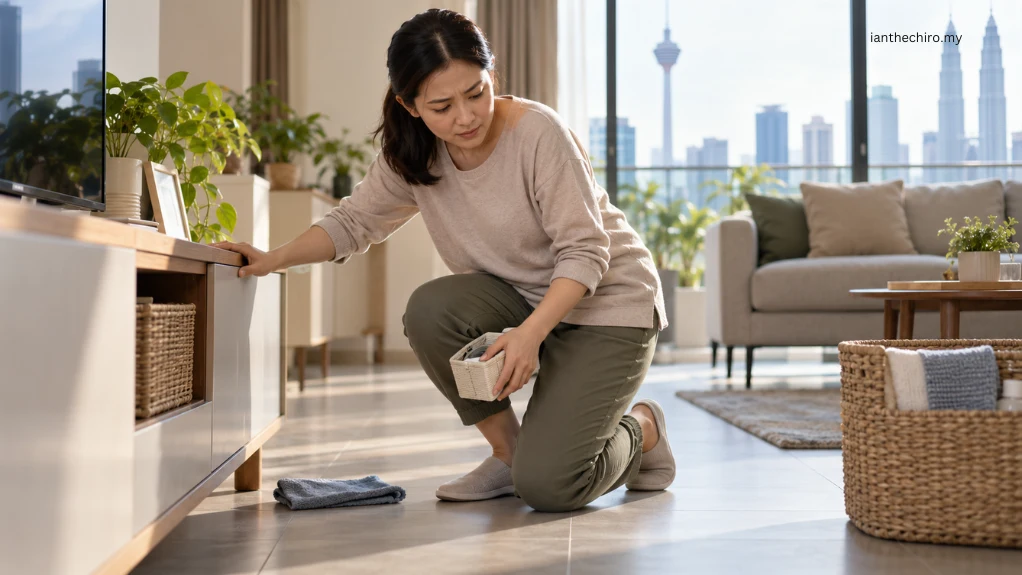
Walking feels fine. Stairs may be manageable. Even a shallow squat might not bother you much. Then you kneel on the floor to clean, reach a low cupboard, work on something, exercise, garden or play with a child, and the front of the knee suddenly feels tender or sharp.
Knee pain when kneeling is a useful symptom because kneeling asks the knee to do two different things at once: tolerate direct pressure from the surface and bend deeply. The pain may therefore come from tissues close to the skin, such as the prepatellar bursa, or from deeper knee structures that are compressed or loaded as the knee flexes. Ian The Chiro’s Hip, Knee, Ankle & Heel Pain page explains why the exact activity and symptom behaviour matter more than assuming every painful knee has the same cause.
The most useful questions are simple: Does it hurt as soon as the kneecap touches the floor, only after staying down for a while, or mainly while getting down and standing back up? Is there swelling? Does the same knee hurt with squats, stairs or sitting? Did the problem follow a fall or repeated floor work? Those details can separate direct-pressure sensitivity from a deeper flexion or load-related problem.
Quick Answer: Why Does Knee Pain When Kneeling Happen?
Kneeling pain can come from several different patterns. A tender or swollen area directly over the kneecap can fit irritation of the prepatellar bursa, especially after repeated kneeling or a direct knock. Pain just below the kneecap may involve the patellar tendon, an infrapatellar bursa or nearby soft tissue. Pain that feels deeper in the joint during full bending may fit patellofemoral pain, osteoarthritis, a meniscus-related pattern or another joint irritation.
The position alone does not diagnose the problem. A knee that only hurts when it presses against a hard surface tells a different story from one that also hurts on stairs, during squats, after sitting or when twisting.
Swelling, redness, heat, fever, a recent significant injury or difficulty bearing weight changes the priority and may justify medical assessment before routine conservative care.
First, Does It Hurt While You Kneel or While You Get Down and Up?
This distinction is easy to miss. Some people say ‘kneeling hurts’ when the painful part is actually lowering into the position or pushing back up. Those transitions behave more like a squat or lunge because the quadriceps, kneecap and knee joint are managing body weight while the knee bends.
Other people can lower themselves comfortably but feel pain the moment the front of the knee touches the floor. That makes direct pressure more relevant. A third group is comfortable at first, then becomes sore after staying in a deep kneeling position for several minutes.
Try to notice which phase is the real trigger. The answer can immediately change which tissues and loads deserve attention during assessment.
Direct Surface Pressure and Deep Knee Flexion Are Different Loads
Kneeling is not one single movement. The surface pushes into the front of the knee while the joint is also held in substantial flexion. A hard floor increases local compression at the skin, bursa and front of the kneecap. A softer mat reduces that external pressure but does not remove the deep bend.
This gives you a simple comparison. If a folded towel or knee pad makes the position dramatically easier, direct pressure is probably an important part of the symptom. If the same deep bend still hurts on a soft surface, the joint position itself may be more relevant.
That comparison is not a home diagnostic test. It is simply a way to describe the behaviour more precisely.
Does the Pain Start Immediately or Build After Several Minutes?
Pain that appears the moment the knee touches the floor makes direct pressure more relevant. The front of the knee may be locally tender even before the joint reaches its deepest angle. By contrast, pain that builds only after several minutes can reflect time under pressure, sustained deep flexion or both.
Timing can also help when you change the setup. If a thick pad removes the immediate sharpness but the knee still develops a deep ache after sitting back toward the heels, the surface and the joint position may each be contributing. If the pad removes the problem completely, prolonged local pressure deserves more attention.
The useful question is not simply whether kneeling hurts. It is how much pressure, depth and time are required before the symptom appears, and how quickly it settles once you come out of the position.
Is the Pain Directly on Top of the Kneecap?
Pain and swelling immediately over the kneecap can fit a prepatellar bursa pattern. The prepatellar bursa sits between the skin and the kneecap and helps those surfaces glide. Repeated pressure from kneeling, a direct impact, inflammation or infection can make that region painful or swollen.
A bursa-related pattern may feel very tender to direct contact even when walking is reasonably comfortable. The front of the knee may look puffy or feel like a soft pocket of swelling. This differs from a diffuse ache behind the kneecap that mainly appears during loaded bending.
A systematic review of septic and aseptic prepatellar bursitis highlights that management depends on the type and severity of bursitis rather than treating every swollen bursa the same way.
Do not assume every lump over the kneecap is harmless ‘fluid’. The appearance, warmth, tenderness, skin condition and general health symptoms matter.
What If the Pain Is Just Below the Kneecap?
Pain immediately below the kneecap shifts the possibilities. The patellar tendon attaches from the kneecap to the shin, while superficial and deep infrapatellar bursae sit nearby. Direct kneeling can compress this region even when the primary issue is not inside the knee joint.
A tendon-related pattern becomes more plausible when jumping, landing, running, repeated squats or forceful knee extension are also painful. By contrast, discomfort that appears mainly from pressure against the floor may point more toward a local pressure-sensitive structure.
The exact spot helps, but palpation alone is not enough. A clinician should compare tenderness with the activities that actually reproduce the problem.
What If the Pain Feels Deep Inside the Knee?
Deep kneeling holds the knee near the end of its flexion range. That can increase contact and compression within the joint and may expose sensitivity that is not obvious during ordinary walking.
Pain around or behind the kneecap can fit a patellofemoral pattern, especially when stairs, squats, running or prolonged sitting are also provocative. A more local joint-line pain with twisting, catching, swelling or a recent injury may raise different questions, including meniscus or other joint structures. Osteoarthritis can also make deep flexion and floor transfers uncomfortable, particularly when stiffness or swelling is part of the picture.
The key is not to decide which structure is ‘damaged’ from the position alone. The accompanying tasks and symptom pattern are more informative.
What If Squats, Stairs or Sitting Hurt Too?
When kneeling is only one of several bent-knee triggers, a broader load-related pattern becomes more plausible. The guide to knee pain when squatting explains what changes when pain appears during loaded bending. The knee pain going down stairs article focuses on controlled lowering and front-of-knee load. Knee pain after sitting looks more closely at stiffness or discomfort when the knee has been held bent before standing.
If all of those tasks reproduce a similar ache around the front of the knee, the common feature may be how the knee handles flexion and load rather than the floor contact itself.
When a patellofemoral pattern genuinely fits, the plan usually needs to rebuild knee capacity rather than treating the kneecap as something that must be pushed back into a perfect track. That still does not mean every kneeling problem is patellofemoral pain.
Why Can a Hard Floor Hurt When a Soft Surface Does Not?
A hard surface concentrates pressure over a smaller area. If the front of the knee is sensitive, even a structurally normal knee can feel uncomfortable when body weight is placed directly onto the kneecap region.
This is why flooring workers, technicians, gardeners and anyone who spends time on their knees may notice symptoms that barely appear during walking. It also explains why a knee pad or folded mat can change symptoms immediately without ‘fixing’ the underlying reason.
Surface sensitivity is useful information. It should not be interpreted as proof of bursitis, cartilage wear or a kneecap problem.
What If Repeated Kneeling at Work Is the Trigger?
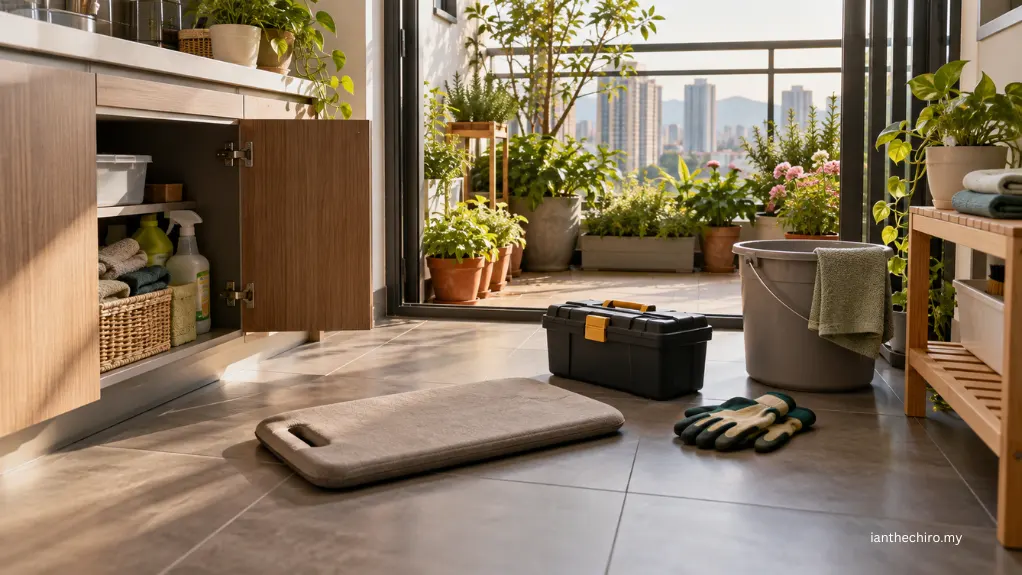
Repeated kneeling can create a very different pattern from one hard injury. A technician, flooring worker, tradesperson, cleaner, gardener or anyone who spends long periods near floor level may notice the knee becoming more sensitive across the day even though no single kneel felt dramatic.
In that situation, the total exposure matters: how often you kneel, how long you stay down, whether the surface is padded and whether the knee has time to settle between tasks. A knee that tolerates ten seconds but reacts after twenty minutes is giving different information from a knee that is sharply painful on the first contact.
For someone working around Cheras or Kuala Lumpur who cannot simply avoid floor-level tasks, the practical goal is usually to reduce the most provocative exposure and rebuild tolerance rather than telling them never to kneel again.
Could a Previous Fall or Direct Knock Still Matter?
A fall directly onto the front of the knee can bruise the tissues over the kneecap, irritate the bursa or, in more significant trauma, injure the patella or other structures. The history matters because a knee that became painful immediately after a hard impact deserves a different threshold for imaging and medical review than gradual soreness from repeated kneeling.
Pay attention to bruising, rapidly developing swelling, focal bony tenderness and whether you could bear weight after the injury. Pain that is steadily improving over several days is different from severe pain that remains unchanged or makes normal walking difficult.
Do not repeatedly kneel on a recently injured kneecap just to test whether it still hurts.
Does Swelling Change What Kneeling Pain Means?
Yes. Swelling narrows the questions but still does not identify one cause by itself. A small superficial swelling directly over the kneecap behaves differently from a large joint effusion that makes the whole knee feel full and difficult to bend.
Notice where the swelling sits, how quickly it appeared and whether the skin looks normal. Swelling after a direct knock may be traumatic. Gradual swelling after repetitive kneeling may fit irritation of a superficial bursa. A hot, red and increasingly painful swelling raises more concern for infection or another inflammatory problem.
A visibly swollen knee that keeps enlarging, restricts movement or follows meaningful trauma is worth assessing rather than simply padding the surface and continuing as normal.
Why Redness, Heat or Fever Changes the Plan
The prepatellar bursa is superficial, so a skin break, abrasion or local infection can sometimes spread into it. Septic bursitis needs medical assessment because it may require aspiration, laboratory testing and antibiotics rather than routine exercise or manual care.
⚠️ Medical caution:
Seek prompt medical assessment if the front of the knee is increasingly red, hot, markedly swollen or very tender, especially with fever, chills, a recent cut or abrasion, drainage, or feeling generally unwell. After significant trauma, inability to bear weight, obvious deformity or severe focal pain also warrants medical review rather than repeatedly testing the knee by kneeling.
The absence of fever does not automatically rule out infection. If the appearance of the knee is changing quickly, the safer choice is medical assessment.
What Can You Try Before an Assessment?
If there was no significant injury and there are no infection or other warning signs, the goal is usually to reduce unnecessary irritation while keeping the knee moving comfortably.
- use a folded mat or knee pad for tasks that require direct kneeling
- shorten how long you stay in one deep kneeling position
- change sides or use a half-kneeling position when practical
- avoid repeatedly pressing, poking or ‘testing’ a swollen spot
- keep comfortable walking and ordinary knee movement if those activities do not aggravate the problem
- notice whether squats, stairs, sitting, running or jumping reproduce the same pain
If symptoms are clearly settling as pressure is reduced, gradually reintroduce kneeling rather than jumping straight back to long periods on a hard floor.
If the same knee keeps settling and then flaring whenever work or activity increases, the guide on why knee pain keeps coming back explains how repeated workload and incomplete capacity rebuilding can create that cycle.
Should You Avoid Kneeling Completely?
Usually not forever. Temporary avoidance can make sense when the area is acutely irritated, swollen or painful to touch, but permanent avoidance is rarely the most useful long-term goal for a person who needs kneeling for work, exercise, family tasks or daily life.
The better target is tolerance. Start with a softer surface, less time and a position that does not sharply increase symptoms. Then build duration or surface firmness gradually if the knee responds well.
If every attempt at kneeling causes a strong flare, the knee remains swollen or ordinary walking and stairs are also worsening, reassessment is more useful than repeatedly forcing exposure.
When Does Imaging Add Useful Information?
Not automatically. The choice depends on the question being asked.
After acute trauma, focal tenderness, a large effusion or inability to bear weight can lower the threshold for plain radiographs. The American College of Radiology rates knee radiography as usually appropriate after acute trauma when findings such as focal tenderness, effusion or inability to bear weight are present.
Ultrasound can sometimes help when a superficial bursa or soft-tissue swelling is the main question. MRI is more relevant when persistent symptoms, examination findings or suspected deeper joint problems would meaningfully change management. A scan should answer a specific question rather than simply confirm that the knee hurts when you kneel.
What Should a Useful Knee Assessment Compare?
A good assessment should reproduce the relevant problem without assuming the answer beforehand. It may compare direct pressure, the depth of knee flexion, getting down and up from the floor, squatting, stair control and any sport or work task that matters to you.
The clinician may also check where tenderness and swelling are located, knee range of motion, quadriceps function, hip and ankle contribution, joint-line findings and whether the symptoms suggest a local bursa, tendon, patellofemoral pattern, arthritis, injury or another cause.
If the pain is only present on a hard floor, that should be recorded. If a deep squat hurts but padded kneeling does not, that should also be recorded. The assessment is useful when it explains the behaviour instead of simply giving the pain a broad label.
The comparison can be made more specific by changing one variable at a time: a hard floor versus a padded mat, one knee versus both knees, staying upright versus sitting back toward the heels, and a brief kneel versus several minutes in the position. If only direct contact reproduces the pain, pressure tolerance deserves attention even when ordinary strength tests feel normal. If getting down, standing up, squatting or stairs reproduce the same pain, the assessment should place more weight on how the knee handles flexion and load across different tasks.
How Ian The Chiro Approaches Kneeling-Related Knee Pain
For a kneeling-related knee complaint in Cheras, Ian first separates pain from direct surface pressure, pain from deep flexion, a broader load-related knee pattern and findings that need medical review before routine conservative care.
The assessment decides whether treatment is useful at all. When conservative care fits, the plan may centre on padding and activity changes, graded exercise, rebuilding knee tolerance or addressing relevant hip or ankle limitations. Chiropractic adjustments or soft-tissue treatment are considered only when they fit the assessment. Dry needling is considered only when a relevant muscular component is present. It does not drain a bursa, repair cartilage or treat an infection.
If kneeling keeps provoking the same knee pain and the source still feels unclear, book a chiropractic consultation to compare surface pressure, deep flexion, swelling and the movement tasks that actually matter to you.
Common Questions About Kneeling-Related Knee Pain
Why does my knee hurt only when I kneel on it?
If walking, stairs and squats are comfortable but direct floor contact hurts, pressure-sensitive tissues at the front of the knee become more relevant. A bursa, bruised tissue or another superficial structure may be involved, but the location and presence of swelling still need to be assessed.
Can prepatellar bursitis go away without treatment?
Some non-infectious irritation can settle when repeated pressure is reduced and the provoking task is modified. Persistent or recurrent swelling should be assessed, and a hot, red or systemically unwell presentation needs medical review because infection requires a different plan.
Why does kneeling hurt but squatting does not?
Kneeling adds direct pressure from the surface, while squatting mainly loads the knee through body weight and muscle force. If squatting is comfortable but kneeling on a hard floor is painful, that difference suggests surface pressure is an important clue rather than deep flexion alone.
Why do both kneeling and squatting hurt?
When both tasks reproduce a similar front-of-knee ache, the shared factor may be bent-knee loading rather than floor pressure alone. The guide to knee pain when squatting can help compare whether depth, load and the phase of the movement change the symptoms.
Should I wear knee pads if kneeling hurts?
Knee pads can be useful when direct pressure is the main trigger, especially for work or household tasks that require prolonged kneeling. They reduce surface pressure but do not diagnose the cause, so persistent swelling or pain with other activities still deserves assessment.
Can arthritis cause knee pain when kneeling?
Yes, osteoarthritis can make deep flexion, floor transfers and prolonged bent-knee positions uncomfortable. However, pain only when the skin or kneecap touches the floor can reflect a different pressure-sensitive pattern. Age or an X-ray finding alone does not explain every episode.
When should knee pain from kneeling be checked?
Book an assessment when the pain keeps returning, limits work or daily tasks, or comes with persistent swelling or reduced movement. Seek medical care sooner after significant trauma, inability to bear weight, rapidly increasing swelling, redness, heat, fever or drainage.
Does kneeling itself wear out the knee?
Not by itself. Kneeling increases pressure and deep flexion, so a sensitive knee may hurt in that position, but pain during kneeling does not prove that the activity is wearing away cartilage or causing damage. The more useful question is whether the knee tolerates the pressure and whether swelling, trauma or another pattern suggests a separate problem.
