

Walking up a staircase feels manageable.
Then you turn around to come back down and suddenly the front of your knee hurts.
Maybe it aches around or behind the kneecap. Maybe you feel less confident putting your weight onto that leg. Or perhaps going downstairs has become one of those oddly specific activities that consistently brings the pain back.
Knee pain going down stairs is common with several knee problems, particularly patellofemoral pain around the kneecap. Stair descent is one of the activities commonly used when assessing this pattern because it places meaningful demand on the knee while the quadriceps control your body as you lower yourself.
But pain on stairs does not automatically mean that your kneecap is “out of place”, your cartilage is wearing away, or something is being damaged every time you take a step.
The location of the pain matters.
So does whether the knee swells, catches, locks, gives way, hurts during squats or running, recently experienced an injury, or has gradually become less tolerant of everyday activity.
At Ian The Chiro in Cheras, Kuala Lumpur, the useful question is therefore not simply:
“Why does going downstairs hurt?”
It is:
What is the knee being asked to do during stair descent, and what about your current knee seems to be struggling with that demand?
This article is for general education and is not a diagnosis.
Quick Answer: Why Does My Knee Hurt Going Down Stairs?
Knee pain when going downstairs may be related to:
- patellofemoral pain around or behind the kneecap
- a recent increase in walking, running, gym, hiking, or stair use
- reduced tolerance of the quadriceps and surrounding muscles
- knee osteoarthritis or another joint-related problem
- tendon-related pain
- symptoms following an injury
The location and behaviour of the pain are more useful than the staircase itself.
Pain around the front of the knee is different from pain directly along the joint line.
A knee that aches but remains stable is different from one that repeatedly locks or gives way.
And a knee that became painful after suddenly increasing training deserves a different interpretation from a knee that became swollen immediately after a twisting injury.
Knee pain going down stairs describes a task that exposes the problem. It does not tell you which structure is responsible or whether the knee is being damaged.
Why Can Going Down Stairs Hurt More Than Going Up?
Going downstairs asks your leg to control your body as you lower it.
Rather than simply pushing upward, the quadriceps have to work while lengthening to control the rate at which the knee bends.
The knee also usually moves through a meaningful amount of flexion while supporting body weight.
That can make stair descent particularly noticeable when the front of the knee is sensitive.
This does not mean that the pressure created during stair descent is automatically harmful.
Healthy knees are designed to tolerate substantial forces.
The issue is more often whether the knee currently has enough capacity for the amount and type of loading being asked of it.
For example, someone may tolerate ordinary walking easily but develop pain when the demand increases through:
walking → stairs → repeated stairs → squatting → running or jumping.
The exact order differs between people, but knowing which activities become painful helps show where the knee’s current tolerance may be.
Is Pain Around the Kneecap a Sign of Patellofemoral Pain?
It can be.
Patellofemoral pain commonly causes discomfort around or behind the kneecap and is often aggravated by activities that load the knee while it is bent, including stair climbing or descent, squatting, running, jumping, and sometimes prolonged sitting.
People may describe:
- a diffuse ache around the front of the knee
- discomfort behind the kneecap
- pain on stairs
- pain during squats or lunges
- symptoms after running or jumping
- discomfort after sitting with the knee bent for a long time
The pain may not be easy to pinpoint with one finger.
That is different from assuming there must be one damaged piece of cartilage or tendon underneath the kneecap.
Patellofemoral pain is a clinical pattern, and assessment usually considers symptoms, activity demands, movement, strength and function together rather than relying on one painful test. A 2024 best-practice guide recommends exercise therapy and education as the primary intervention, with additional treatments selected according to the individual’s presentation.
Does Knee Pain Going Down Stairs Mean My Kneecap Is “Tracking Wrong”?
Not necessarily.
“Kneecap tracking” is often used as a simple explanation for front-of-knee pain.
The kneecap does move as the knee bends and straightens, and individual anatomy and movement can influence how forces are distributed.
But it is usually too simplistic to tell someone:
“Your kneecap is out of alignment, and we need to put it back in place.”
There is substantial normal variation between people.
Pain can also be influenced by how much activity the knee is performing, how well the surrounding muscles tolerate that demand, previous injuries, sensitivity, recovery and many other factors.
The goal is therefore not to make every kneecap move according to one supposedly perfect path.
It is to understand why your knee is painful during the tasks that matter to you.
What If the Pain Is Along the Inside or Outside of the Knee?
Pain away from the kneecap creates different questions.
Pain along the joint line may sometimes involve local joint structures, particularly if there has been a twisting injury, swelling, catching or locking.
Pain along the outside of the knee may appear with certain running or training patterns.
Tendon and soft-tissue structures around either side of the knee can also become sensitive.
The location alone still does not provide a diagnosis.
It becomes useful when combined with:
how the symptoms started + what movements reproduce them + whether swelling or mechanical symptoms are present.
Could Knee Osteoarthritis Make Stairs Painful?
Yes.
Knee osteoarthritis can cause pain during weight-bearing activities such as walking and stairs, particularly in people whose symptoms have developed gradually alongside stiffness or reduced function. Current NICE guidance emphasises exercise as a core treatment rather than assuming an osteoarthritic knee should simply be protected from activity.
Clues that may make a joint-related pattern more relevant include:
- gradual development over time
- stiffness after inactivity
- reduced knee movement
- discomfort during several weight-bearing activities
- intermittent swelling
- difficulty with everyday tasks as well as stairs
However, pain on stairs does not prove that someone has arthritis.
And seeing osteoarthritis on an X-ray does not automatically tell us how much pain someone should have.
The imaging findings still need to make sense alongside the symptoms and examination.
What If My Knee Clicks or Cracks on the Stairs?
Noise by itself does not necessarily mean something is wrong.
Knees can click, pop, grind, or crack for several reasons, including movement of normal tissues and changes in pressure inside the joint.
The more useful question is whether the noise is accompanied by:
- pain
- swelling
- locking
- a recent injury
- loss of movement
- repeated instability
A painless noisy knee is very different from a knee that suddenly became painful, swollen and mechanically blocked after a twisting injury.
You do not need a silent knee for it to be healthy.
What If the Knee Hurts During Squats Too?
That combination is common because both squatting and descending stairs require the knee to bend while accepting load.
If the front of the knee is sensitive, both activities may therefore reproduce symptoms.
What becomes useful is how much knee bend and load you can tolerate before the pain appears. One person may tolerate a shallow squat but develop pain deeper down, while another may squat comfortably with body weight and become symptomatic only when load is added.
Pain during a squat does not automatically mean you should stop squatting permanently. The movement can often be adjusted and progressively rebuilt according to what the knee currently tolerates.
If squatting is one of your main triggers, the dedicated guide to knee pain when squatting explains how pain location, depth, load, swelling and training history may change the interpretation.
What If Knee Pain Started After Running, Gym, Hiking, or Sport?
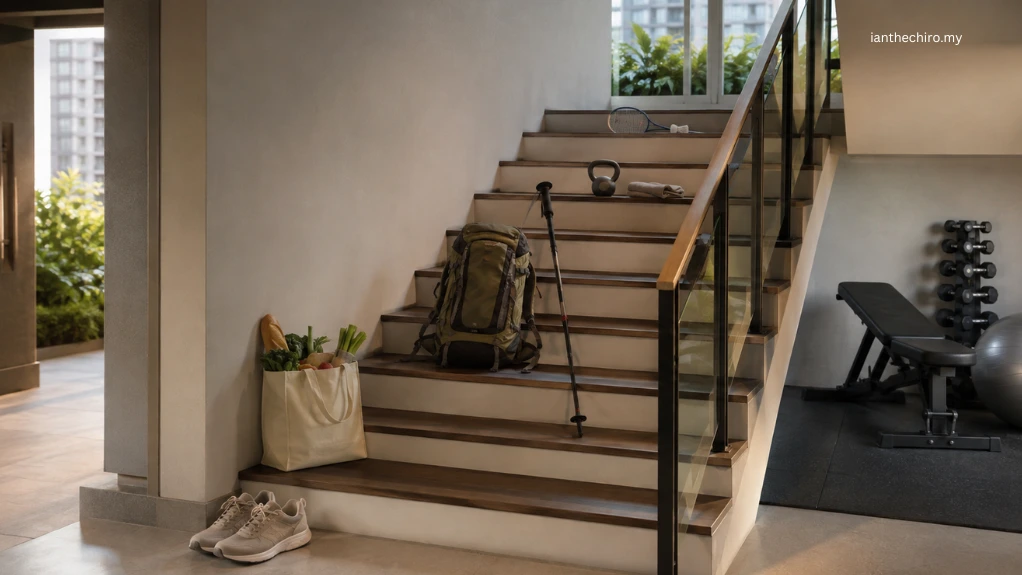
Look at what changed.
Knee pain sometimes appears after an obvious injury.
But frequently there was no single dramatic event.
Instead, the person may have recently:
- increased running distance
- added more hills or stairs
- started hiking
- increased squat or lunge volume
- added jumping or court sports
- returned to training after a break
The knee may simply have been asked to tolerate substantially more load than it had recently been prepared for.
That does not mean exercise is damaging your knee.
It means the relationship between load and current capacity deserves attention.
If the knee becomes progressively more painful every session, remains aggravated for longer, or starts limiting normal daily activity, repeatedly pushing the same workload may not be productive.
If the symptoms are closely tied to training or a specific injury, the sports injuries guide explains how workload, recovery and return to activity are assessed.
Would Strengthening Help Knee Pain on Stairs?
Often, yes, but “your quads are weak” is usually too simple an explanation.
Descending stairs requires the quadriceps to control the knee as your body lowers. If the leg does not currently tolerate that demand well, stair descent may expose the limitation.
But strength is only part of the picture. Hip and calf capacity, balance, coordination, training history, pain sensitivity and overall workload may also influence how the movement feels. Someone can also be objectively strong and still develop knee pain after suddenly increasing training volume.
For patellofemoral pain, current best-practice guidance recommends exercise therapy and education as the main approach, with the programme adapted to the individual’s presentation.
Depending on the case, rehabilitation may involve quadriceps-loading exercises, squats, step-ups or step-downs, split-squat or lunge variations, and hip or calf strengthening.
The useful question is therefore not simply:
“Are my quads weak?”
It is:
“Does my leg have enough capacity for the activities I am asking it to do?”
Someone who struggles with one flight of stairs may need a very different starting point from a runner preparing for a mountain race.
Should I Avoid Stairs or Change How I Go Down Them?
Not necessarily.
If every descent substantially aggravates the knee, temporarily reducing unnecessary stair exposure or changing how you descend may make the task easier while the knee is irritable.
That could mean using the handrail, slowing down, reducing repeated stair trips where practical, changing how much the knee bends, or temporarily adjusting training that involves a lot of step-downs, squats, or similar loading.
If you are unsure how much to modify, the broader guide on whether to rest or keep moving when something hurts explains how to balance temporary protection with gradually rebuilding activity.
Avoiding stairs forever does not rebuild your ability to use them.
The longer-term goal is usually to find a tolerable level of loading and gradually increase what the knee can manage. Current best-practice recommendations for patellofemoral pain centre rehabilitation around education and exercise rather than prolonged avoidance of loading.
Movement can be adjusted during rehabilitation and expanded again as capacity improves. The goal is more movement options, not fear of one supposedly perfect way to walk downstairs.
Do I Need an X-Ray or MRI for Knee Pain on Stairs?
Not automatically.
Knee pain going down stairs can often first be assessed through the symptom history and physical examination.
Imaging becomes more useful when there is a specific question that could change management.
For example, imaging or medical investigation may become more relevant after substantial trauma, with persistent major swelling, a genuinely locked knee, suspected fracture, unusual progressive symptoms, or when the clinical picture does not behave as expected.
An MRI can show many structural findings.
That does not mean every finding explains the pain.
The guide on whether you need an X-ray before seeing a chiropractor explains why imaging is usually guided by the clinical question rather than requested automatically.
When Should Knee Pain Going Down Stairs Be Checked Medically?
Most knee pain that appears gradually during stairs is not an emergency.
Some patterns deserve earlier medical assessment.
⚠️ Seek Medical Attention for Knee Warning Signs
Seek prompt medical assessment following significant trauma if you cannot bear weight, the knee appears deformed, rapidly develops substantial swelling, or becomes mechanically locked and cannot move normally. A hot, markedly swollen and painful knee accompanied by fever or feeling systemically unwell also requires prompt medical assessment. New significant calf pain, swelling or warmth should also be assessed urgently, especially if accompanied by chest pain or unexplained shortness of breath.
If the pain is non-urgent but persists or continues limiting normal activity, start with a proper consultation
What Should an Assessment for Knee Pain Going Down Stairs Look At?
A useful assessment should look beyond the fact that stairs hurt.
Depending on the presentation, it may consider:
- where the pain is located
- how the symptoms began
- whether there was an injury
- swelling
- locking, catching or instability
- stair ascent compared with descent
- squatting and other knee-loading movements
- knee range of motion
- quadriceps and hip function
- calf function
- balance and single-leg control
- recent changes in work, walking, gym or sport
- previous knee or lower-limb injuries
- medical history and warning signs
The goal is not to identify one supposedly faulty muscle from a staircase.
It is to understand why that particular task has become difficult and what the knee needs to tolerate it more comfortably again.
How Ian The Chiro Approaches Knee Pain Going Down Stairs
At Ian The Chiro, knee pain going down stairs is not automatically blamed on a “misaligned kneecap”, weak glutes, arthritis, or one tight muscle.
First, where exactly does the knee hurt?
Pain around the kneecap creates a different starting point from joint-line pain or pain around a tendon.
Second, what other activities reproduce it?
Squatting, running, prolonged sitting, jumping, walking and stair ascent can help clarify the broader pattern.
Third, what changed before the symptoms began?
A new training programme, hiking trip, more badminton, increased gym volume, prolonged standing, or no obvious change at all may each matter.
Fourth, what can the leg currently tolerate?
Depending on the presentation, knee movement, quadriceps function, hip and calf capacity, balance, single-leg control and relevant activities may be assessed.
Fifth, is there anything suggesting the knee needs another direction?
Significant trauma, repeated instability, mechanical locking, substantial swelling, unusual neurological findings, or medical warning signs may warrant imaging, medical assessment, or referral rather than routine conservative care.
Treatment is then selected according to the findings.
Depending on the case, this may include exercise and progressive loading, temporary activity modification, movement advice, chiropractic adjustments or other selected hands-on treatment where appropriate, dry needling when a relevant muscular component is present, or referral when another direction is more suitable.
The goal is not simply to find a way to avoid stairs.
It is to improve what the knee and leg need so that everyday activities become easier to tolerate again.
What Not to Do
Try to avoid:
- assuming pain on stairs means your kneecap is permanently out of alignment
- assuming every painful step is causing cartilage damage
- repeatedly avoiding stairs without rebuilding tolerance
- pushing through progressively worsening pain simply because exercise is “good for knees”
- blaming one supposedly weak or tight muscle without considering the rest of the pattern
- stopping all lower-body exercise indefinitely without a clear reason
- assuming knee clicking means something is being damaged
- ignoring repeated instability, substantial swelling, or genuine locking
- assuming an X-ray or MRI finding automatically explains the symptoms
Knee pain going down stairs is common, particularly when the front of the knee has become sensitive to loading.
But stairs are usually exposing the problem rather than diagnosing it.
Where the pain is, what other activities reproduce it, what changed before it began, and how the knee responds to progressively greater load are usually much more useful.
What If My Knee Feels Like It Is Giving Way?
This deserves a little more clarification.
Sometimes pain causes someone to momentarily hesitate or reduce force through the leg, creating a sensation that the knee “gave way”.
That is different from repeated true instability after a ligament injury or another mechanical problem.
Think about what actually happens.
Does the knee briefly feel unreliable because it hurts?
Or does it genuinely buckle without warning?
Was there a previous injury?
Is there swelling?
Can you change direction confidently?
Repeated instability, particularly after trauma, deserves assessment rather than simply being labelled muscle weakness.
If the symptoms repeatedly settle and return, the guide to recurring knee pain explains why short-term relief may not resolve the wider workload or capacity problem.
Common Questions About Knee Pain Going Down Stairs
Why does my knee hurt going down stairs but not up?
Descending stairs requires the quadriceps to control your body as the knee bends. That may expose a painful or load-sensitive knee even when going upstairs remains comfortable.
Is knee pain going down stairs a sign of patellofemoral pain?
It can be. Patellofemoral pain commonly causes discomfort around or behind the kneecap during activities such as stairs and squatting. The symptom still needs to be interpreted alongside the rest of the examination.
Does knee pain on stairs mean my cartilage is worn out?
No. Pain during stairs does not tell you how much cartilage you have or prove that cartilage damage is responsible. Many different knee patterns can become painful during stair descent.
Why does my kneecap hurt when I walk downstairs?
The front of the knee experiences meaningful loading as the quadriceps control you during stair descent. If the patellofemoral region is currently sensitive, this activity may reproduce pain.
Should I stop using stairs if my knee hurts?
Not automatically. Temporarily reducing repeated painful stair use may help during an irritable period, but the longer-term goal is generally to rebuild the knee’s tolerance rather than avoid stairs indefinitely.
Should I strengthen my quads for knee pain on stairs?
Quadriceps strengthening may be useful, particularly with patellofemoral pain, but exercise selection and loading should match the individual’s presentation. Hip, calf and overall lower-limb capacity may also matter.
Why does my knee click when going downstairs?
Knee noises are common and are not automatically a sign of damage. Clicking becomes more clinically relevant when it appears alongside pain, swelling, locking, significant injury, or loss of function.
What if my knee gives way while going downstairs?
A painful knee may briefly feel unreliable, but repeated true buckling or instability deserves assessment, particularly after an injury or when accompanied by swelling.
Do I need an MRI for knee pain going down stairs?
Not routinely. Imaging is more useful when the result is likely to change management, such as after significant trauma, with mechanical locking, major swelling, suspected serious injury, or an unusual clinical pattern.
When should I get knee pain going down stairs assessed?
Consider assessment when the pain persists, worsens, repeatedly returns, limits ordinary activity, or prevents you from exercising normally. Seek medical assessment sooner for major trauma, inability to bear weight, substantial swelling, deformity, a locked knee, fever with a hot swollen joint, or another unusual presentation.