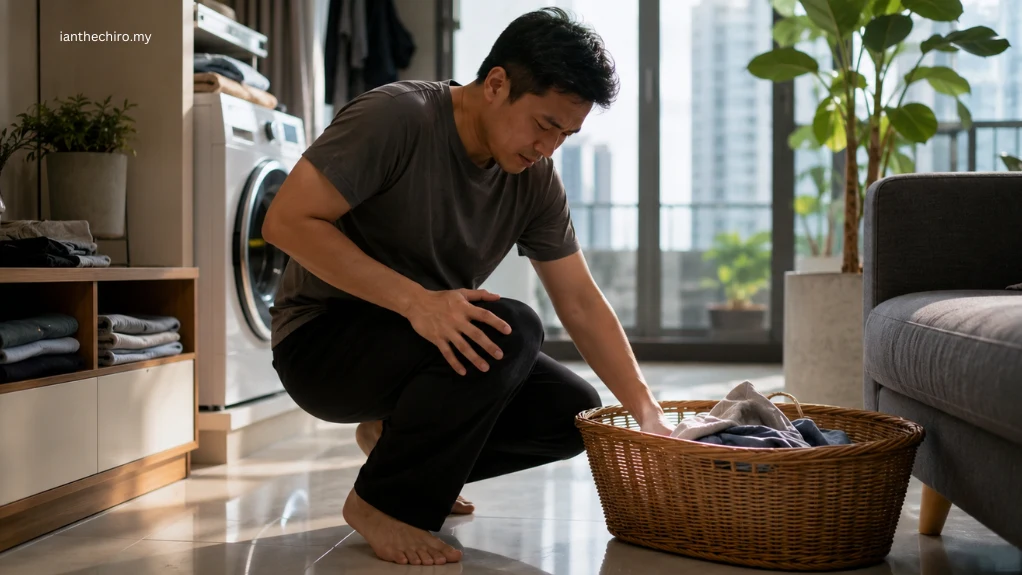
Your knee feels reasonably comfortable while walking or standing.
Then you squat to pick something up, sit into a chair, exercise at the gym, use the toilet, or lower yourself towards the floor.
The knee starts to hurt.
The pain may appear at the beginning of the squat, only when you go deeper, at the bottom, while standing back up, or after several repetitions.
This can leave you wondering:
“Why do I have knee pain when squatting?”
Pain during a squat does not identify one exact injured structure by itself.
The pattern may involve the kneecap, patellar tendon, knee joint, meniscus, surrounding muscles, the hip or ankle, workload, previous injury, or several contributing factors together.
Where the pain is felt, when it appears during the movement, whether swelling or weakness is present, and what changed before the symptoms began all matter.
At Ian The Chiro in Cheras, Kuala Lumpur, the goal is not simply to tell everyone to stop squatting or force the knee through the pain. The first step is to understand why the movement hurts and whether conservative care is appropriate or medical assessment is needed first.
This article is for general education and is not a diagnosis. New, severe, unusual, or worsening symptoms should be assessed appropriately.
If the pain is non-urgent but persists or continues limiting normal activity, start with a proper consultation.
Quick Answer: What Causes Knee Pain When Squatting?
Knee pain when squatting may occur when the depth, resistance, repetitions, or total workload exceeds what the knee currently tolerates, or when the movement loads an injured or sensitive area.
Possible contributors include:
- kneecap-related or patellofemoral pain
- irritation involving the patellar tendon
- a recent increase in squatting, running, jumping, or gym volume
- reduced leg strength or endurance
- returning to exercise too quickly after rest or injury
- knee stiffness or reduced movement tolerance
- symptoms involving the meniscus or joint
- arthritis-related changes
- movement influenced by the hip or ankle
- a previous knee or ankle injury
- an acute injury following twisting, impact, or an awkward landing
The squat can provide useful information, but it cannot confirm the diagnosis by itself.
A proper assessment should consider the pain location, squat depth, resistance, repetition, strength, movement, swelling, injury history, and how the knee responds afterward.
The painful part of your squat may provide a clue, but it does not identify the cause by itself.
What Does Knee Pain During a Squat Actually Mean?
Squatting requires coordinated movement from the hips, knees, ankles, feet, and trunk.
As you lower yourself, the knee bends while the muscles around the thigh, hip, and lower leg control the movement.
As you stand back up, those muscles produce force to raise the body.
Pain may occur when:
- the knee is sensitive to the current depth or load
- a muscle or tendon is working beyond its present tolerance
- the knee has recently been injured
- training or activity increased faster than recovery
- the knee feels stiff or guarded
- the leg becomes fatigued
- another area changes how the movement is performed
- the movement loads an already sensitive structure
Squatting places meaningful demand on the knee, particularly as depth and resistance increase. However, that does not mean the squat is inherently damaging or that every painful squat reflects structural injury.
The history and wider examination are more useful than judging the problem from one repetition.
Where Is the Knee Pain Felt?
The location may help guide the assessment, although it cannot confirm the cause by itself.
You may feel pain:
- around or behind the kneecap
- directly below the kneecap
- above the kneecap
- along the inner side of the knee
- along the outer side
- deep inside the joint
- behind the knee
- through the thigh or lower leg
- in several areas at once
Pain around or behind the kneecap may make patellofemoral pain more relevant.
Pain directly below the kneecap may make patellar tendon involvement more relevant.
Pain around the joint line may make the meniscus or other joint structures more relevant, particularly after twisting or trauma.
However, pain location alone is not sufficiently reliable to identify one structure. It needs to be interpreted with the history, movement, strength, swelling, and other findings.
Does It Matter When the Pain Appears During the Squat?
Yes, it may provide useful clues.
Some people feel pain:
- immediately as the knee begins bending
- during the middle of the descent
- only as they approach a deep squat
- while holding the bottom position
- while beginning to stand up
- near the top of the ascent
- only when resistance is added
- only after several repetitions
- later that day or the following morning
Pain that appears only at greater depth may mean the knee currently tolerates shallower bending better than deeper bending.
Pain that develops after repeated squats may point towards fatigue, endurance, or accumulated workload.
Pain during the ascent may occur when the leg is producing more force to lift the body or an external weight.
However, these patterns do not diagnose a tendon, meniscus, kneecap, or joint problem on their own.
The same person may also feel pain at different points depending on the load, speed, stance, footwear, fatigue, and what they did earlier that day.
Can Pain Around the Kneecap Make Squatting Painful?
Yes.
Patellofemoral pain is commonly felt around or behind the kneecap and is often aggravated by activities that load a bent knee, including squatting, stairs, running, jumping, and prolonged sitting.
The pain may feel:
- dull or aching
- sharp during part of the movement
- uncomfortable around the edges of the kneecap
- worse at greater squat depth
- irritated after repeated squats
- noticeable when standing after sitting
Pain during a squat can be consistent with patellofemoral pain, but it is not specific enough to confirm that diagnosis by itself. A 2024 best-practice guide combining research evidence, patient perspectives and expert clinical reasoning recommends considering symptoms, activity demands, movement, strength and function together.
Pain near the kneecap also does not automatically mean that the kneecap is permanently misaligned, grinding away, or being damaged every time the knee bends.
Could the Patellar Tendon Be Involved?
Possibly.
The patellar tendon sits below the kneecap and connects it to the shinbone.
Patellar tendon symptoms may be more relevant when pain is:
- localised below the kneecap
- aggravated by jumping
- noticeable during loaded squats
- worse with sprinting or rapid changes in direction
- associated with a recent increase in sports or gym activity
- sensitive during repeated forceful knee extension
Patellar tendon pain is often related to load, but pain below the kneecap does not automatically confirm tendinopathy.
Other nearby structures may feel similar, and the assessment should consider the exact location, activity pattern, strength, training history, and response after loading.
Complete rest is not always the long-term solution. A progressive plan may be needed to rebuild how much force the tendon and surrounding muscles can tolerate.
Could It Be a Meniscus Problem?
The menisci are cartilage structures inside the knee that help distribute load and contribute to joint function.
Meniscus-related symptoms may sometimes involve:
- pain around the inner or outer joint line
- swelling
- pain after twisting
- discomfort during deep bending
- catching
- locking
- difficulty turning on the leg
- symptoms after a specific injury
However, pain during squatting does not confirm a meniscus tear.
Different knee problems can produce similar symptoms, and meniscal changes may also appear on imaging without fully explaining the pain.
A knee that becomes genuinely locked and cannot straighten normally requires prompt assessment.
Could Arthritis Cause Knee Pain During Squats?
Yes, but pain during squatting does not automatically mean arthritis.
Knee arthritis may involve:
- pain during weight-bearing activity
- stiffness after rest
- reduced movement
- swelling
- difficulty with stairs
- discomfort during deeper bending
- symptoms that fluctuate between better and worse periods
However, younger or active people can experience squat-related knee pain without arthritis.
Some people also have arthritic changes on imaging without severe symptoms.
Age, medical history, movement, swelling, function, examination findings, and imaging when genuinely necessary should be considered together.
Even when osteoarthritis is present, movement and appropriately selected exercise usually remain important rather than the knee being treated as permanently worn out and unusable.
Does Squat Depth Affect Knee Pain?
It can.
As the knee bends further, the demands placed on the muscles and knee structures change.
Someone may tolerate:
- a shallow squat but not a deep squat
- a box squat but not a free squat
- bodyweight but not added resistance
- a few repetitions but not a full session
- a supported squat but not an unsupported one
Greater depth is not automatically dangerous.
A 2013 literature review of more than 164 publications concluded that deep squats are not inherently harmful to healthy knees when technique and loading are appropriate. However, the suitable depth still depends on the person’s symptoms, mobility, capacity, goals and training history.
Temporarily reducing depth may be a useful modification.
That is different from deciding that the knee should never bend deeply again.
Are Squats Bad for Your Knees?
Not automatically.
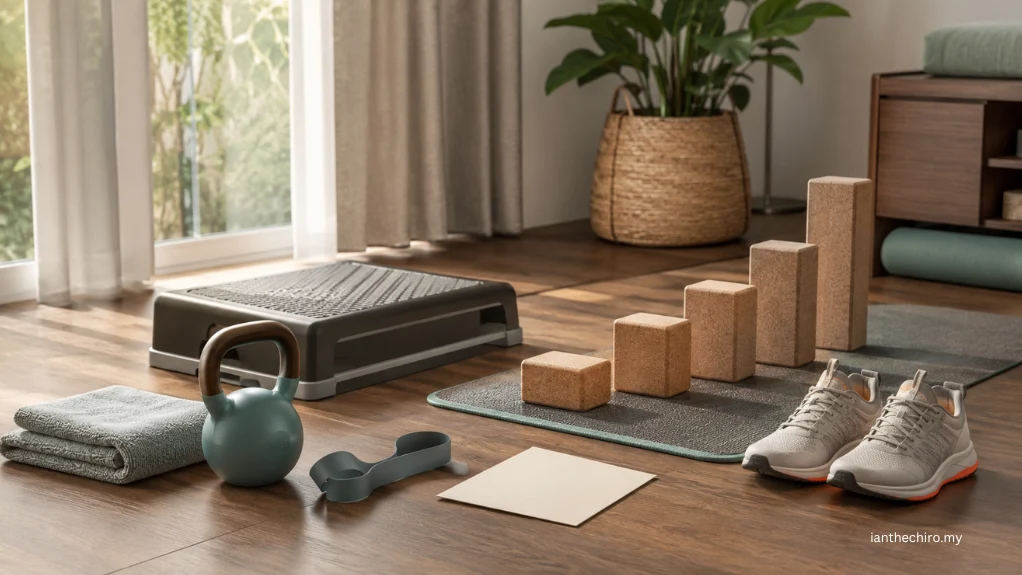
Squats are common in daily activity, exercise, sport, and rehabilitation. They can help build leg strength, muscular endurance, lifting capacity, and confidence with knee bending.
Problems may occur when the depth, resistance, repetitions, weekly volume, or speed of returning to training exceeds what the knee currently tolerates. An unresolved injury or medical problem may also make squatting inappropriate temporarily.
A movement can be useful and still require short-term modification.
Does Squat Technique Matter?
Technique can influence how demand is distributed, but “bad form” is often used too simplistically.
Squat technique varies according to body proportions, mobility, balance, experience, exercise variation, load, fatigue, and the person’s goals.
Pain does not prove that the squat looked wrong. A technically tidy squat may still hurt when the workload exceeds current tolerance, while a movement that looks slightly different may remain comfortable.
Is It Bad for Your Knees to Go Past Your Toes?
Not necessarily.
Allowing the knees to travel forwards during a squat is a normal part of many squat styles and everyday movements.
The amount of forward movement varies according to:
- limb proportions
- squat depth
- stance
- ankle mobility
- footwear
- balance
- the type of squat being performed
Keeping the knees behind the toes may reduce demand at the knee in some situations, but it can shift more demand towards the hips or trunk.
There is no single rule that every person’s knees must always stay behind their toes.
A more useful question is whether the chosen technique is comfortable, controlled, appropriate for the person, and suitable for the current training or rehabilitation goal.
Does the Knee Moving Inwards Mean Something Is Wrong?
Not automatically.
Some inward movement can occur during squatting, particularly with deeper movement, fatigue, or single-leg tasks.
It may become more relevant when it is:
- substantial
- difficult to control
- clearly different between sides
- consistently linked with pain
- accompanied by weakness or instability
- increasing as the person becomes fatigued
However, one visual movement pattern does not prove that it caused the pain.
The hip, knee, ankle, foot, balance, confidence, and task demands may all influence the movement.
Can the Hip, Ankle or Foot Influence the Squat?
Yes.
The hip, knee, ankle, and foot work together during a squat.
The ankle normally bends as the knee and body move forwards. If ankle movement is limited, a person may compensate by:
- lifting the heel
- turning the foot out further
- shifting weight to one side
- leaning the trunk more
- reducing squat depth
- changing how the knee moves
The squat may also change when:
- hip strength or control is reduced
- the person shifts away from one side
- a previous ankle injury affects confidence
- foot position changes
- fatigue develops
- pain causes guarding
- one leg tolerates less load than the other
This does not mean that the hip, ankle, or foot is automatically causing the knee pain.
It means the hip, ankle, and foot should be considered when they appear to influence the painful task.
Technique changes are most useful when they produce a meaningful improvement in comfort, control, confidence, or performance. The goal is not to force every person into one identical squat.
Why Does Only One Knee Hurt?
One-sided pain may occur when:
- one leg is more sensitive
- a previous injury affected that side
- the person shifts their weight
- strength or endurance differs between legs
- ankle or hip movement differs
- one knee has recently faced more load
- pain causes protective movement
- a local knee structure is irritated
A visible weight shift does not prove whether it caused the pain or developed because of it.
The assessment should compare both sides while still focusing on the symptoms and function of the painful knee.
Why Does the Knee Hurt After Squats but Not During Them?
Symptoms do not always appear immediately.
The knee may feel comfortable during the session but become painful:
- later that day
- after sitting
- while using stairs
- the following morning
- during the next training session
This may happen when the total load of the session exceeded what the knee currently tolerates.
Relevant factors may include:
- weight
- depth
- repetitions
- number of sets
- other exercises performed
- running or sport completed earlier
- recovery between sessions
- sleep
- previous irritation
The individual squat may not have been the only factor.
The total workload across the day or week may matter more.
Should You Keep Testing the Painful Squat?
Repeatedly squatting to see whether the knee still hurts can add more load to an already sensitive area.
This is particularly relevant if you test it:
- every few minutes
- through sharp pain
- with increasing weight
- at progressively greater depth
- immediately after treatment
- despite increasing swelling or weakness
Monitoring progress is useful.
Constantly provoking the same movement is not always useful.
It may be better to review the squat at planned intervals while temporarily modifying the depth, load, repetitions, support, or exercise variation.
Should You Stop Squatting Completely?
Not automatically.
You may need to stop and seek assessment when:
- the pain followed significant trauma
- the knee is substantially swollen
- the knee locks
- the leg repeatedly gives way
- you cannot bear weight normally
- strength or movement is rapidly worsening
- the squat causes severe or progressively worsening pain
- warning signs are present
For non-urgent knee pain that remains manageable, complete avoidance may not always be necessary.
Possible modifications include:
- reducing the depth
- reducing the resistance
- performing fewer repetitions
- slowing the movement
- using support
- changing the squat variation
- temporarily reducing weekly volume
- maintaining other comfortable lower-body activity
Modification is different from permanent avoidance.
The longer-term aim is usually to rebuild useful movement and tolerance where appropriate.
Can Exercise Help Knee Pain During Squats?
Yes, when the programme matches the presentation.
Exercise may help improve:
- quadriceps strength
- hip and calf capacity
- muscular endurance
- knee-bending tolerance
- movement confidence
- control during loaded tasks
- return to gym or sport
- tolerance for daily squatting
For patellofemoral pain, current best-practice guidance places knee-targeted exercise at the centre of care, with supportive interventions selected according to the individual presentation.
However, there is no single exercise programme that suits every painful knee.
The starting point may depend on whether the knee is mainly painful, swollen, weak, stiff, recently injured, or sensitive only at greater depth or load.
Can Hands-On Treatment Help?
Hands-on treatment may sometimes reduce discomfort, guarding, or stiffness enough to make movement easier.
Depending on the findings, this could involve:
- chiropractic adjustments
- dry needling
- soft-tissue treatment
- mobilisation
However, hands-on treatment should have a clear purpose.
It does not automatically rebuild strength, endurance, squat tolerance, or confidence.
If the knee repeatedly becomes painful under the same workload, the plan may also need to address exercise, activity modification, gradual loading, recovery, or another contributing area.
Progress should be judged by whether squatting and normal activity become easier, not only by whether the knee feels looser immediately.
Do You Need an X-Ray, Ultrasound, or MRI?
Not every person with knee pain when squatting requires imaging.
An X-ray, ultrasound, or MRI may be considered when the history and examination suggest that the result could meaningfully affect the diagnosis, referral decision, or treatment plan.
Imaging may be more relevant when there is:
- significant trauma
- suspected fracture or dislocation
- rapid or persistent swelling
- genuine locking
- progressive weakness or neurological symptoms
- suspected infection or serious disease
- symptoms that are not behaving as expected
- a complex medical or surgical history
A scan should not be ordered only because squatting is painful.
Imaging findings need to be interpreted together with the symptoms, function, injury history, and examination findings.
When You Should Be Checked Medically First
Most knee pain during squatting is not caused by a medical emergency.
However, some symptoms require medical assessment rather than routine exercise or hands-on treatment.
⚠️ Seek Medical Attention for Knee-Pain Warning Signs
Seek urgent medical attention if knee pain follows major trauma, the knee is visibly deformed, you cannot bear weight after an injury, the knee becomes locked and cannot straighten normally, or there are signs of a possible joint infection such as rapid-onset heat, redness, severe swelling, or fever.
Seek urgent medical assessment for sudden, unexplained one-sided calf swelling, warmth, or pain. If this occurs with chest pain, fainting, or difficulty breathing, seek emergency care immediately.
You should also get checked if the knee pain:
- is rapidly worsening
- follows a significant fall, twist, collision, or awkward landing
- causes repeated or substantial swelling
- causes progressive weakness or numbness
- repeatedly gives way
- is accompanied by fever, illness, or unexplained weight loss
- occurs in someone with cancer or a significantly weakened immune system
- is significantly worse at night or at rest
- feels severe and distinctly different from your usual symptoms
Do not repeatedly squat, jump, stretch, massage, or manipulate the knee to test whether these symptoms disappear.
These patterns should be assessed appropriately before routine exercise or hands-on treatment is recommended.
What Should a Knee-Pain Assessment Look At?
A useful assessment should consider more than whether the squat hurts.
It may include:
- how the symptoms began
- whether trauma occurred
- where the pain is felt
- when pain appears during the squat
- how depth and resistance affect it
- whether pain appears during descent or ascent
- swelling, clicking, locking, or instability
- knee movement and strength
- bodyweight and loaded squats where appropriate
- hip and ankle movement
- balance and weight shifting
- nerve-related findings where relevant
- work, gym, sport, and daily activities
- previous injuries
- recovery and training volume
- treatment history
- warning signs
- goals and concerns
The same painful squat may require different care depending on the pattern behind it.
How Ian The Chiro Approaches Knee Pain When Squatting
At Ian The Chiro, the goal is not simply to tell everyone that their form is wrong or that one structure needs to be fixed.
The first step is to understand the painful movement.
First, where is the pain felt?
Pain around the kneecap may require a different assessment from pain below the kneecap, along the joint line, or behind the knee.
Second, when does the pain appear?
Pain during descent, at the bottom, while standing up, after repeated squats, or only with added weight may respond differently to changes in depth, resistance, repetition, and support.
Third, did anything recently change?
This may involve gym volume, squat weight, sports activity, running, work demands, footwear, recovery, or returning after a break.
Fourth, are swelling, weakness, locking, or instability present?
These findings may affect whether conservative care is appropriate or whether medical assessment is needed first.
Fifth, what does the knee need to tolerate?
The plan should match real activities such as sitting and standing, using stairs, lifting, gym training, climbing, running, sport, or squatting during daily life.
Depending on the findings, care may involve:
- explanation and advice
- temporary squat or activity modification
- movement and exercise
- gradual loading
- chiropractic adjustments
- dry needling or soft-tissue treatment
- review of hip, ankle, or nerve involvement
- referral for medical assessment
- another direction entirely
The goal is not to remove squatting from your life unnecessarily.
The goal is to help the knee tolerate the depth, load, and activities that matter to you.
What Not to Do
Try to avoid:
- assuming every painful squat means a meniscus tear
- assuming pain around the kneecap means it is permanently misaligned
- forcing deeper squats through progressively worsening pain
- increasing weight simply to test the knee
- stopping all lower-body movement indefinitely without a clear reason
- obsessing over whether the knees pass the toes
- blaming one visible movement without reviewing workload and symptoms
- relying repeatedly on needling, massage, or adjustments without reviewing progress
- ignoring swelling, locking, instability, numbness, or weakness
- hiding trauma or unusual symptoms from your practitioner
Knee pain during squatting is usually better understood by assessing the pain location, depth, resistance, workload, movement, physical capacity, and injury history rather than assuming that one structure is being damaged.
Common Questions About Knee Pain When Squatting
Why do I have knee pain when squatting?
Knee pain when squatting may involve kneecap-related pain, the patellar tendon, joint irritation, workload, reduced movement tolerance, a previous injury, or another contributing area. The squat alone cannot confirm the diagnosis.
Does knee pain when squatting mean a meniscus tear?
Not necessarily. Meniscus problems may involve joint-line pain, swelling, catching, or locking, particularly after twisting or trauma. However, these symptoms and imaging findings need to be interpreted together with the history and examination.
Why does the front of my knee hurt during squats?
Front-of-knee pain may involve the kneecap or patellar tendon. The exact location, squat depth, workload, swelling, and other activities that trigger the symptoms help determine which explanation is more relevant.
Why does my knee hurt only during deep squats?
Greater squat depth changes the demands placed on the knee and surrounding muscles. The knee may currently tolerate shallower bending better, although pain at depth does not prove that deep squatting is permanently harmful.
Are squats bad for your knees?
Not automatically. Squats are commonly used in daily activity, training, and rehabilitation. Pain may occur when the depth, resistance, repetitions, or total workload exceeds what the knee currently tolerates.
Is it bad if my knees go past my toes?
Not necessarily. Forward knee movement is normal in many squat styles. The amount varies with depth, body proportions, ankle movement, stance, and the task being performed.
Should I keep squatting if my knee hurts?
You may be able to modify the depth, load, repetitions, or exercise variation if the symptoms are non-urgent and remain manageable. Significant trauma, swelling, locking, instability, worsening weakness, or severe pain requires assessment first.
Can weak leg muscles cause knee pain during squats?
Limited strength or endurance may contribute when the demands of the squat exceed the leg’s current capacity. However, weakness is not the only possible factor.
Do I need an MRI for knee pain when squatting?
Not automatically. Imaging is generally considered when the result is likely to change the diagnosis, referral decision, or treatment plan, especially after trauma, repeated swelling, genuine locking, or an unusual clinical pattern.
Do I need a consultation for knee pain when squatting?
A proper consultation can help determine whether the symptoms relate to kneecap-related pain, the patellar tendon, joint irritation, movement tolerance, workload, injury, hip or ankle involvement, or another condition requiring a different direction.