

When something hurts, it is normal to wonder whether you should rest or keep moving.
Some people stop everything immediately because they are afraid of making the pain worse. Others push through the pain because they do not want to lose progress, miss training, or feel “weak”.
Both reactions are understandable.
But the answer is usually not as simple as “rest completely” or “push through everything”. The better answer depends on what kind of pain you are dealing with, how irritable it is, whether symptoms are improving or worsening, and what your body can currently tolerate.
If you are asking yourself, “should I rest or keep moving when something hurts?”, the goal is to understand the pain enough to make a sensible decision.
This article is for general education and is not a diagnosis. If your pain is severe, unusual, worsening, or you are unsure what applies to your case, start with a proper consultation.
Quick Answer: Should I Rest or Keep Moving When Something Hurts?
In many cases, you should not completely stop moving, but you also should not blindly push through pain.
A good starting point is:
- rest briefly if the pain is sharp, severe, new, or very irritated
- keep gentle movement if it feels tolerable and does not worsen symptoms
- avoid activities that clearly flare the pain
- modify the activity instead of forcing it
- gradually rebuild when symptoms settle
- get assessed if the pain keeps returning, travels, worsens, or affects daily life
“Pain is information. It does not always mean danger, but it should not be ignored either.”
Why This Question Gets Confusing
The advice around pain can feel contradictory.
You may hear:
“Rest until it fully heals.”
Then someone else says:
“Movement is medicine.”
Both can be true in the right context, and both can be wrong if applied blindly.
For example, if you have a fresh ankle sprain and can barely put weight on it, forcing yourself to walk normally may make things worse.
But if you have mild back stiffness after sitting too long, lying in bed all day may make you feel even stiffer.
When you are trying to decide whether to rest or keep moving when something hurts, the real question is not just whether movement is good or bad.
The better question is:
“What type of movement is appropriate for this stage of pain?”
Pain Does Not Always Mean Stop Everything
Pain is your body’s warning signal, but it is not always a perfect damage meter.
Sometimes pain appears because an area is irritated, sensitive, overloaded, stiff, guarded, or not tolerating the current demand well. That does not always mean something is badly damaged.
This is why complete rest is not always the best answer.
Too much rest can sometimes make the body feel more stiff, guarded, weak, or sensitive. It may also make returning to normal activity harder because the area has not been gradually reintroduced to movement.
This matches NICE low back pain and sciatica guidance, which encourages people with low back pain, with or without sciatica, to continue normal activities as part of self-management.
That said, this does not mean you should ignore pain.
The goal is to keep the right amount of movement while avoiding loads or positions that clearly make symptoms worse.
When Rest Is More Appropriate
Rest may be more appropriate when the pain is clearly irritated, intense, or linked with a recent injury.
You may need more rest or medical review first if there is:
- sudden severe pain
- pain after a fall, accident, or trauma
- visible swelling, bruising, deformity, or heat
- inability to put weight on the area
- sudden weakness
- worsening numbness
- pain that feels severe and unusual for you
- symptoms that are rapidly worsening
- loss of bladder or bowel control
- numbness around the groin or saddle area
- chest pressure, shortness of breath, fainting, confusion, or stroke-like symptoms
In these situations, the question is not “should I stretch it out?” or “should I push through?”
The priority is safety and proper assessment.
When Gentle Movement May Help
Gentle movement may be helpful when the pain is mild to moderate, not worsening, and not linked with serious symptoms.
This may include situations like:
- mild back stiffness after sitting
- neck tightness after desk work
- knee discomfort that improves after warming up
- shoulder stiffness that feels better with gentle range of motion
- muscle tightness that eases with light movement
- general soreness after training
- pain that improves with walking or easy movement
The key is that the movement should feel tolerable.
A little discomfort may be acceptable in some cases, but the pain should not sharply worsen, spread, or continue flaring long after the activity.
A Simple Traffic Light Rule for Pain
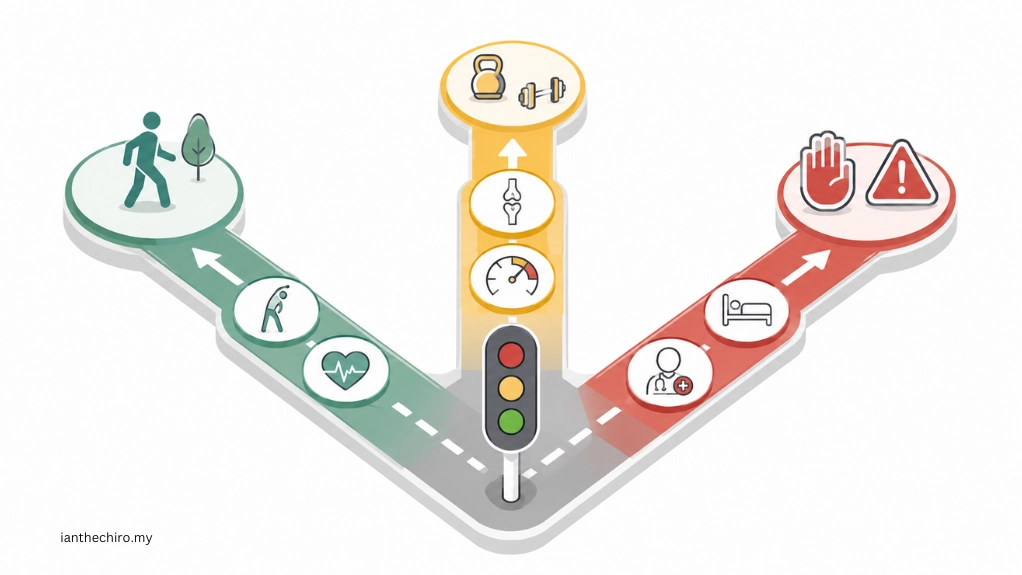
A simple way to think about pain and movement is the traffic light rule.
Green Light: Usually Okay to Continue
Green light pain is mild, manageable, and does not worsen as you continue.
Examples:
- mild stiffness that improves as you move
- slight discomfort that stays stable
- soreness that does not affect your control
- symptoms that settle quickly after activity
In this zone, gentle movement is usually reasonable, although you may still need to reduce intensity.
Yellow Light: Modify and Monitor
Yellow light pain is more noticeable, uncertain, or slightly increasing.
Examples:
- pain that appears during movement but stays manageable
- discomfort that increases with load
- symptoms that feel okay during activity but worse later
- pain that changes your movement or confidence
- symptoms that keep returning every time you do the same activity
In this zone, you should modify.
That may mean reducing weight, range, speed, duration, frequency, or intensity. It may also mean swapping the activity temporarily.
Red Light: Stop and Get Assessed
Red light pain is sharp, severe, worsening, unusual, or linked with worrying symptoms.
Examples:
- sudden severe pain
- pain that makes you unable to continue
- worsening numbness, tingling, or weakness
- pain after trauma
- pain that spreads aggressively
- symptoms that affect walking, balance, grip, or control
- pain that feels very different from your usual pattern
In this zone, pushing through is not a good idea.
Stop the activity and get properly assessed.
Resting Too Much Can Become a Problem
Short-term rest can be useful when pain is very irritated.
But resting too much for too long can create another problem.
If you avoid movement completely, the painful area may become less prepared for normal activity. Then when you finally feel better and return to your usual routine, the same pain may come back because the body was not gradually prepared for that load again.
This is common in recurring pain cycles.
The pattern may look like this:
- pain appears
- you stop everything
- pain settles
- you return to full activity
- the area gets overloaded again
- pain comes back
- you stop everything again
This is why the goal is usually not permanent rest. The goal is the right level of activity at the right time.
For chronic low back pain specifically, the WHO guideline for chronic primary low back pain supports non-surgical care in primary and community settings, including education and exercise-based approaches where appropriate.
Pushing Through Can Also Become a Problem
The opposite mistake is pushing through every pain.
Some people ignore symptoms until the pain becomes harder to manage. This is common in gym training, running, badminton, football, work demands, and busy periods where people do not want to slow down.
This is especially common with sports injuries or training-related pain, where people often try to continue until the symptoms become harder to manage.
Pushing through may be a problem if:
- the pain gets sharper during activity
- your movement changes because of pain
- symptoms are worse later or the next morning
- pain keeps returning every session
- you need more warm-up each time just to feel normal
- you feel weaker, less stable, or less controlled
- symptoms start travelling into the arm or leg
Discipline is useful. Ignoring signals is not.
What “Modify, Do Not Stop Everything” Can Look Like
Modification means adjusting the activity so your body can still move without repeatedly irritating the problem.
For example:
- walk shorter distances instead of stopping all walking
- reduce gym load instead of quitting training completely
- change the range of motion instead of forcing full depth
- reduce running volume instead of continuing the full plan
- take more breaks from sitting instead of lying down all day
- use lighter movements before returning to heavier ones
- swap painful exercises for tolerable alternatives temporarily
The aim is not to protect the area forever.
The aim is to stay active within a range your body can currently tolerate, then rebuild from there.
What to Pay Attention To After Movement
How you feel during movement matters, but how you feel after movement also matters.
Useful questions include:
- Did the pain settle quickly after activity?
- Did it feel worse later that day?
- Did it feel worse the next morning?
- Did the pain spread further?
- Did you lose strength, control, or confidence?
- Did you need painkillers just to function afterward?
- Is the same activity becoming easier or harder over time?
A movement that feels fine during activity but causes a big flare later may still be too much for your current stage.
That does not always mean the movement is bad forever. It may just mean the dose is too high right now.
Why the Same Advice Does Not Work for Everyone
Two people can have similar pain in the same area but need different advice.
For example:
One person with lower back pain may feel better with walking and gentle movement.
Another person may have leg symptoms that worsen with certain positions and need a more careful approach.
One person with knee pain may need temporary load reduction.
Another may need gradual strengthening and better activity planning.
One person with neck pain may need movement breaks and upper back work.
Another may need careful screening because symptoms travel into the arm with numbness or weakness.
This is why generic advice can only go so far.
The right next step depends on the pattern.
How Ian Thinks Through Rest vs Movement
Ian does not decide based only on the painful area.
He usually thinks through a few layers.
First, how irritable is the pain?
If pain is severe, worsening, or easily triggered, the first step may be to calm things down and avoid aggravating activities.
Second, does movement help or worsen it?
Some symptoms improve with gentle movement. Others flare with certain positions, loads, or directions.
Third, are there nerve-like symptoms or red flags?
Numbness, tingling, weakness, travelling pain, trauma, or unusual symptoms may change the advice.
Fourth, what does the patient need to return to?
A desk worker, runner, gym-goer, parent, athlete, and older adult may all need different movement advice because their daily demands are different.
The aim is not to give a generic “rest” or “move” answer. The aim is to decide what kind of movement makes sense now.
When You Should Get Properly Assessed
You should consider getting assessed if:
- pain keeps coming back
- pain affects work, sleep, sport, or daily movement
- you are unsure whether to rest or keep moving
- pain travels into the arm or leg
- there is numbness, tingling, weakness, or nerve-like pain
- the pain is worsening instead of improving
- you feel afraid to move
- you keep needing painkillers just to get through normal activity
- symptoms return every time you restart exercise
- you want a clearer plan instead of guessing
You do not need to wait until the pain is unbearable. If you are repeatedly unsure what is safe, it is worth getting clarity.
What You Can Do Before Booking
Before booking, pay attention to the pattern.
You can note:
- when the pain started
- what you were doing before it started
- what movements make it worse
- what movements make it better
- whether rest helps or makes it stiffer
- whether movement helps or flares it
- whether symptoms travel anywhere
- whether symptoms are changing over time
- what activities you want to return to
This information helps make the consultation more useful.
What Not to Do
⚠️ Try To Avoid:
- forcing sharp pain because you do not want to stop
- resting completely for weeks without a plan
- aggressively stretching an irritated area
- self-cracking repeatedly just to get temporary relief
- returning to full activity the moment pain settles
- ignoring symptoms that travel, worsen, or affect strength and control
Practical Next Steps
If something hurts and you are unsure what to do, use this simple approach:
- Do not panic immediately.
- Do not force through sharp or worsening pain.
- Do not rest completely for too long without a plan.
- Try gentle movement if it feels tolerable.
- Modify painful activities instead of stopping everything.
- Watch how symptoms respond later and the next day.
- Get assessed if the pain keeps returning, worsening, or affecting your life.
The goal is not to be fearless or overly cautious.
The goal is to make a better decision based on what your body is telling you.
Common Questions About Whether to Rest or Keep Moving When Something Hurts
Should I rest if my back hurts?
Short-term rest may help if the pain is very irritated, but resting completely for too long can make it harder to return to normal movement. If gentle walking or light movement feels tolerable and does not worsen symptoms, it may be more useful than staying completely still.
Is it okay to walk when something hurts?
Walking can be helpful if it reduces stiffness, feels manageable, and does not make symptoms worse later. But if walking causes sharp pain, limping, worsening symptoms, or pain travelling down the leg, stop and get assessed.
Should I stretch painful muscles?
Stretching may help some types of tightness, but forcing an irritated area into aggressive stretching can make symptoms worse. If the same muscle keeps tightening again and again, the better question is why that area keeps reacting in the first place.
Should I push through gym pain?
No, not if the pain is sharp, worsening, affecting your form, or getting worse after training. It is usually better to reduce the load, shorten the range, change the exercise, or pause that movement temporarily instead of forcing through it.
Why does pain feel better after rest but come back again?
Rest may calm the painful area down, but it may not change the reason the area became irritated. If the same load, habit, weakness, movement pattern, or recovery issue is still there, the pain may return when activity increases again.
How do I know if pain is serious?
Pain should be checked properly if it is severe, unusual, worsening, linked with trauma, travelling into the arm or leg, or associated with numbness, tingling, weakness, fever, unexplained weight loss, or bladder or bowel changes.
Can chiropractic care help if I am not sure whether to rest or keep moving?
It depends on the case. A consultation can help assess what may be driving the pain, whether chiropractic care is suitable, and what level of rest, movement, or activity modification makes sense.
When should I book a consultation?
Book a consultation if your pain keeps returning, affects daily life, stops you from moving normally, or leaves you unsure what is safe to do next.