
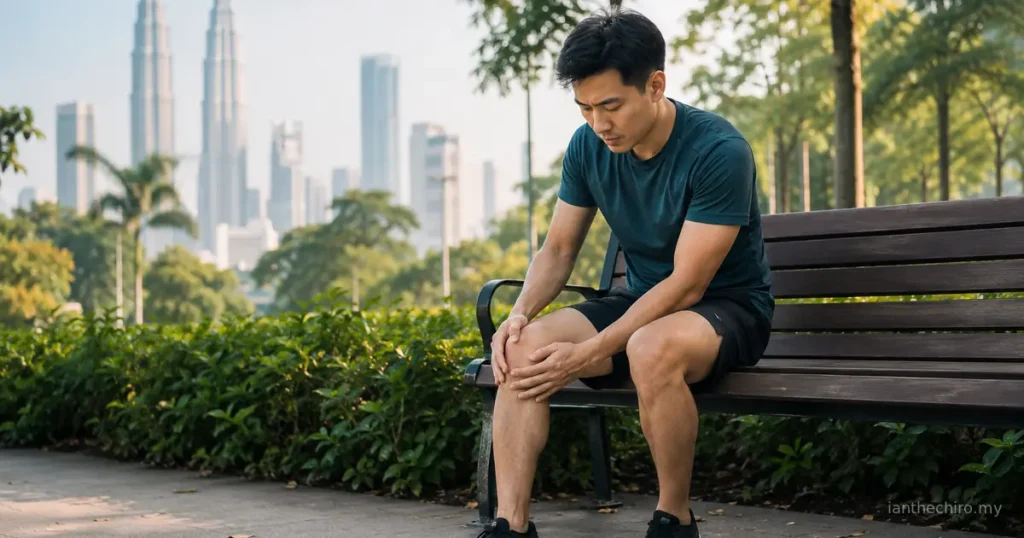
Your run felt comfortable at first. Then an ache appeared around the knee during the final few kilometres, after you stopped, or when you used the stairs later that day. Perhaps the knee felt stiff the next morning. You may now be wondering whether you have injured something, whether your shoes are wrong, or whether you should stop running completely.
Knee pain after running can come from several different patterns. The kneecap, patellar tendon, joint, muscles, training load and even symptoms referred from another area can all be relevant. The timing and location of the pain usually tell us more than the fact that it happened after a run.
Running is not automatically damaging your knees. Problems are more likely when the demand of a run, or the total demand across the week, exceeds what the knee currently tolerates. Ian The Chiro’s sports injury assessment and rehabilitation approach considers the training history, symptom pattern, movement and physical capacity together.
This article is general education, not a diagnosis. A sudden injury, major swelling, inability to bear weight or a hot, red knee needs appropriate medical assessment.
Quick Answer: Why Do You Get Knee Pain After Running?
Knee pain after running may develop when repeated running load exceeds the present capacity of the knee and surrounding tissues. This can happen after increasing distance, pace, hills, frequency or other lower-body training, even when no single step felt injurious.
Common possibilities include:
- patellofemoral pain around or behind the kneecap
- irritation of the patellar or quadriceps tendon
- iliotibial band-related pain at the outside of the knee
- joint or meniscus irritation
- a muscle or tendon problem around the back or side of the knee
- an acute ligament, cartilage or bone injury after a twist, fall or collision
- pain referred from the hip, lower back or a nerve
Pain location, onset, swelling and the 24-hour response help separate these patterns. A mild ache that settles quickly after an unusual run differs from increasingly focal pain, repeated swelling or symptoms that affect walking.
Why Can Running Trigger Knee Pain?
Running involves repeated cycles of landing, supporting body weight and pushing forward. The knee is designed for this, but the amount of load adds up across thousands of steps.
A knee may tolerate three easy runs each week, then become irritated when you add intervals, hills, a longer run and a hard leg session within the same few days. The issue may not be one terrible movement. It may be the total dose and how quickly it changed.
Capacity can also change. A familiar route may suddenly feel harder after illness, poor sleep, travel, a training break or several stressful weeks. The same external workload can therefore create a different internal response.
Load is not the enemy. Mismatched load is the problem. Appropriate loading helps tissues adapt. Too little activity for too long can reduce capacity, while repeatedly doing more than the knee can recover from may keep symptoms irritable.
Where Exactly Does the Knee Hurt?
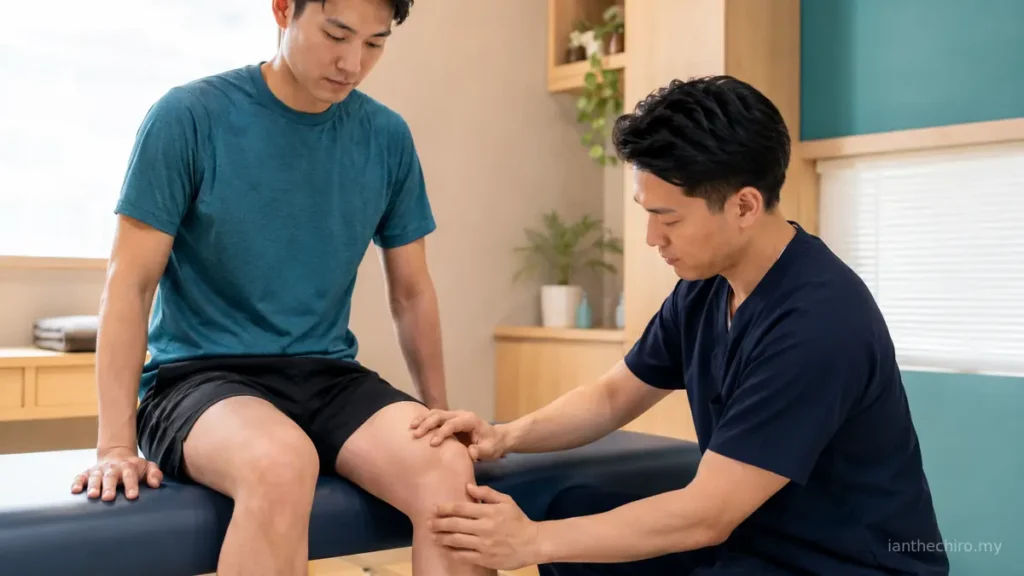
The painful location is an important starting point, although it cannot confirm a diagnosis by itself.
Pain around or behind the kneecap
Pain around the front of the knee is often associated with patellofemoral pain. It may feel diffuse rather than pinpoint. Running, stairs, squatting, prolonged sitting and getting up from a chair may reproduce it.
The patellofemoral pain clinical practice guideline supports assessing the symptom pattern and using combined hip- and knee-targeted exercise where appropriate. This does not mean every runner with front-of-knee pain simply has weak glutes or a badly tracking kneecap.
The kneecap is not usually “rubbing itself away” because one run hurt. Symptoms can change considerably as load, sensitivity and physical capacity change.
Pain below or above the kneecap
Pain localised just below the kneecap may involve the patellar tendon. It is often load-related and may be provoked by faster running, hills, jumping, landing or repeated squats. Pain above the kneecap may involve the quadriceps tendon or nearby tissue.
Tendon pain usually needs more than rest alone. A review of patellar tendinopathy management notes that load management combined with progressive tendon-loading exercise is central to conservative care. The exact exercise dose still needs to match irritability and function.
Pain on the outside of the knee
Outer-knee pain during running may involve the iliotibial band region, the lateral joint line, a nearby tendon or another structure. Iliotibial band-related pain often appears predictably after a certain running duration and may settle after stopping.
However, outside pain should not automatically be blamed on a “tight IT band” that needs aggressive rolling. The area is part of a wider system involving the hip, thigh and knee. Training changes, running tolerance and local sensitivity may matter more than trying to physically stretch one band into submission.
Pain along the inner joint line
Inner-knee pain can involve the joint, meniscus, medial ligament, tendons or bursa. A twisting injury, swelling, catching, locking or loss of movement makes an internal joint problem more relevant.
Joint-line tenderness alone does not prove a meniscus tear. Many findings overlap, and imaging changes do not always explain the pain. The history and physical examination need to agree.
Pain behind the knee
Pain at the back of the knee may come from the hamstring or calf tendons, the popliteus muscle, the joint, a fluid-filled swelling such as a Baker’s cyst, or referred symptoms.
New calf swelling, warmth, redness, breathlessness or chest pain requires urgent medical attention because a blood clot must be considered. This is not a routine running-injury presentation to monitor casually.
When Does the Pain Appear?
The timing can narrow the possibilities.
Pain that starts at a predictable distance may suggest that repeated load is exceeding current tolerance. Pain that appears only with faster running or hills may point towards a higher-force demand. Pain after stopping may reflect irritation that became more noticeable once the body cooled down.
Next-morning stiffness shows how the knee responded beyond the session itself. Ask three questions:
- What happened during the run?
- What happened in the hours afterwards?
- Was the knee near its normal baseline the next morning?
A run can feel manageable during the session and still be too much if symptoms progressively accumulate afterwards. Conversely, a mild response that settles reliably may allow careful training modification rather than complete rest.
Pain from the first few steps, pain that worsens continuously, or pain that changes your gait deserves more caution than a low-level ache that remains stable and settles promptly.
Which Training Changes Commonly Set It Off?
Look back over the previous two to six weeks rather than only the painful run. Common changes include:
- increasing weekly distance
- adding speed work, sprints or race-pace sessions
- introducing hills, stairs or trails
- running on more consecutive days
- returning after illness, travel or time off
- combining running with squats, lunges, jumping or court sports
- changing shoes and training volume at the same time
- replacing easy runs with sessions that are all moderately hard
- reducing sleep, food intake or recovery during a busy period
There is no universal percentage increase that guarantees safety. The popular idea that every runner must follow one exact weekly rule is too simple. Running history, pace, terrain, strength work, recovery and the type of increase all affect the real demand.
Count the whole week, not only the kilometres. A modest mileage increase may become a large overall spike when badminton, football, gym training or long workdays are added.
Are Running Form, Shoes or Foot Shape to Blame?
They can influence how force is distributed, but they are rarely a complete explanation by themselves.
There is no single perfect running form for every body. A particular stride, foot angle or amount of pronation should not be labelled the cause without checking whether it matches the symptoms and training history. Many runners have visible movement differences without pain.
Shoes matter most when there is a meaningful context. A sudden change to a very different shoe, worn-out footwear, discomfort from the fit, or simultaneously changing shoes and workload may be relevant. Buying the most expensive pair does not automatically solve knee pain.
Cadence or stride adjustments can help selected runners by changing knee demand, but they are tools rather than universal corrections. Making several form changes at once may create new problems elsewhere.
Do not let a slow-motion video convince you that your knee is broken. Running mechanics should be interpreted alongside pain behaviour, workload and capacity.
Should You Stop Running?
Not automatically. The right decision depends on severity, mechanism and symptom response.
Stopping is more appropriate when:
- pain is sharp, severe or escalating
- you are limping or changing your stride substantially
- a twist, fall or collision occurred
- the knee is swollen, unstable or unable to move normally
- symptoms affect ordinary walking
- pain is very focal over bone
- each run produces a worse response that lasts longer
- a clinician has advised temporary protection for a suspected injury
Modification may be reasonable when the pain is mild, stable, not linked with trauma and settles close to baseline within a predictable period. Options can include reducing distance, pace, hills, intervals or frequency.
The guide on whether to rest or keep moving when something hurts explains why the useful middle ground is often temporary de-loading followed by gradual rebuilding.
Complete rest can calm symptoms, but it does not automatically restore running capacity. Returning to the same programme after a long break may simply repeat the mismatch.
Can You Run Through Mild Knee Pain?
Sometimes, but “mild” needs context. A pain score alone is not enough.
A more useful monitoring approach considers whether:
- the pain stays low and stable rather than increasing
- your running pattern remains normal
- there is no swelling, locking or giving way
- symptoms settle soon after the run
- the next morning is not progressively worse
- the weekly trend is stable or improving
One tolerable run does not prove that the current programme is suitable. Look for the trend across several sessions.
If pain begins earlier each run, lasts longer afterwards or starts affecting daily activities, the current dose is probably not working. Reduce the aggravating demand and get the pattern assessed if it does not settle.
The goal is not to prove toughness. It is to keep enough useful activity while avoiding a worsening cycle.
What Should You Do in the First Few Days?
First, stop repeatedly testing the painful movement. Running, squatting or hopping every few hours to see whether it still hurts can keep the area irritated without giving useful new information.
Second, identify the likely load change. Review distance, pace, hills, frequency, strength training, sport, sleep and recovery.
Third, maintain comfortable movement where appropriate. Easy walking, gentle knee bending and normal daily activity may be reasonable if they do not cause progressive worsening. Total immobilisation is not routinely necessary for an uncomplicated overload pattern.
Fourth, choose a temporary training adjustment. That may mean replacing a hard run with an easy cycle, shortening a route, avoiding hills or taking a few days away from impact. Cross-training is only helpful if the alternative itself is comfortable.
Ice, heat or simple pain relief may change symptoms for some people, but they do not identify the cause. Medication should be used according to medical or pharmacy advice, especially if you have other health conditions or take other medicines.
Which Exercises May Help?
Exercise depends on the pain pattern. There is no single “runner’s knee exercise” that suits every cause.
For kneecap-related pain, a programme may include knee and hip strengthening, movement retraining where relevant, and graded exposure to the tasks that hurt. Examples may involve squats, split squats, step-downs, knee extensions or hip exercises, selected and progressed according to tolerance.
For patellar tendon symptoms, progressive loading may move from isometric work to slower resistance and then towards faster, spring-like tasks. Running and jumping capacity must eventually be rebuilt if those are the goals.
Calf strength, single-leg control and trunk or hip capacity may also matter for some runners. However, seeing the knee move inward during one squat does not automatically prove that weak glutes caused the pain.
The separate guide to knee pain when squatting explains how squat depth, symptom location and workload change the interpretation. The article on knee pain going down stairs covers the higher control demand during descent.
The best exercise is not the most impressive one. It is the one that loads the relevant capacity at a dose you can recover from and progress.
Could the Pain Come From Somewhere Else?
Yes. The hip, lower back and nerves can sometimes produce pain felt around the knee.
Referred or nerve-related symptoms become more relevant when knee pain occurs with:
- lower back or buttock pain
- burning, tingling or numbness
- pain travelling down the thigh or leg
- unusual heaviness or weakness
- symptoms that change strongly with spinal position
- a knee examination that does not reproduce the familiar pain
This does not mean every runner with knee pain needs spinal treatment. It means a purely local plan may miss the real pattern.
The hip, knee, ankle and heel pain guide explains how nearby regions are considered together. If numbness or altered sensation is prominent, the article on numbness in the leg covers why nerve involvement needs a different assessment.
Do You Need an X-Ray or MRI?
Not routinely for every episode of knee pain after running.
Many load-related knee problems can initially be assessed through the history and physical examination. Imaging is more useful when the result is likely to change management.
An X-ray may be considered after significant trauma, when arthritis or a bone problem is suspected, or when symptoms persist in a way that makes imaging relevant. MRI may be more useful for suspected internal joint, ligament, cartilage or bone-stress injuries.
Scans must be interpreted carefully. Meniscus changes, cartilage changes and other findings can exist without being the main pain source. A scan result should fit the symptom pattern rather than replace the assessment.
Imaging deserves earlier consideration when pain is very focal over bone, worsens with impact, begins affecting walking or rest, or follows a substantial training increase with bone-health risk factors.
⚠️ When Should You Seek Urgent Medical Care?
Seek urgent medical assessment if knee pain is associated with:
- inability to bear weight after an injury
- obvious deformity
- a knee that is locked and cannot straighten
- rapid, substantial swelling after trauma
- a hot, red, very swollen joint, especially with fever or illness
- severe pain that is worsening quickly
- new calf swelling, warmth or redness
- chest pain, breathlessness or coughing blood
- major weakness, spreading numbness or loss of bladder or bowel control
Arrange prompt assessment if there is persistent night pain, unexplained weight loss, a history of cancer, immune suppression, repeated unexplained swelling, or pain that feels distinctly unusual.
Do not massage a newly swollen calf or try to run these symptoms off. When the presentation could involve a blood clot, infection, fracture or major internal injury, routine musculoskeletal treatment is not the first step.
What Should a Proper Assessment Look At?
A useful assessment starts with the story. Where does it hurt? Did it begin suddenly or gradually? What changed in training? Does it appear during the run, afterwards or the next morning? Is there swelling, locking, instability or altered sensation?
The physical assessment may then consider:
- knee movement and swelling
- the exact painful location
- strength and symptom response under load
- squatting, stepping, hopping or running where appropriate
- hip and ankle movement
- tendon, joint and ligament findings
- neurological findings when symptoms suggest nerve involvement
- footwear and running changes where relevant
- recovery, previous injury and training goals
Tests should be selected to answer a question, not performed as a generic checklist. One painful squat or one “weak” muscle does not provide the whole diagnosis.
Assessment should change the plan. If the findings do not explain what should be reduced, maintained, strengthened, monitored or referred, more testing has not necessarily created more clarity.
What Treatment May Be Suitable?
Treatment depends on the diagnosis and the runner’s goals.
Education and load management help establish what can continue and what needs temporary adjustment. Exercise is commonly used to rebuild the relevant knee, hip, calf or running capacity. A gradual return-to-run plan can then increase demand while monitoring the response.
Chiropractic adjustments may be considered when relevant joint restriction elsewhere is contributing to movement or comfort, but an adjustment does not put a kneecap, meniscus or tendon back into place.
Dry needling may help selected muscle-related pain or guarding. It does not repair a ligament, reverse cartilage changes or directly rehabilitate tendon capacity.
Medical referral may be required for suspected fracture, infection, blood clot, major ligament injury, a locked knee or another condition outside routine conservative care.
Hands-on relief can be useful, but running tolerance is usually rebuilt through appropriate loading rather than passive treatment alone.
How Long Does Knee Pain After Running Take to Settle?
There is no honest universal timeline.
A mild, recent overload response may improve over days to a few weeks once the provoking demand is adjusted. A tendon or persistent kneecap-related problem often needs a longer period of progressive rehabilitation. A significant ligament, cartilage or bone injury follows a different timeline entirely.
Progress is not measured only by pain disappearing at rest. Useful milestones may include:
- normal walking and stairs
- comfortable strength exercises
- improved single-leg control and endurance
- tolerating short easy runs
- recovering near baseline by the next day
- gradually restoring distance, pace, hills and sport
Expect some variation as load increases. One slightly sore day does not automatically mean reinjury, but a worsening weekly trend means the progression needs review.
The article on why knee pain keeps coming back explains why short-term relief and long-term capacity are not the same thing.
What Should You Avoid?
Try to avoid:
- forcing repeated runs through escalating pain
- stopping all leg activity for weeks without a clear reason
- changing shoes, cadence, stride and training plan simultaneously
- aggressively rolling or stretching the painful area because it feels tight
- assuming every click means damage
- blaming one muscle or one movement from a social-media video
- returning directly to full mileage after symptoms settle
- relying indefinitely on massage, needling or adjustments without rebuilding capacity
- ignoring swelling, locking, instability, focal bone pain or nerve symptoms
Do not chase zero sensation by removing every activity. The longer-term goal is to restore tolerance for the running you want to do, provided the underlying condition is suitable for conservative rehabilitation.
How Ian The Chiro Approaches Running-Related Knee Pain
At Ian The Chiro in Cheras, Kuala Lumpur, running-related knee pain is not automatically labelled as weak glutes, poor tracking or a misaligned joint.
First, the assessment identifies the pain location, timing and training change. Second, it checks whether the knee behaves more like a load-sensitive kneecap, tendon, joint, acute injury or referred symptom. Third, it tests what the leg can currently tolerate and what the runner needs to return to.
The plan may include explanation, temporary training modification, exercise, gradual loading, an appropriate hands-on treatment or medical referral. Adjustments and dry needling remain separate options and are only used when the findings support them.
If your knee pain keeps returning, affects your running or is difficult to interpret, a chiropractic consultation can help clarify whether the problem is suitable for care here and what the next step should be. You can also WhatsApp Ian The Chiro to ask about booking.
Common Questions About Knee Pain After Running
Why does my knee hurt after running but not during the run?
Pain can become more noticeable after the knee has accumulated repeated load or once you cool down. The response later that day and the next morning helps show whether the session exceeded current tolerance.
Is knee pain after running normal for a beginner?
Mild temporary soreness can occur when someone begins running, but knee pain should not automatically be accepted as normal. Review the training increase, pain location, severity, gait and recovery. Persistent or worsening symptoms deserve assessment.
Does runner’s knee mean the kneecap is damaged?
No. “Runner’s knee” commonly refers to patellofemoral pain, which is diagnosed from the clinical pattern rather than proof that the kneecap is wearing away. Symptoms can improve as load and capacity are addressed.
Should I use a knee brace when running?
A brace or taping may change symptoms for some people, but it is not automatically necessary and does not replace appropriate rehabilitation. Its usefulness depends on the pain pattern and whether it meaningfully improves function.
Can weak glutes cause knee pain after running?
Hip strength or control may contribute for some runners, but weak glutes are not a complete diagnosis. Knee capacity, calf function, training load, recovery and the exact pain source may also matter.
Should I stretch if my knee hurts after running?
Gentle mobility may feel helpful, but aggressive stretching is not a universal solution. Stretching should match the involved tissue and should not repeatedly worsen symptoms. Tendon or joint problems may require a different loading approach.
When can I start running again after knee pain?
Return depends on the cause and severity. A common progression restores comfortable daily activity and suitable strength work first, then introduces short easy runs while monitoring the same-day and next-morning response.
Is clicking in the knee after running a concern?
Clicking without pain, swelling, locking or loss of function is often less concerning than painful mechanical symptoms. A knee that locks, repeatedly swells or gives way should be assessed.
When should knee pain after running be checked?
Arrange an assessment when pain persists, repeatedly returns, worsens, changes your gait or limits training and daily activity. Seek care sooner after trauma or with swelling, locking, instability, focal bone pain, fever, calf swelling, weakness or numbness.