

Your back starts aching halfway through a squat session, or it feels stiff the morning after deadlifts. The first instinct may be to stop every exercise that loads the spine. The opposite advice can be just as blunt: ignore the pain, brace harder and keep training.
Lifting weights with back pain is not automatically unsafe, but the right decision depends on the symptom pattern, the load, and how your body responds during the next 24 hours. Mild, local discomfort that remains stable may allow a modified session. New leg symptoms, progressive weakness, major trauma or loss of bladder or bowel control changes the decision.
The back pain, slipped disc and sciatica guide explains how different back and leg symptoms are assessed in Cheras, Kuala Lumpur. This article focuses on the practical question lifters usually need answered first: what can you safely change today, and when should you stop?
Quick Answer: Can You Keep Lifting Weights With Back Pain?
Sometimes, yes. Continuing with a tolerable, modified version of training can help you maintain confidence, routine and physical capacity. That does not mean every painful lift should continue unchanged.
A reasonable session usually has three features:
- the discomfort stays local or familiar rather than spreading farther down a leg
- technique remains controlled without repeated sharp catching or protective collapse
- symptoms settle toward baseline after the session and are not clearly worse the next day
Reduce the demand if pain is climbing set by set, changing your movement substantially or lingering well beyond your usual response. Stop and seek assessment when pain follows a significant fall or accident, or when it comes with worsening numbness, weakness, saddle-area numbness, fever or bladder or bowel changes.
The goal is not to prove that you can tolerate pain. It is to find a training dose your back can recover from.
Why Can the Back Hurt During or After Strength Training?
Back pain is a symptom, not a single diagnosis. A barbell session can expose sensitivity in muscles, joints, discs or nerves, but it can also reveal a temporary mismatch between current capacity and recent training demand.
Perhaps you returned after a long break and used your old working weights. Maybe sleep has been poor, work has been stressful, or you added extra sets while preparing for a competition. Even if each change looks small, their combined effect may exceed what your back currently tolerates.
Pain does not measure tissue damage precisely. A sore back can be sensitive without being structurally fragile, while a serious problem can occasionally begin with symptoms that seem modest. That is why context matters: onset, location, leg symptoms, strength, general health and recovery all shape the decision.
What Does the Symptom Pattern Tell You?
The location and behaviour of pain usually give more useful guidance than the exercise name alone.
A broad muscular ache
A dull ache across the lower back that appears after high-volume rows, squats or hinges may reflect muscle fatigue or unfamiliar workload. It often feels tender and stiff but does not travel below the buttock. Delayed soreness may peak a day or two after an unusual session and then ease.
Local sharp or catching pain
A sharper pain in one spot may reflect irritation from a particular position or range. It deserves a reduction in load and a check of whether the same catch appears with daily bending, coughing, sitting or getting out of a chair. A sharp sensation is not a diagnosis by itself.
Buttock or leg symptoms
Pain, tingling or numbness travelling into the buttock, thigh, calf or foot may involve a nerve-related pattern. If symptoms move farther down the leg, strength changes or walking becomes difficult, do not treat the session as ordinary muscle soreness. The guide to sciatica versus piriformis syndrome explains why similar-looking leg symptoms need different assessment.
Did the Training Load Change Faster Than Your Capacity?
Many flare-ups happen after a change rather than because one exercise is inherently bad. Relevant changes include heavier weight, more sets, more weekly sessions, shorter rest, a new movement, deeper range or extra sport outside the gym.
Life load matters too. A person may tolerate four sets of squats during a quiet week but struggle with the same programme after long driving, poor sleep and a weekend of lifting boxes. Training stress is only part of the total demand.
Look back over the previous two to four weeks. If several variables increased together, reduce one or two rather than abandoning all strength work. For example, keep the exercise but cut the load and sets, or keep the load but shorten the range and remove the final high-fatigue set.
Capacity is specific and changeable. A flare-up often means the current dose needs adjusting, not that your back has failed.
Does Technique Need to Be Perfect?
Technique matters because it changes where force goes and how efficiently you perform a task. It does not follow that there is one perfectly safe spinal position for every person and every repetition.
A rounded back is not automatically injured, and a visibly neutral back is not automatically protected. Body proportions, exercise variation, load, fatigue and experience all influence how a lift looks. A technique cue is useful when it reduces symptoms, improves control or helps you express force. It becomes unhelpful when it creates fear and rigid guarding without improving the lift.
Myth correction: pain during a deadlift does not prove that your spine moved “out of alignment.” It may indicate sensitivity, fatigue, load intolerance or another issue that needs assessment, but the sensation alone cannot identify a displaced joint or damaged disc.
Film one or two representative sets if helpful. Look for repeatable control, bar path, breathing and where the repetition starts to change as fatigue builds. Avoid analysing every millimetre of movement while ignoring load and recovery.
How Much Pain Is Acceptable While Lifting?
There is no universal number that makes a lift safe or unsafe. A simple traffic-light approach can help, provided it is paired with the next-day response.
- Green: no pain or mild familiar discomfort that stays stable, does not spread and settles normally
- Amber: moderate discomfort, altered confidence or symptoms that rise across sets; reduce load, range, volume or exercise difficulty
- Red: sharp escalating pain, new leg symptoms, marked weakness, loss of control or a significant change in function; stop that lift and assess the situation
The response later that day and the following morning is important. A session may feel manageable but still be too much if sleep is disturbed, normal walking becomes harder or symptoms remain clearly elevated for more than 24 hours.
Use your own baseline rather than comparing pain scores with another lifter. Someone with long-standing back pain may safely train with low-level symptoms, while a person with sudden unfamiliar pain after trauma needs a more cautious decision.
How Can You Modify Load, Range, Tempo and Volume?
Change one or two variables and retest. This makes the response easier to interpret.
Reduce load
Drop the weight enough that repetitions feel controlled and leave several repetitions in reserve. A 20 to 40 per cent reduction is a starting experiment, not a rule. The useful amount is the one that changes symptoms without making the movement meaningless.
Shorten the range
Use a rack pull, blocks, a box squat or a higher handle position if the painful range is near the bottom. Gradually restore depth as tolerance improves instead of treating the shorter range as permanent.
Slow the tempo
A slower lowering phase can improve awareness and reduce sudden loading, although it also increases time under tension. Use lighter weight when adding tempo.
Reduce volume
Fewer sets or repetitions may be more effective than removing the exercise. High-fatigue final sets are often the first place control and confidence deteriorate.
A modification is successful when it lets you train a useful pattern without producing a disproportionate flare-up.
Which Exercise Substitutions May Be Useful?
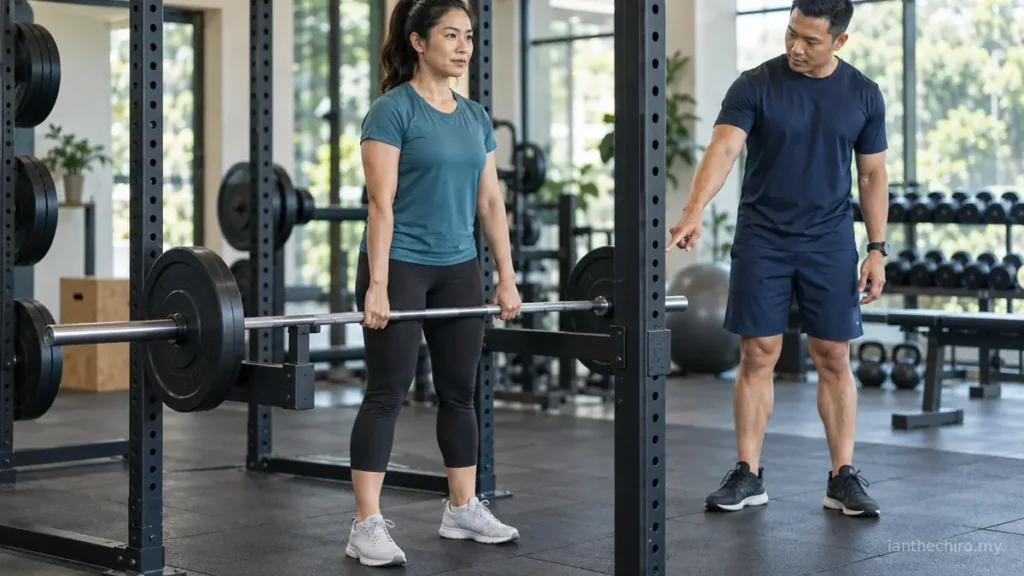
Choose a substitute that keeps the training goal while reducing the feature that currently aggravates symptoms.
For a painful conventional deadlift, options may include a trap-bar deadlift, block pull, cable pull-through or supported single-leg exercise. For a back-sensitive squat, try a goblet squat, safety-bar squat, split squat, leg press or box squat. For unsupported rows, a chest-supported row may keep upper-body training while reducing sustained trunk demand.
Machines are not inferior, and free weights are not automatically dangerous. Both are tools. The best temporary option is one that trains the desired muscles, feels predictable and can be progressed.
The sports injury care guide describes how gym-related symptoms can be assessed alongside training load, movement and recovery. If every hinge or squat variation remains painful, the problem may need more than exercise substitution.
Should You Rest Completely During a Flare-Up?
Short-term rest from one provocative lift can be sensible. Prolonged avoidance of all activity is rarely the only answer for uncomplicated back pain. Current guidelines commonly support staying active and using exercise as part of care when appropriate.
The NICE guideline on low back pain and sciatica recommends encouraging normal activity and exercise within a broader plan. A 2021 clinical practice guideline on low back pain supports several forms of exercise training for persistent low back pain, including strengthening and endurance work.
Keep what is tolerable: walking, upper-body work with support, light leg training or a reduced-range hinge. The article on whether to rest or keep moving gives a broader framework for adjusting activity when something hurts.
Relative rest means reducing the irritating dose while preserving safe movement and daily function. It is different from forcing painful repetitions and different from staying in bed.
When Should You Stop the Session?
Stop the painful exercise when symptoms escalate despite sensible changes, when you cannot maintain controlled movement or when pain starts travelling farther down a leg. A sudden pop with immediate severe pain, inability to bear load or obvious deformity also warrants stopping.
End the session and seek timely assessment if you notice new or worsening leg weakness, persistent numbness or a major change in walking.
⚠️ Medical caution
Seek urgent medical care for loss of bladder or bowel control, numbness around the groin or saddle area, rapidly progressive weakness, major trauma, fever with severe back pain, or severe unremitting pain with significant illness.
These features are uncommon, but they matter. Do not test them with another heavy set.
Do You Need an MRI Before Returning to the Gym?
Usually not. Most uncomplicated back pain can first be assessed with a detailed history, physical examination and neurological screening when indicated. Imaging is more useful when the result is likely to change management, or when a serious condition, significant neurological deficit or other specific problem is suspected.
An MRI can show disc bulges and age-related changes in people who have no pain. It can also identify important findings when the clinical situation warrants it. The scan must be interpreted alongside symptoms and function, not used as a stand-alone verdict on whether lifting is allowed.
Read when an MRI may be needed for back pain if a scan has been suggested or you are worried about a disc finding.
What Should a Proper Assessment Check?
An assessment should begin with how the episode started, which lifts provoke it, where symptoms travel and what happens during the following day. Previous episodes, medical history, sleep, work demands and recent programme changes add context.
The physical examination may include comfortable movement, loaded tasks, hip and trunk capacity, neurological checks and relevant orthopaedic tests. The clinician may watch a squat or hinge, but the goal is not to award a perfect-form score. It is to identify modifiable factors and determine whether the presentation is suitable for conservative care.
If symptoms only appear above a certain weight, that threshold can help guide a graded plan. If they are also present with coughing, prolonged sitting or walking, the problem may not be limited to gym technique.
A useful assessment connects findings to the activity you want to regain. It should leave you with a clear explanation, a safe starting point and criteria for progression or referral.
What Treatment May Help a Lifter With Back Pain?
Treatment depends on the presentation. Education and load management may be enough for a mild flare-up. A progressive exercise plan may target trunk endurance, hip and leg strength, general conditioning or confidence in the specific lift.
The exercise choice should reflect what is limited. A lifter who feels comfortable at low load but loses control under fatigue may need more repeated submaximal work. Someone who avoids bending after a painful episode may need graded exposure to the hinge itself. Another person may benefit more from leg strength, aerobic conditioning or a better distribution of hard sessions across the week. None of these findings proves that a single weak muscle caused the pain.
Chiropractic adjustments may be considered when joint-related stiffness or movement restriction appears relevant and the technique is suitable. They do not push a disc back into place or replace strength training. Dry needling may be considered for a contributing muscular pain or guarding pattern. It does not correct lifting mechanics or diagnose the cause.
For persistent back pain, the World Health Organization supports person-centred care that may combine education, exercise and selected physical or psychological interventions rather than relying on one treatment in isolation. The practical aim is to reduce symptoms enough to restore useful movement and build capacity.
Medication decisions should be discussed with a doctor or pharmacist, particularly if you have other health conditions or take regular medicines. Treatment should also have a review point. If function is not improving, symptoms are spreading or the plan only provides brief relief without improving training tolerance, the working explanation and next step should be reconsidered.
How Do You Rebuild Toward Normal Training?
Start below the level that repeatedly triggers a strong response. Use a variation you can perform confidently, keep a few repetitions in reserve and repeat it often enough to learn how your back responds.
Progress only one main variable at a time:
- add a small amount of load
- add one set
- restore more range
- increase weekly frequency
- move from a supported or machine variation toward the original lift
Hold the change for several sessions before adding another if symptoms have been unpredictable. A training log can record exercise, load, sets, discomfort during the session and response the next morning.
Progress does not need to look identical every week. You might first rebuild volume at a lighter load, then reduce repetitions as the weight rises. If one progression produces a clear flare-up, return to the last tolerable dose for a few sessions instead of restarting from zero. That response is useful information for the next adjustment.
The article do weak muscles cause back pain? explains why strength can be useful without being the only explanation for pain. The endpoint is not necessarily a pain-free test on one perfect day. It is reliable participation across ordinary weeks.
What Should You Avoid While Your Back Is Sensitive?
Avoid repeatedly testing the exact load that caused the flare-up just to see whether it still hurts. Maximal attempts, forced repetitions and sudden programme changes provide little room for adjustment.
Also avoid turning one episode into a permanent list of forbidden movements. A temporary block pull does not mean you can never lift from the floor. A belt may improve confidence or performance for some lifters, but it should not become proof that the spine is unsafe without it.
Do not chase pain aggressively with stretching, rolling or repeated manipulation when symptoms become more irritable. More treatment is not always better. The most useful intervention is the one that matches the likely driver and supports a measured return.
How Long Can a Lifting-Related Flare-Up Take to Settle?
Minor load-related soreness may improve over several days. A more irritable episode can take weeks, especially if sleep, work and repeated training exposure keep provoking it. Nerve-related symptoms or a significant injury may follow a different timeline.
Recovery is rarely perfectly linear. A slightly sore day after progression does not necessarily mean reinjury, and one good day does not mean you should jump straight to previous maximums. Look for trends: easier daily movement, less spreading pain, improved tolerance and more predictable recovery.
If there is no meaningful improvement after one to two weeks of sensible modification, or the same problem returns whenever the load increases, arrange an assessment. Earlier review is appropriate when symptoms are severe, unfamiliar or neurological.
How Ian The Chiro Approaches Lifting-Related Back Pain
Ian starts by understanding the lift, the symptom behaviour and the person behind the programme. That may include reviewing recent load changes, watching a comfortable variation, checking relevant movement and strength, and screening the nerves when leg symptoms are present.
The plan may combine education, a temporary training change, progressive exercise and selected hands-on care when suitable. The aim is not to make you dependent on treatment or insist on one “correct” technique. It is to help you understand the problem, recover capacity and make better training decisions.
For lifters travelling from work or training around a busy Kuala Lumpur schedule, the plan also needs to be realistic. Two useful sessions that fit your week may be better than a complex daily programme you cannot sustain.
Bring your usual programme, recent training log and any previous reports if you have them. Knowing the exact exercise, load, set and symptom response makes the assessment more useful than a vague instruction to avoid lifting. It also gives you a measurable point from which to progress.
Conclusion: When Should You Book an Assessment?
You may be able to manage a mild, local and improving flare-up by reducing load, range or volume and watching the next-day response. Book an assessment if pain keeps returning, limits several exercises, travels into the leg, affects strength or confidence, or does not improve with sensible modification.
At a chiropractic consultation, Ian can assess whether your symptoms appear suitable for conservative care, explain which factors may matter and help you choose a practical path back to training. If medical review or imaging is more appropriate, that should be made clear rather than forcing treatment.
Common Questions About Lifting With Back Pain
Is lifting weights with back pain always dangerous?
No. Mild, local and stable symptoms may be compatible with modified training. Safety depends on the cause, symptom behaviour, neurological signs, load and recovery response. New weakness, spreading numbness, major trauma or bladder or bowel changes require a different decision.
Should I stop deadlifting if my lower back hurts?
Stop the current set if pain is sharp, escalating or changing your control. You may be able to reduce the load, pull from blocks or use another hinge variation. If symptoms keep returning or travel into the leg, arrange an assessment instead of repeatedly testing the same lift.
Can squats damage a slipped disc?
A squat does not automatically damage a disc, and an MRI finding does not determine what every person can lift. Symptoms, neurological function, training history and load tolerance matter. A graded squat variation may be suitable for some people, while others need temporary modification or medical review.
Is a lifting belt helpful for back pain?
A belt may improve bracing awareness or performance and can make some lifters feel more confident. It is not a treatment for the cause and does not make a painful lift automatically safe. Use it as equipment, not as proof that your spine needs external support forever.
Should I stretch my hamstrings when my back hurts?
Only if the stretch feels useful and does not worsen symptoms. A feeling of tightness can reflect muscle stiffness, nerve sensitivity or protective guarding. Aggressive stretching is a poor choice if it increases leg pain, tingling or numbness.
Can I train upper body while my lower back is painful?
Often yes. Supported rows, machines, seated work or lighter pressing may let you train without provoking the back. Choose positions you can control and monitor the next-day response. Avoid holding your breath excessively or forcing an exercise that reproduces escalating symptoms.
How do I know when to increase the weight again?
Increase when the current dose feels controlled, symptoms remain stable during training and recovery is close to baseline by the next day. Add one variable at a time, such as a small amount of weight or one extra set, then observe several sessions.
Does back pain mean my core is weak?
Not necessarily. Strength and endurance can influence capacity, but pain can also reduce force and confidence temporarily. A useful plan should assess the task, the relevant capacities and the symptom pattern rather than blame one muscle.
When should I seek urgent care for back pain after lifting?
Seek urgent medical care for loss of bladder or bowel control, saddle-area numbness, rapidly progressive leg weakness, major trauma, fever with severe back pain or severe unremitting pain with significant illness. The 60-second symptom checker can help with general next-step guidance, but it is not a diagnosis or an emergency service.