

Pain in the buttock that travels down the back of the leg is often labelled either sciatica or piriformis syndrome. The difficulty is that both names can describe a similar experience: aching, burning, pulling, tingling or shooting pain that becomes worse with sitting, walking or certain hip movements. That overlap is why sciatica vs piriformis syndrome cannot be decided from location alone.
For patients in Cheras and Kuala Lumpur, the sensible first step is not to guess which muscle needs stretching. It is to compare the symptom pattern with the lower back, hip, deep buttock and nervous system. Our guide to back pain, slip disc and sciatica explains the broader spinal picture. This article focuses on what genuinely helps separate it from a possible deep-gluteal source.
Quick Answer: Sciatica vs Piriformis Syndrome
Sciatica is a symptom pattern involving pain or nerve-like symptoms along part of the sciatic nerve pathway. It commonly relates to irritation of a nerve root in the lower back, but the word itself does not identify one exact structure or cause.
Piriformis syndrome is used for sciatic-nerve irritation associated with the piriformis muscle in the buttock. However, modern clinicians often prefer the broader term deep gluteal syndrome because several structures in the deep buttock, not only the piriformis, can irritate or entrap the sciatic nerve.
The strongest distinction comes from a cluster of findings. Lower-back movement, coughing or sneezing, symptoms below the knee, altered sensation, reflex changes or neurological weakness can point more towards a lumbar nerve-root pattern. Buttock-dominant pain aggravated by sitting, hip rotation or deep-gluteal loading, with a quieter lower-back examination, may make deep gluteal involvement more plausible.
Neither pattern can be confirmed by one stretch, one tender spot or one online test. Some people also have overlapping contributors.
What Does Sciatica Actually Mean?
Sciatica is not a diagnosis in the same way that a fracture is a diagnosis. It is a clinical description of pain that travels along the sciatic nerve distribution, usually from the buttock into the back or outer part of the thigh and sometimes into the calf, foot or toes.
The most common clinical concern is lumbosacral radicular pain, where a spinal nerve root becomes irritated or compressed. A disc herniation can contribute, but so can age-related narrowing, inflammation around a nerve root or other spinal changes. A scan finding does not automatically explain symptoms, and a person can have genuine sciatica without dramatic back pain.
Symptoms may include:
- shooting, burning or electric-like leg pain
- tingling or numbness
- pain travelling below the knee
- symptoms affected by sitting, bending or spinal position
- pain worsened by coughing, sneezing or straining
- true weakness in part of the leg or foot
Sciatica names the travelling symptom pattern, not the culprit. Saying “I have sciatica” is the beginning of the assessment, not the end of it.
What Is Piriformis Syndrome or Deep Gluteal Syndrome?
The piriformis is one of several small muscles deep in the buttock that help control the hip. The sciatic nerve normally passes nearby, although anatomy varies between individuals. Pain in this area is sometimes attributed to a tight or inflamed piriformis pressing on the nerve.
That explanation can be too neat. A 2020 systematic review of deep gluteal syndrome defined the condition more broadly as non-discogenic sciatic-nerve entrapment in the deep gluteal space. Potential contributors include fibrous bands, other deep hip rotators, hamstring-related structures and space-occupying lesions, not just one muscle.
Typical clues may include deep buttock pain, pain after sitting for a while, tenderness around the deep gluteal region and symptoms reproduced by certain hip positions or tests that load the tissues around the sciatic nerve. Pain can travel down the thigh and may include tingling, which is why it can resemble lumbar sciatica.
A sore piriformis does not prove piriformis syndrome. The muscle may become sensitive because you are guarding, sitting differently or moving differently in response to another problem.
Why the Two Conditions Are So Easily Confused
The sciatic nerve links the two regions. Nerve roots from the lower spine contribute to the sciatic nerve, which then travels through the pelvis and deep buttock before continuing down the leg. Irritation anywhere along that pathway can create symptoms in overlapping areas.
Everyday language adds more confusion. People commonly call any buttock-to-leg pain “sciatica”, while social media often calls any sore buttock “piriformis syndrome”. Both shortcuts skip the question that matters: where along the pathway is the symptom being generated or sensitised?
There is also no rule that symptoms must start in the back if the source is spinal. Likewise, a deep-gluteal problem can radiate below the buttock rather than staying in one small spot. Pain location narrows the possibilities, but it rarely closes the case.
Sciatica vs Piriformis Syndrome: The Most Useful Clues
The following differences are tendencies, not absolute rules:
- Symptom origin: lumbar sciatica may begin in the lower back or buttock; deep-gluteal symptoms are usually buttock-dominant.
- Travel: symptoms below the knee, particularly with numbness or weakness, make nerve-root involvement more important to assess.
- Spinal response: lumbar bending, repeated spinal movement, coughing or sneezing may change lumbar radicular symptoms.
- Sitting: both can dislike sitting, but focal deep buttock pain on a chair may fit a deep-gluteal pattern.
- Hip response: resisted hip rotation or positions that compress or stretch the deep buttock may reproduce deep-gluteal symptoms.
- Neurology: altered reflexes, sensation in a nerve-root distribution or repeatable muscle weakness support a lumbar neurological pattern.
- Local tenderness: deep-gluteal problems may have recognisable buttock tenderness, although tenderness alone is not diagnostic.
The useful question is not “Which column has more ticks?” A clinician looks for findings that agree with one another and explain the behaviour of the symptoms.
How Location and Sitting Change the Clues
It helps, but only when combined with other clues.
Deep central buttock pain
Pain that feels buried in the buttock and worsens on a chair can fit deep gluteal syndrome. It may also come from the hip, sacroiliac region, proximal hamstring tendon or referred pain from the lower back. Palpating one painful spot cannot reliably separate these possibilities.
Pain travelling below the knee
Pain, tingling or numbness extending into the calf, foot or toes raises the relevance of a nerve-related pattern. The numbness in the leg guide explains why distribution and neurological findings matter more than simply calling every travelling sensation a trapped nerve.
Back pain with leg pain
Back pain plus leg symptoms makes a lumbar contribution more plausible, especially when the leg pain changes with spinal movement. Still, absence of back pain does not rule it out. Some lumbar radicular presentations are mainly felt in the leg.
What sitting tells you
Sitting is a common trigger for both patterns, so it is not a clean separator.
With a lumbar nerve-root problem, prolonged sitting and spinal flexion may increase sensitivity in some people. Symptoms may spread farther down the leg, and getting up after a long drive or desk session may feel difficult. The article on why sciatica gets worse when sitting explores this response in more detail.
With deep-gluteal involvement, the pressure of the chair and sustained hip position may provoke a more focal ache in the buttock. Sitting on a wallet or keeping one hip rotated for long periods can add local pressure, although these habits do not prove a diagnosis.
Notice whether symptoms stay in the buttock or move down the leg, how quickly they begin, whether changing spinal posture helps, and what happens after you stand and walk. The full response to sitting is more useful than the fact that sitting hurts.
Do Back and Hip Movements Change the Pattern?
They can provide valuable clues when tested systematically.
Repeated spinal movement may cause leg symptoms to retreat towards the back, known as centralisation, or spread farther down the limb, known as peripheralisation. This response can support a lumbar mechanical component, but it must be interpreted alongside the history and neurological examination.
Deep-gluteal symptoms may be reproduced when the hip is placed into flexion, adduction and internal rotation, or when the deep rotators work against resistance. A diagnostic-accuracy study of gluteal sciatic nerve entrapment found that combining an active piriformis test with a seated piriformis stretch test performed better than either alone in its small surgical sample.
That study does not turn these into do-it-yourself proof. Test accuracy depends on patient selection, technique and the reference standard. A positive test is a clue, not a verdict.
Tingling, Numbness and Weakness Matter
Tingling and numbness increase concern that neural tissue is involved, but they do not reveal where the irritation sits. A nerve root in the lower back, the sciatic nerve in the buttock, a more peripheral nerve or a non-musculoskeletal condition can all alter sensation.
Weakness needs even more care. Pain can make a movement hesitant or reduce effort. Neurological weakness is a repeatable loss of function that cannot be explained only by discomfort. Trouble lifting the front of the foot, repeated tripping, inability to push through the toes or a clear loss of control deserves assessment.
Changes in reflexes or sensation that follow a particular nerve-root pattern favour lumbar radiculopathy more than an isolated sore piriformis. However, a normal quick self-check does not safely rule out a nerve problem. The wider pinched nerve and nerve pain guide explains why travelling symptoms need a proper neurological screen.
Can coughing or sneezing help tell the difference?
Coughing, sneezing or straining can increase pressure around spinal structures and may aggravate lumbar radicular pain. If a cough consistently sends pain from the back or buttock farther down the leg, it is a relevant clue for a lumbar source.
It is not perfectly specific. Any sudden body movement can jar an irritable area, and people often brace the hips and trunk when they cough. The finding matters most when it matches other evidence, such as symptoms below the knee, altered sensation, a positive neural-tension test or a consistent response to spinal movement.
One dramatic symptom should not outweigh the rest of the examination.
Why One Piriformis Stretch Cannot Diagnose the Problem
A figure-four stretch loads several tissues around the hip and buttock. It may stretch the piriformis and other rotators, compress parts of the hip, tension neural tissues or simply reproduce sensitivity in an already painful region.
If the stretch feels tight, that does not prove the piriformis is shortened. If it temporarily eases pain, that does not prove it released a trapped nerve. If it worsens tingling down the leg, pushing harder may be irritating neural tissue rather than fixing the cause.
The popular myth is that a tight piriformis is sitting on the sciatic nerve like a clamp and only needs to be stretched open. Bodies are rarely that mechanically obedient. Muscle tone, nerve sensitivity, hip load, spinal position and pain protection can all change from one day to the next.
Use a stretch only if it feels comfortable and leaves symptoms no worse afterwards. Stop if symptoms travel farther down the leg, numbness increases or the leg feels weaker.
Can You Have Both a Lumbar and Deep-Gluteal Problem?
Yes. A person can have a sensitive lumbar nerve root and local buttock tissues that have become overloaded or guarded. Someone recovering from back pain may sit, walk or train differently, increasing demand on the hip rotators. Conversely, prolonged buttock pain can change movement and make the lower back more reactive.
This overlap is one reason a single-treatment story often fails. Releasing the buttock may give short-term relief without changing a lumbar driver. Focusing only on the spine may miss a local hip-loading problem. The existence of two contributors also does not mean something is seriously damaged in two places.
The hamstring pain vs sciatica comparison shows a similar principle: local tissue and nerve-related findings can coexist, so treatment should follow the dominant and modifiable features rather than the loudest label.
How a Clinician Assesses the Difference
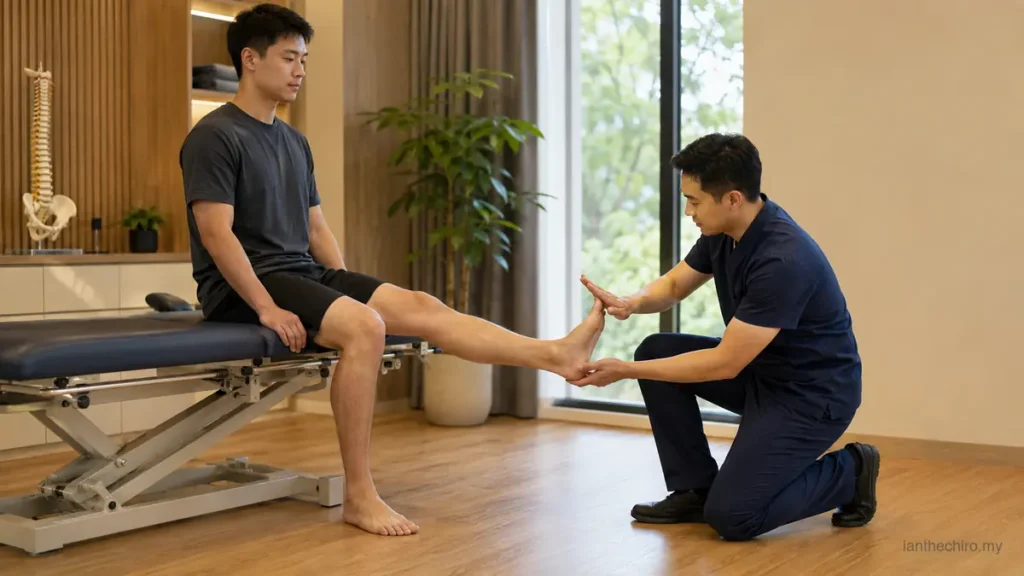
A good assessment builds a pattern rather than hunting for one magic test.
History and symptom behaviour
Useful details include where symptoms begin, how far they travel, whether there is tingling or numbness, how sitting affects them, what happened at onset and whether coughing, bending, walking, stairs or hip rotation changes them. Sleep, work demands, running, gym training and previous episodes also matter.
Lumbar and neurological examination
This may include lumbar movement, repeated-movement response, neural-tension testing, strength, reflexes and sensation. The clinician compares findings with the reported distribution instead of treating a painful test as a diagnosis by itself.
Hip and deep-gluteal examination
Hip range, resisted rotation, deep-gluteal palpation and tests that load the sciatic nerve around the buttock may be relevant. The hip joint, proximal hamstring and sacroiliac region may also need consideration.
Reassessment
Symptoms can be irritable and inconsistent on one day. A working diagnosis may become clearer through follow-up, response to carefully chosen movement and repeated neurological checks. Clinical reasoning is allowed to evolve when the evidence changes.
Do You Need an MRI or Other Imaging?
Usually not at the first step if symptoms are stable, there are no serious warning signs and the examination provides a sensible conservative direction.
Lumbar MRI may be appropriate when there is severe or progressive neurological loss, concern about a serious condition, symptoms that are not following an expected course, or when the result would change management. Current clinical guidelines similarly place imaging and referral decisions within a structured assessment rather than using scans routinely for everyone.
Imaging the deep gluteal space may be considered in selected persistent or unusual cases, particularly when a mass, major trauma, vascular issue or another non-routine cause is suspected. Specialist evaluation, ultrasound, MRI or diagnostic injections may sometimes contribute, but none should be treated as an automatic confirmation in isolation.
If you already have imaging, bring the report. The scan still needs to match your current symptoms. The guide on whether you need an MRI for back pain explains why incidental findings can otherwise create unnecessary fear.
When Symptoms Need Urgent Medical Review
Most buttock and leg pain is not an emergency. Seek urgent medical assessment if you develop new loss of bladder or bowel control, numbness around the groin or saddle area, rapidly progressive leg weakness, symptoms affecting both legs, major trauma, fever with severe back pain, unexplained weight loss, or severe pain with significant illness. These features should not be managed by repeatedly stretching the piriformis or waiting for a routine appointment.
Progressive foot weakness, expanding numbness or a rapidly worsening neurological pattern also needs prompt review even when bladder and bowel function are normal. When function is being lost, speed matters more than finding the perfect label.
What Can You Do While the Cause Is Still Unclear?
You do not need to stay completely still, but you also do not need to prove toughness by provoking the leg repeatedly.
- Change position regularly rather than sitting through escalating symptoms.
- Keep comfortable walking or daily movement if it does not drive symptoms farther down the leg.
- Reduce movements, stretches or gym exercises that consistently increase tingling, numbness or weakness.
- Note whether symptoms move towards or away from the spine.
- Avoid aggressive massage directly over an acutely irritable nerve-like area.
- Use sleep and sitting positions that are tolerable rather than chasing one supposedly perfect posture.
The advice on whether to rest or keep moving can help you find a middle ground. A small, temporary activity adjustment is often more useful than complete bed rest or a random collection of internet exercises.
What Treatment May Involve
Treatment depends on the working diagnosis, irritability, neurological status and what the person needs to return to.
For a lumbar radicular pattern, care may involve education, graded activity, exercise, load modification and monitoring of neurological signs. Chiropractic adjustments may be considered when joint restriction or mechanical sensitivity appears relevant and the technique is suitable. An adjustment does not push a disc or nerve back into place.
For a deep-gluteal pattern, management may involve changing aggravating sitting or training loads, gradually strengthening the hip and improving tolerance to relevant positions. Dry needling or other soft-tissue techniques may be considered for associated muscle sensitivity, but they do not automatically prove or remove sciatic-nerve entrapment.
Medication, physiotherapy, medical assessment, image-guided procedures or surgical opinion may be appropriate in selected cases. The modality should follow the assessment, not the label on a social-media video.
What to Avoid When Comparing the Two
Avoid deciding that back pain must mean sciatica and buttock pain must mean piriformis syndrome. That shortcut ignores leg-dominant lumbar presentations and the many other sources of buttock pain.
Do not repeatedly reproduce strong nerve symptoms to test yourself. Do not assume that the most painful spot is the source. Do not interpret temporary relief after stretching, massage or an adjustment as proof of a diagnosis.
Also avoid letting an MRI report replace the examination. A disc bulge may be relevant, incidental or only part of the picture. Useful care explains why the findings fit your current pattern and what should change next.
How Ian Approaches Sciatica-Like Buttock and Leg Pain
At Ian The Chiro in Cheras, the first goal is to understand whether the presentation looks more lumbar, deep-gluteal, hip-related, mixed or medically unsuitable for chiropractic care.
Ian considers the history, symptom distribution, spinal and hip movement, neurological findings, daily sitting, training load and what has already been tried. Treatment is not automatic. Depending on the case, the next step may be advice, movement guidance, chiropractic adjustments, dry needling for a relevant muscular component, referral, imaging discussion or monitoring.
This assessment-first approach is especially useful when you have been told different things by different people. You do not need to arrive knowing the correct label. You need a plan that respects uncertainty and tracks meaningful changes.
Not Sure Which Pattern Fits? Start With an Assessment
If buttock or leg symptoms keep returning, travel below the knee, interfere with sleep or sitting, or have not improved with repeated stretching, a first chiropractic consultation can help organise the picture. The aim is to decide what seems most likely, what needs monitoring and whether chiropractic care is suitable.
Patients from Cheras and nearby Kuala Lumpur can WhatsApp the clinic with a short description of where symptoms begin, where they travel and whether numbness or weakness is present. Urgent warning signs still require medical assessment first.
Frequently Asked Questions About Sciatica vs Piriformis Syndrome
Is piriformis syndrome a type of sciatica?
It can create sciatica-like symptoms when the nerve is irritated in the deep buttock. The likely source may still be lumbar, deep-gluteal or elsewhere.
Can piriformis syndrome cause pain below the knee?
It can, but symptoms below the knee also make lumbar nerve-root irritation important to assess. Distribution alone cannot locate the irritation.
Does sciatica always cause lower back pain?
No. Symptoms may be felt mainly in the buttock, thigh, calf or foot. A lumbar source remains possible even without obvious back pain.
Does a painful figure-four stretch prove piriformis syndrome?
No. The position loads muscles, the hip joint and neural tissues. Familiar pain is one clue, not confirmation of its source.
Should I massage a painful piriformis?
Gentle massage may ease muscular soreness temporarily. Avoid aggressive pressure if it sends tingling down the leg, worsens numbness or increases irritability.
Can a slipped disc and piriformis syndrome happen together?
Yes, lumbar and deep-gluteal contributors can coexist. Assessment should compare symptom behaviour, neurological findings and hip or buttock loading.
How long does piriformis syndrome take to recover?
There is no universal timeline. Recovery depends on the contributor, symptom duration, nerve irritability, activity demands and management of aggravating load.
Can chiropractic care help sciatica vs piriformis syndrome?
It depends. Some cases may suit advice, graded movement, chiropractic adjustments or treatment of a muscular component. Others need medical review. A chiropractic consultation should establish suitability first.
When should leg pain be assessed?
Arrange assessment for persistent or recurring symptoms, especially with tingling or numbness. Seek prompt care for progressive weakness and urgent care for bladder or bowel changes or saddle numbness.