
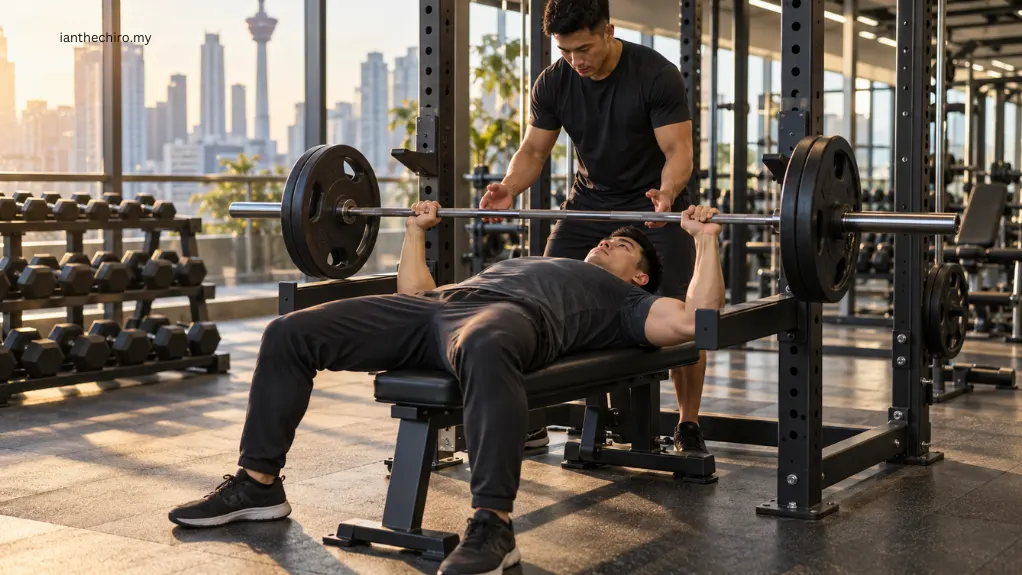
Your warm-up sets feel normal, but the moment the bar nears your chest, one shoulder starts to ache. Or perhaps it only hurts when you drive the weight upward. Shoulder pain during bench press can be frustrating because a movement that used to feel familiar suddenly requires a decision: train through it, change something, or stop?
The answer is rarely obvious from one painful repetition. A bench press places demands on the shoulder that vary with bar depth, grip, load, fatigue and the way you move. Pain may reflect a temporary mismatch between those demands and your current tolerance, but certain injuries and joint problems need a different response. Our shoulder, elbow and wrist pain overview explains why location alone does not establish a diagnosis.
This guide focuses on what makes bench pressing distinctive: where in a repetition symptoms appear, which training changes provide useful clues, and how to return without blindly pushing through pain.
Quick Answer: What Can Shoulder Pain During Bench Press Mean?
Shoulder pain during bench press may arise when the bottom position, pressing load or movement setup challenges tissues that are already sensitive. Possible contributors include rotator-cuff-related symptoms, irritation near the acromioclavicular joint on top of the shoulder, front-of-shoulder tendon or joint sensitivity, or a more specific injury. The same pain location can have several explanations.
Notice whether discomfort begins as the bar descends, appears only near the chest, peaks while pressing upward, or develops after training. Also notice whether the shoulder behaves normally during daily tasks or hurts with simple reaching and lifting.
If a light, controlled variation feels significantly better, that is useful information. It does not prove that your previous technique damaged the shoulder or that you have identified the precise structure responsible. A sudden tearing sensation, major weakness or inability to move the arm needs more caution than a mild ache that settles when the set ends.
Which Part of the Bench-Press Repetition Triggers It?
Instead of asking only whether bench pressing hurts, divide the movement into phases. A consistent trigger offers a more useful starting point for deciding what to modify.
At the Unrack or While Holding the Bar
Pain that appears before the first repetition may relate to the position needed to lift the bar out of the rack, shoulder tension while supporting it, or an already irritable joint. Check whether the rack height forces an awkward reach. Use a competent spotter when appropriate rather than twisting or shrugging one shoulder to escape the hooks.
While Lowering the Weight
The descent controls the weight as the shoulders move into increasing horizontal extension. A familiar ache that builds during the lowering phase may respond to lighter weight, a slower controlled descent or reduced depth. Repeatedly dropping into a painful bottom position is not a useful diagnostic test.
Right at the Bottom
If symptoms appear only during the final few centimetres toward the chest, compare a slightly shorter, comfortable range. This phase changes shoulder position and tissue demands. Being able to touch the chest is not proof that the full depth currently suits your shoulder.
During the Press or Lockout
Pain on the upward drive may reflect a different combination of muscular effort and joint loading. Notice whether it occurs immediately out of the bottom, midway through the press or only near straight arms. A painful or unstable-feeling lockout deserves a different examination from an isolated bottom-range ache.
Later That Day or the Following Morning
Symptoms that appear only after training may reflect a response to total exercise exposure rather than one single repetition. Compare soreness, joint-specific pain, sleep disruption and next-session tolerance before labelling it a technique fault.
Why the Bottom Position Can Be More Demanding
Near the bottom of a conventional barbell bench press, the upper arm is usually farther behind or out to the side of the torso than it is near the top. The shoulder is working in a different position, while the chest and other pressing muscles manage the weight. A deep stretch sensation is not itself an injury, but repeated pain at that depth is worth taking seriously.
A fixed barbell also determines where both hands travel together. If one shoulder needs a different path, the bar may not allow much freedom to accommodate it. That is one reason a person can tolerate one pressing variation and struggle with another.
Try comparing an unloaded movement, a lighter barbell and a controlled partial range. If discomfort only appears at the lowest point under heavier loads, depth and load are more useful variables to explore than a vague label of poor form. But do not repeatedly test heavy painful repetitions just to prove the point.
The point is not that the bottom position is universally dangerous. Full-range bench pressing can be appropriate for many trained people. What matters is the current relationship between your shoulder’s symptoms, the exercise demands and how the shoulder responds after training.
Did Your Training Change Before the Shoulder Became Painful?

Review the previous two to four weeks. Did you increase the weight, add a second chest day, return after a break, take more sets to failure or add dips, flyes and overhead pressing on top of bench work? Even if each change seems small, the combined workload may be unfamiliar.
Volume is not just the count of sets. Repetitions, proximity to failure, exercise order, range and recovery also shape what a session asks of the shoulder. Record your recent changes instead of assuming the last painful set caused every symptom.
This is where the distinction between muscular soreness and a more localised painful response becomes useful. Our muscle soreness versus injury guide explains why the timing and quality of symptoms matter. A new load can expose a limited tolerance without automatically indicating a tear, but continuing a clearly aggravating training progression is rarely sensible.
Ask one practical question: if you temporarily reduce demanding pressing work, does the shoulder become more comfortable during normal movement and the next training session? That trend often tells you more than a single painful rep.
Grip Width and Elbow Angle: Variables, Not Magic Numbers
A wide barbell grip and a narrower grip place the upper arm in different positions. Elbows that drift farther out or remain closer to the torso also alter the way the shoulder and wrist are loaded. These are adjustable variables, not a simple division between safe and unsafe technique.
A 2024 biomechanical study of ten experienced strength athletes compared bench-press techniques and modelled shoulder joint forces. Grip width, shoulder-blade position and force direction affected the estimated loads. That is helpful mechanistic evidence, but the study did not demonstrate that one grip prevents injuries or treats people who already have shoulder pain. The lifting trials also used a relatively light bar, limiting direct generalisation to maximal attempts.
If your usual wide grip provokes discomfort, try a modest change toward the centre with an easily controlled load. A moderate elbow angle might feel better than either an exaggerated flare or an extremely tucked position. There is no need to force one arbitrary angle such as 45 degrees into every repetition.
Evaluate the complete response: pain during the set, the bar path you can control, and how your shoulder feels afterwards. If a technically neat-looking grip still hurts, the appearance of your elbows is not proof that you should push harder.
Small, tolerable changes are experiments, not corrections of a supposedly broken shoulder. A spotter, safety bars or a rack with correctly set safeties matter whenever you are trialling an unfamiliar barbell setup.
Does Your Bench Setup Change What the Shoulder Has to Do?
Before blaming a tendon, look at the whole pressing task. A rack set too high may make the unrack awkward. A bench that does not feel stable can affect how confidently you position yourself. A heavy lift done without adequate safety equipment may also encourage rushed movements.
It is reasonable to set your feet securely, keep the shoulders supported on the bench and use a repeatable bar path you can control. But the presence of an arch or shoulder-blade retraction does not automatically explain pain.
Pay attention to whether the bar comes down to a comfortable area of your chest or whether you are fighting to match a powerlifting standard. A competitor preparing for a paused bench has different demands from someone simply trying to train their chest.
If you cannot unrack safely, cannot control the descent, or find yourself twisting under a loaded bar to avoid pain, stop that version of the exercise. Self-experimenting is only worthwhile when the setup is safe.
Does the Pain Location Suggest a Particular Pattern?
Where pain sits matters, but it rarely tells the whole story. Several tissues share overlapping pain areas, and different people use words such as “front”, “inside” or “deep” differently. Use location alongside onset, movement restriction and strength findings.
Pain at the Front of the Shoulder
Front-of-shoulder pain during a deep press can accompany tendon or joint-related presentations, including discomfort around the long head of the biceps. It may also occur with broader rotator-cuff-related problems. A painful spot alone does not confirm biceps tendinopathy or a labral injury.
Notice whether similar symptoms occur when reaching behind the body, lifting a bag or doing an incline press. Sudden pain followed by bruising, a visible change in muscle shape or marked weakness after heavy lifting requires prompt examination.
Pain on Top Near the Collarbone
A localised ache over the acromioclavicular joint may behave differently from pain on the outer upper arm. Cross-body movements, direct pressure or certain pressing positions may reproduce it. Heavy bench work can challenge this area, but the location alone cannot establish a joint injury.
Outer Shoulder Pain or Weakness
Pain around the outer upper arm, especially if reaching overhead, lifting away from the body or sleeping on one side also hurts, may fit a rotator-cuff-related pattern. Clinical guidelines support a careful history and examination rather than guessing the exact tendon from one gym movement.
Deep Clicking, Catching or Instability
An isolated painless click does not necessarily indicate damage. Repeated painful catching, a feeling that the shoulder may slip or major loss of control is different. These symptoms deserve examination, especially if they followed a sudden loading event.
Symptoms That Travel From the Neck
Pain influenced by neck movement, tingling down the arm or altered hand sensation may involve another source. These features are not explained simply by adjusting bench-press grip width. Our guide to neck pain radiating down the arm helps identify symptoms worth discussing with a clinician.
A painful shoulder can have more than one contributing factor. Examination looks for a consistent pattern rather than assigning a diagnosis from an online pain map.
When Is It Ordinary Gym Soreness and When Should You Stop?
Diffuse chest or upper-arm muscle soreness that starts after unfamiliar training and gradually settles differs from focal pain during a specific part of a lift. A sharp pain during one repetition, a sudden loss of power or discomfort that becomes worse with each set changes the decision.
If the shoulder starts aching on the second warm-up set, do not assume you can simply warm it out with heavier weights. If it becomes easier at lower load, assess whether that improvement persists without increasing pain later.
You might also finish the workout comfortably and notice soreness the following morning. That does not automatically mean injury. Consider location, intensity, how long it lasts, whether ordinary reaching is affected and whether the next session is more difficult.
One useful rule is to stop a lift when pain is escalating, your pressing becomes uncontrolled, or your strength suddenly drops. A mild familiar ache that remains stable may sometimes permit modified activity, but using a number on a pain scale is not a substitute for judging the complete response.
If you train regularly in a commercial gym around Kuala Lumpur, ask the coach or training partner to watch your bar path rather than insisting every visible variation must be corrected. The priority is a movement you can perform safely and recover from.
A Same-Session Decision When Your Shoulder Starts Hurting
Suppose you planned five working sets but the first few repetitions produce unfamiliar shoulder pain. The decision is not necessarily between completing all five sets and abandoning upper-body exercise for weeks.
First, stop the painful set safely and check whether there was a sudden injury, significant weakness, swelling or loss of movement. If there was, do not experiment with heavier variations.
If symptoms are mild and familiar, try one change at a time at a clearly easier workload. You might reduce weight, shorten the painful bottom range, or use a supported press that allows a comfortable hand position. Notice whether the variation feels controlled through its entire range.
If it still hurts, shift toward exercises that do not provoke symptoms or finish the pressing work. Repeated heavy test attempts provide diminishing information and add more exposure.
The next morning matters. If a modification seemed acceptable in the gym but led to much worse symptoms overnight, it may not have been a useful training dose. Success means the shoulder tolerates the session and recovers, not merely that you completed the set.
Can You Train Chest Without Barbell Bench Pressing?
Your training goal matters. If the goal is general chest strength, you may have more options than someone preparing for a competitive barbell lift. A chest-press machine, neutral-grip dumbbells, a cable press or an incline variation could feel different because each changes grip, depth and shoulder demand.
None is automatically safer. Dumbbells permit independent arm paths but can demand more control during setup. A machine offers stability but may force a path your shoulder dislikes. An elevated push-up changes the challenge yet may still hurt.
Compare these at a manageable dose instead of switching to another movement at maximum intensity. Our shoulder pain during push-ups guide explains the different demands of that exercise.
Training legs, walking or other comfortable activities may remain possible while pressing is reduced. Our sports injuries guide discusses broader return-to-activity principles.
A temporary substitution keeps you active and gives you a way to monitor improvement. It does not mean you must avoid bench pressing forever.
A Practical Pressing Regression Ladder
This is a menu of progressions, not a prescription everyone must follow. Choose the starting point by what is currently comfortable and appropriate for your symptoms.
Start With a Controlled, Easier Press
A light machine press, wall push-up or neutral-grip dumbbell press may be useful if you can perform it without aggravating symptoms. Focus on a controlled path rather than exhausting the shoulder. If even gentle pressing hurts, get the problem assessed instead of forcing through.
Restore Tolerable Load and Range Separately
Increase resistance or depth gradually, not both aggressively in the same session. Someone who is sensitive only at the deepest bar position may start with a shorter range and revisit depth later. Another may be comfortable through full range with very light weight.
Bring Back the Barbell at a Manageable Dose
Once easier pressing remains comfortable during and after training, a lighter barbell session can help test the specific movement. Leave repetitions in reserve rather than grinding to failure. Reintroduce the training volume and intensity progressively.
What matters is your 24-hour response. A tolerable session followed by a normal next day is more promising than a heavy personal best followed by several days of worsening pain.
How Quickly Should You Return to Your Usual Bench?
There is no universal number of days or weeks. The starting severity, cause, prior training exposure and everyday shoulder function all influence the pace. A mild load-related irritation that settles with modification follows a different course from an acute injury with persistent weakness.
Choose concrete milestones: can you reach overhead without major discomfort, manage ordinary carrying, control a light press and tolerate the following day? If these are improving, you have useful evidence that your current programme is appropriate.
The 2025 rotator-cuff tendinopathy guideline supports individualised education and active rehabilitation, including resistance exercise with adjustable loads. It also recommends considering load tolerance and functional measures when planning a return to sport. That does not mean everyone who benches with pain has rotator-cuff tendinopathy.
Track your response across several sessions, not just one. If each attempt makes the shoulder progressively worse, reduce the demand and reassess the working explanation. If improvement is steady, restore specific bench-press demands over time.
When Bench-Press Shoulder Pain Needs Medical Assessment
A sudden snap or tearing sensation under load followed by bruising, a new contour change around the chest or upper arm, marked swelling, inability to raise the arm, or pronounced weakness needs prompt medical assessment. Suspected dislocation, deformity, severe pain after trauma, or fever with a hot and swollen joint also requires urgent evaluation.
Seek emergency help for chest pain, shortness of breath, fainting, or other concerning systemic symptoms. Do not assume all pain near the shoulder during exercise comes from a muscle or joint.
Even without an emergency, persistent pain that interferes with sleep, worsening weakness, recurrent instability or loss of daily function deserves a professional review. Continuing to train around symptoms for months without progress is not a substitute for understanding them.
A clear history and examination help determine whether imaging or specialist review would change management. Scans are not an automatic requirement for routine shoulder pain, although acute injuries or specific concerning findings may justify them.
What a Useful Shoulder Assessment Should Compare
A bench-related assessment should reconstruct the movement rather than assume a diagnosis from where you point. It may consider the first onset, changes in training volume, the exact painful part of the repetition, comfortable movement ranges, strength, joint tenderness and whether neck symptoms are involved.
The examination can compare active and passive shoulder movement, resisted movements, functional lifting and, when safe, the differences between pressing variations. A clinician should also determine whether the pattern suggests an acute injury, a more gradual load-related problem or something outside the shoulder.
Treatment suitability follows the findings. Exercise and graded exposure may help rebuild tolerance; adjustments and soft-tissue work may be considered in selected cases but do not replace a progressive loading plan. Dry needling, if clinically suitable for muscle-related symptoms, is not a method of repairing a torn tendon or correcting the bar path.
Get Back to Pressing With a Clearer Plan
If shoulder pain keeps interrupting your bench press, you do not have to choose between ignoring it and giving up strength training. The goal is to identify what provokes your symptoms, whether an injury needs medical review, and which pressing demands can be rebuilt in a controlled way.
At Ian The Chiro in Cheras, Kuala Lumpur, we assess movement and symptoms before suggesting treatment. Where appropriate, a chiropractic consultation can help you understand the shoulder pattern and map out practical next steps toward comfortable training.
Frequently Asked Questions About Shoulder Pain During Bench Press
Is a close-grip bench press always safer for shoulders?
No. Changing grip width can alter shoulder forces, but a narrower grip is not guaranteed to feel better or prevent injury. It may also change wrist and elbow demands. Test a modest, comfortable adjustment with light weight rather than assuming the narrowest possible grip is correct.
Why does my shoulder hurt with bench press but not overhead press?
The movements place the upper arm and shoulder blade in different positions and use different force directions. A sensitive shoulder may tolerate one while resisting the other. This contrast is useful information, but it cannot identify the injured tissue or rule out a condition on its own.
Should I touch the bar to my chest on every repetition?
Not necessarily while symptoms are sensitive. Full range may be part of your normal training or competition requirements, but temporarily working within a comfortable range may make sense. Progress toward the desired depth when the shoulder can handle it rather than repeatedly forcing a painful bottom position.
Can I replace barbell bench press with dumbbells?
Possibly. Dumbbells allow each hand to move somewhat independently, which may improve comfort for some lifters. They also have their own setup and stability demands. Start with a light, controlled version and judge symptoms later that day and the following morning.
What if my shoulder also hurts when reaching behind my back?
This makes the problem broader than one barbell technique. Pain or restricted movement during daily tasks can help distinguish different shoulder patterns. Our guide to frozen shoulder versus rotator-cuff pain discusses that symptom separately. Seek assessment if movement restriction or weakness is progressing.
Do I need to strengthen my rotator cuff before benching again?
Not everyone needs the same isolation programme. If rotator-cuff-related symptoms are suspected, a tailored exercise plan may include specific strengthening, general resistance work and gradual pressing exposure. The relevant exercises depend on strength, mobility, symptoms and goals, not simply on one positive online self-test.