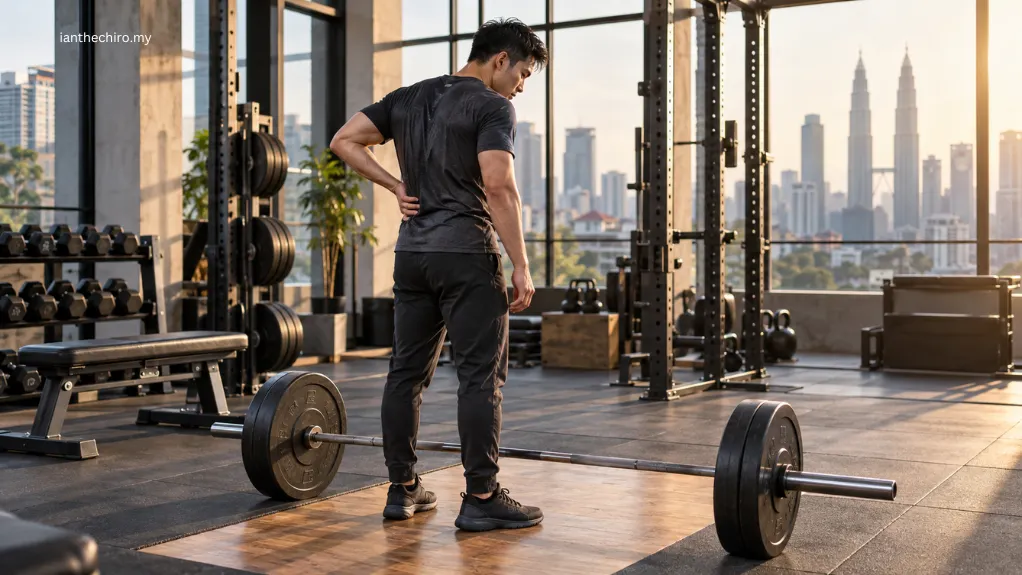
You finish your last set of deadlifts feeling strong. Later that evening, your lower back becomes stiff. By the next morning, getting out of bed or bending to put on your shoes feels uncomfortable. Did you train your back muscles hard, or have you injured something?
Lower back pain after deadlifts can reflect ordinary muscle soreness, a temporary flare of a sensitive back, or an injury that deserves assessment. The fact that it followed a deadlift does not tell you which explanation is correct. Our back pain, slipped disc and sciatica guide explains why even familiar pain locations cannot identify one spinal structure with certainty.
The useful clues are the timing, location, type of symptoms, your recent loading history and what happens when you move again. This guide is about the deadlift itself: the pull from the floor, the lowering phase, changes in training dose and a sensible progression back to lifting.
Quick Answer: Is Lower Back Pain After Deadlifts Normal?
Some lower-back muscle soreness after deadlifts can be an expected response, particularly when you are new to the lift, returning after time off or increasing training demands. Deadlifts ask the muscles of the back and hips to produce and resist force. A dull, fairly widespread ache that develops hours later, peaks over the next day or two and gradually fades may fit delayed-onset muscle soreness.
But soreness and injury cannot be distinguished by timing alone. A sudden sharp pain during a repetition, pain that is worsening rather than settling, significant restriction, or symptoms travelling with numbness or weakness need a different response. Even a gradual ache may deserve review if it repeatedly disrupts sleep or daily activity.
Avoid immediately testing another heavy single to find out whether your spine is okay. First compare what changed in your workout with how your back behaves during normal movement.
What the Deadlift Actually Asks of Your Lower Back
During a deadlift, the hips and knees move while the trunk manages the weight and the forces acting through the body. The back muscles help control trunk position. Feeling those muscles work is not automatically evidence of excessive stress or damage.
A deadlift is not one unchanging movement. Conventional, sumo, trap-bar, Romanian and rack-pull variations change the starting position, range and relative demands on the hips, legs and trunk. A lifter can tolerate one version better than another without proving a particular diagnosis.
The Pull From the Floor
The start requires you to establish balance, reach the bar and produce enough force to lift it. A bar too far from the body, a rushed first repetition or an unexpectedly heavy load can make the task feel harder to control. These factors are worth reviewing, but they do not diagnose injury.
The Lockout
Near the top, you straighten the hips to finish the lift. Some people aggressively lean backward at lockout to demonstrate completion. This extra movement is not essential for general strength training and may be uncomfortable when the back is already sensitive. Aim to finish standing tall rather than forcing an exaggerated arch.
Lowering the Weight
Lowering a bar under control exposes muscles to a different task from lifting it. An unfamiliar volume of controlled lowering, particularly with Romanian deadlifts or long ranges, can make post-workout soreness more noticeable. Dropping or losing control of a bar also has obvious gym safety implications.
The phase that feels hardest matters more than blaming every deadlift on one posture rule. Note whether discomfort began before the bar moved, midway up, at lockout, while lowering or only later.
Does the Timing Look Like Muscle Soreness?
Delayed-onset muscle soreness, often called DOMS, commonly follows an unfamiliar or unusually demanding workout. A review of eccentric muscle contractions describes soreness that often appears around 12 to 24 hours later, peaks between 24 and 72 hours, and then improves over the following days. These are typical ranges, not a diagnostic timetable.
If you went from two light sets of Romanian deadlifts to five demanding sets, a broad ache through the lower-back and hip muscles the following morning is plausible. It may feel worse when sitting down, rising, bending or using the affected muscles. This alone does not establish how much microscopic muscle change occurred.
Our muscle soreness versus injury guide discusses the general differences. In a deadlift-specific situation, ask whether the sensation is broadly muscular and gradually improving, or whether one particular movement creates a distinct sharp catch or spreading symptoms.
Soreness does not mean the workout was exceptionally effective. Nor does being sore prove poor technique. The next session should be planned around what you can control and recover from, not around how much soreness you can tolerate.
Which Pain Patterns Change the Decision?
People often ask whether pain is in the middle or on one side of the lower back. That detail matters, but the symptom’s behaviour is more useful than a small dot on a pain map.
A Broad, Dull Ache Around the Back and Hips
A widespread tender or heavy feeling after an unfamiliar session may resemble ordinary training soreness. Moving around may feel stiff at first and become easier as you warm up. See whether walking, reaching and daily tasks are gradually returning to normal across the next few days.
A Local Sharp Pain During One Repetition
A sudden painful catch during the pull is different from waking up sore the next morning. Stop that set safely rather than finishing the prescribed repetitions. It might reflect several irritated structures, and a painful moment does not reveal the exact tissue or severity. Note whether you can still move and whether pain escalates afterwards.
Pain Travelling Into the Buttock or Leg
Pain that travels down a leg, especially with tingling, numbness or changes in strength, may involve a nerve-related presentation. It should not be explained away simply as a tight hamstring. Our muscle pain versus nerve pain comparison helps describe how these sensations can differ.
Pain That Keeps Increasing Between Sessions
If ordinary bending, sleep or walking becomes progressively more difficult, do not repeatedly use heavy deadlifts as a test. Training soreness ordinarily trends toward resolution; worsening function deserves review even without a dramatic lifting incident.
No single symptom proves a strain, disc injury or normal soreness. The combination of location, onset, neurological features and trajectory determines what needs attention.
Did Your Deadlift Workload Change More Than You Realised?
A personal-record attempt is an obvious change. More subtle ones include adding sets, moving the exercise earlier in the workout, reducing rest, returning after a holiday or shifting from trap-bar pulls to full-range conventional deadlifts. The total challenge can rise even when the weight printed on the plates stays the same.
Consider a lifter who usually performs three sets of five at a comfortable intensity. This week they do extra back-off sets, Romanian deadlifts and bent-over rows after the heavy sets. Each exercise may be reasonable, but the combined work is not the same training dose as before.
Rep quality may also change as fatigue accumulates. A technique that looks and feels controlled during the first few repetitions can become less repeatable later. This is a reason to reassess the session, not proof that fatigue always causes injury.
Ask what happened over the previous two to four weeks: load, sets, repetitions, exercise order, sleep, recovery, other sports and missed training days. Many lifters remember their heaviest weight but overlook their total exposure. An increase in demands can expose an irritable back without telling you that a disc has been damaged.
Does a Rounded Back Mean You Injured Yourself?
Deadlift technique matters for balancing a load and controlling a heavy object. But there is no simple rule that one visible amount of spinal rounding diagnoses injury or that a perfectly straight-looking back makes a lift injury-proof.
Spinal position changes somewhat with body proportions, the height of the bar, fatigue and the lifting variation. A long-armed lifter with different hip mobility may not resemble an athlete in a demonstration video. The appearance of a single video frame does not show whether the lifter’s tissues can tolerate the task.
That does not mean technique is irrelevant. If you repeatedly lose balance, let the bar drift far away, cannot control the descent or develop pain at a consistent phase, an adjustment may help. Consider a more manageable load, bar position, stance, range or tempo. Use a coach’s input where useful, but avoid a ritual of obsessively correcting tiny angles.
Instead of asking whether your back was perfectly neutral, ask: Could you control the bar, repeat the motion comfortably, and tolerate the session afterwards? If not, reduce the demand and investigate the specific limitation.
Can You Still Train While Your Lower Back Is Sore?
If this is uncomplicated muscle soreness and you are otherwise functioning well, returning to exercise at an easier intensity may be reasonable. But the workout should not be treated as a challenge to lift through pain.
A practical question is whether you can perform unloaded hinges, walking and ordinary lifting without increasingly sharp discomfort. If so, an easy exercise session may help maintain your routine. If those simple tasks remain difficult, another heavy pull session is unlikely to be the most informative next step.
A 2021 clinical practice guideline for low-back pain supports active education, appropriate exercise and individually selected activity. It does not identify one universally superior exercise for every person with back pain. Its recommendations concern low-back pain generally, not a deadlift-specific return protocol.
Our broader guide to lifting weights with back pain explains options for training when pain is already present. This article’s additional question is whether your last deadlift session created unfamiliar soreness, revealed sensitivity to a certain range, or produced symptoms that warrant examination.
Consider a simple rule for the next session: choose a variation you can control, and assess how you feel later and the following morning. Finishing a set without pain is encouraging, but it does not automatically prove the overall session load was appropriate.
A Return-to-Deadlift Progression Worth Testing
There is no fixed percentage or universal number of rest days that fits every lifter. The goal is to restore the task progressively while checking the response. This is a set of options, not a personalised rehabilitation prescription.
Start With a Comfortable Hinge
You might begin with an unloaded hip hinge, a light kettlebell from an elevated surface or a very light trap-bar pull if those are comfortable. The initial aim is steady control without a symptom flare, not maximum muscle fatigue.
Adjust the Range Before the Intensity
A block pull or rack pull from a higher starting position reduces how far you need to reach to the weight. This may be useful if discomfort appears mainly near the floor. A different lifter may prefer a lighter full-range movement. The result is individual and does not prove that deeper movement is dangerous.
Reintroduce the Barbell With Room to Spare
Once an easier variation is consistently tolerated, restore a light barbell pull and a manageable number of sets. Avoid grinding repetitions or adding back volume and intensity at the same time. Think in terms of repeatable sessions rather than an immediate return to your personal best.
Review the Next-Day Response
Compare the next morning with your baseline. Some normal training sensation may be expected, but a pronounced increase in pain, a new leg symptom or reduced everyday function suggests the progression needs adjustment or assessment.
Return to a lift is a sequence of tolerable exposures, not one successful heavy repetition. Competition lifters may eventually need to restore full-range heavy pulling, but the route there should reflect their training demands and clinical findings.
Will a Belt, Better Bracing or Different Shoes Fix It?
A lifting belt can help some people create trunk pressure and feel more confident under heavy loads. It is not an injury-proof shield, and needing a belt does not mean your back is fragile. Similarly, holding your breath and bracing aggressively through every daily movement is not necessary.
When you return to a barbell, practise breathing and bracing in a way that lets you control the intended load without dizziness or excessive strain. A coach may help with setup, especially if you are learning a heavy strength movement. For people with medical conditions affected by breath-holding or blood-pressure changes, exercise advice should be individualised.
Flat stable footwear and a predictable lifting surface can change how secure you feel. But switching shoes, adding a belt or copying a famous lifter’s stance cannot explain every episode of back pain. Equipment may improve control; it does not substitute for managing the training dose.
How Long Should the Soreness Last?
Ordinary delayed muscle soreness often builds during the first day, is most noticeable during the following day or two, then subsides over several days. It may take longer after an unusually demanding session. There is no exact stopwatch that separates soreness from injury.
Look for improvement in practical activities rather than waiting for every trace of sensation to disappear. Are you walking and bending more comfortably? Does the ache become less intrusive between workouts? Can you control lighter hinges without symptoms spreading?
A brief recurrence of discomfort during recovery does not necessarily mean new damage. However, pain that remains intense, steadily worsens, keeps waking you or substantially limits normal movement should not be labelled DOMS indefinitely. Similarly, a back that feels fine during the first few hours can still become more symptomatic later.
If you are trying to return to a meet or heavy training programme, your timeline should be based on what you can repeatedly tolerate, not solely on the calendar.
⚠️ When Does Deadlift-Related Back Pain Need Medical Attention?
Seek emergency medical assessment for new bladder or bowel control problems, loss of sensation around the saddle or genital region, or new severe or rapidly progressing leg weakness. These symptoms require a different priority from routine post-exercise soreness.
Seek prompt medical review for severe pain after significant trauma, fever or feeling seriously unwell with back pain, or rapidly worsening function. After extreme exertion, unusually severe widespread muscle pain or swelling accompanied by dark urine or marked weakness can indicate a serious muscle problem and also requires urgent care.
Back pain with persistent pain travelling below the buttock, increasing numbness or weakness deserves a timely clinical assessment. The fact that it started after deadlifts does not rule out neurological or other causes. Do not repeatedly load the bar to test whether your symptoms are improving.
For most mild post-workout aches, these findings will not be present. The practical distinction is between a back that is gradually becoming more capable and one developing new or concerning signs.
What Should a Deadlift-Specific Assessment Check?
A useful assessment starts with the exact history of your last few lifting sessions. How did the first symptom begin? Was there one sharp repetition, or did the ache appear gradually? What changed in the load, volume or variation? What do sitting, walking, coughing, bending and everyday tasks feel like now?
An examination may compare comfortable lumbar and hip movement, strength, functional hinges and, where indicated, sensation, reflexes and other neurological findings. The clinician should also decide whether the presentation is suitable for conservative care or whether medical investigation is necessary.
Routine imaging is not needed for every lifter with post-exercise back pain. Clinical guidelines recommend considering scans when serious causes are suspected or findings would influence management, rather than using MRI to assign an exact painful disc to every sore deadlift.
Treatment is not automatic. Education, graded exercise and practical load changes may be helpful. Manual therapy may be considered in some cases alongside active care, while dry needling targets selected muscle-related symptoms and is not a way to repair a herniated disc. Decisions should follow the assessment, not the name of the lift.
Build Your Next Deadlift Session Around Better Information
Lower-back discomfort after a demanding lift is not a verdict on your strength, your technique or your spine. The useful distinction is whether you are dealing with expected post-exercise soreness, a back that is temporarily sensitive to the current workload, or symptoms that need medical attention.
If this keeps happening every time you deadlift, compare the workout details with the response of your back rather than simply adding another stretch or trying a heavier belt. At Ian The Chiro in Cheras, Kuala Lumpur, a chiropractic consultation can help you review the symptom pattern and decide on appropriate activity and treatment options, including referral when indicated.
Frequently Asked Questions About Deadlift-Related Back Pain
What if I feel pain only when lowering the bar?
The lowering phase challenges control and muscle loading differently from the upward pull. Try comparing a much lighter, controlled version without forcing the painful range. If the discomfort repeats, persists or makes everyday movement difficult, an assessment can clarify whether something beyond normal training soreness is involved.
Should I stretch my hamstrings or lower back after deadlifts?
Stretching is optional, not a required fix. Gentle mobility may feel pleasant, but forcing a deep forward bend while the back is sensitive can aggravate symptoms. Prioritise comfortable activity and observe the next-day response. A stretch that produces shooting leg pain or increasing tingling is not one to push through.
Are trap-bar deadlifts safer than conventional deadlifts?
A trap bar changes your starting position and how the weight sits relative to the body, which may feel more comfortable for some people. It does not make the exercise universally injury-proof. Try a manageable load and compare control, range and recovery instead of choosing an exercise solely because it is labelled safer.
Can I do squats if deadlifts hurt my back?
Possibly. Squats and deadlifts have different movement and loading demands, and one may be easier to tolerate. Begin with an appropriate variation and light resistance rather than testing a heavy squat immediately after a painful deadlift. Stop if the movement aggravates symptoms or changes your ability to function.
Should I use heat or ice for lower-back soreness after lifting?
Either can be used for short-term comfort if it feels helpful and is applied safely to protect the skin. Neither establishes whether you have injured your back or replaces appropriate activity changes. Our guide to heat or ice for back pain explains how to choose based on comfort and precautions.
When should I attempt a heavy deadlift again?
There is no universal number of days. First look for easier everyday movement, control of lighter hinges and no worsening after training. Build load and volume separately over several tolerable sessions. An unexplained sharp injury, progressive weakness or symptoms travelling down the leg warrants assessment before returning to maximum effort.