
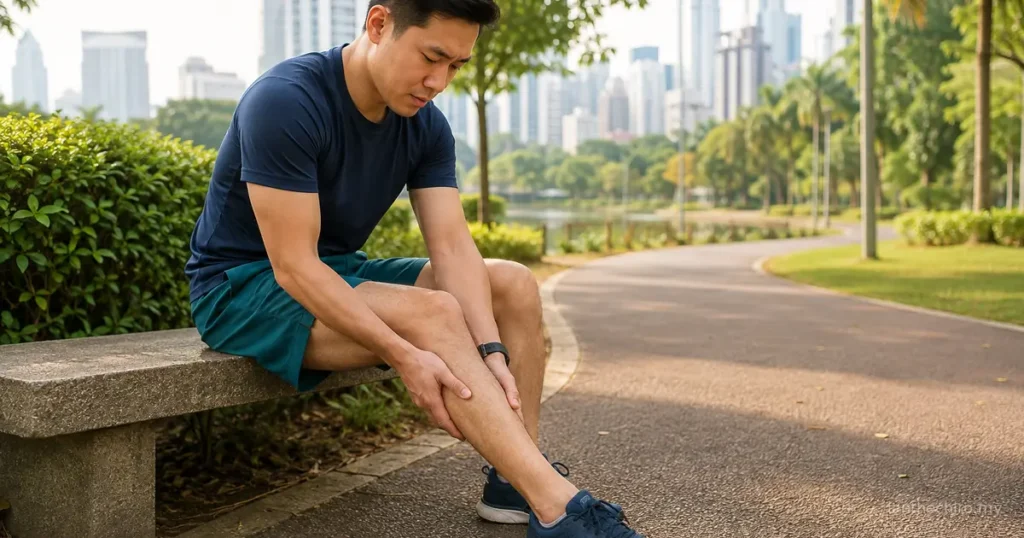
You finish a run and notice a dull ache along the inside of one shin. Perhaps it settles while you walk home, then returns when you use the stairs. Or the discomfort appears earlier with each run until even a short jog feels uncomfortable.
Shin pain after running is a symptom pattern, not a diagnosis. It may reflect a manageable training-load problem, irritation around the muscles and bone, or a more focused bone stress injury that should not be run through. The location, tenderness, timing and response to impact all matter.
At Ian The Chiro in Cheras, Kuala Lumpur, a sports injury assessment looks beyond the sore spot. Your recent mileage, hills, speed work, recovery, footwear, calf capacity and movement are considered together. This article offers general education and cannot diagnose your individual shin pain.
Quick Answer: What Does Shin Pain After Running Mean?
Shin pain after running commonly appears when repeated impact has increased faster than the lower leg can adapt. Possible patterns include:
- diffuse irritation along the inner border of the shin, often called medial tibial stress syndrome or shin splints
- a more localised tibial bone stress injury
- overload of the calf or muscles beside the shin
- irritation of a nearby tendon
- exercise-related pressure within a muscle compartment
- less commonly, nerve or circulation-related symptoms
The most useful first question is not simply, “Is this shin splints?” It is, “Does this behave like a broad load-related irritation, or is there a focal pattern that needs medical assessment?”
Why Can Running Make the Shin Hurt?
Running repeatedly loads the tibia, calf, foot and ankle. These tissues normally adapt when training increases gradually and recovery is adequate. Trouble can begin when the size or frequency of the loading change exceeds current capacity.
That does not mean one hard session has permanently damaged your leg. It means the recent balance between demand and recovery deserves attention. Common changes include:
- adding distance, frequency or speed too quickly
- returning after illness, injury or a long break
- introducing hills, sprints or harder intervals
- moving from a treadmill to roads or uneven trails
- changing shoes while also increasing training
- adding running on top of demanding gym, court or field sessions
- sleeping poorly or under-fuelling during a high-load period
Training load is more than weekly mileage. Pace, hills, surface, fatigue and the amount of recovery between sessions can change how demanding the same distance feels.
Where Exactly Does the Shin Hurt?
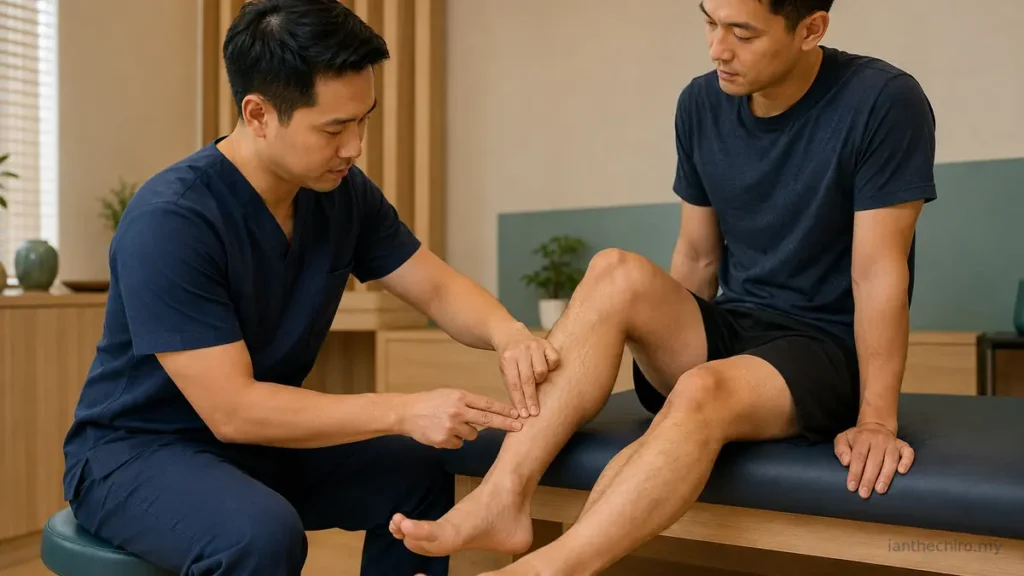
Location does not confirm a diagnosis, but it can narrow the possibilities and guide the examination.
Along a broad area of the inner shin
A diffuse ache or tenderness along several centimetres of the inner lower tibia is commonly associated with medial tibial stress syndrome. It may begin after running, then appear earlier as the irritation becomes more sensitive.
At one small, sharply tender spot
A focal point of bone tenderness raises more concern for a tibial bone stress injury. Pain may become easier to provoke with hopping, walking or daily weight-bearing. A person may also describe pain at rest or at night when the condition has progressed.
At the front or outside of the lower leg
Pain in the muscles beside the shin may relate to muscular overload, tendon irritation or exercise-related compartment pressure. Tightness, burning, numbness, weakness or a predictable onset after a certain running time changes the clinical picture.
Near the ankle, knee or calf
Symptoms close to another joint may be coming from a structure around that region rather than the shin itself. For example, Achilles pain after running behaves differently from pain along the tibia, while knee symptoms may need their own assessment.
What does the timing of shin pain tell you?
Timing can be as informative as location. A runner may only notice discomfort after finishing, during the first few minutes, at a predictable distance, or throughout the day.
Pain that appears after an unfamiliar high-load session may reflect a short-term response to demand. If the next day is comfortable and the symptom does not return with ordinary activity, monitoring and a modest training adjustment may be reasonable.
Pain that begins earlier on successive runs suggests the area’s tolerance is falling relative to the load. A previously comfortable five-kilometre run may start hurting at four kilometres, then two. That shrinking window is a reason to reduce impact and reassess rather than waiting for the pain to become severe.
A warm-up effect also needs context. Some tendon and load-related symptoms ease once movement begins, then return later. Temporary improvement during a run does not prove the tissue has recovered.
Symptoms that switch off quickly after a predictable running time, especially with tightness, burning, numbness or weakness, may raise suspicion for exertional compartment pressure. By contrast, pain that persists during walking, wakes you at night or remains sharply localised at rest is more concerning for bone stress or another condition that needs medical review.
Keep a simple record of when the discomfort starts, its location, what happens after stopping and how the leg feels the next morning. This is more useful than repeatedly rating pain without noting the activity around it.
What Usually Causes Shin Pain After Running?
Several conditions can create a similar complaint. More than one may contribute at the same time.
Medial tibial stress syndrome
Often called shin splints, this usually creates exercise-related discomfort along a broader section of the inner tibial border. The area may feel tender to touch, especially after an increase in running load.
The term does not mean the shin bone is splintering. “Shin splints” is a label for a pain pattern, not evidence that your tibia is cracking apart with every step. The symptoms still deserve proper load management because ongoing provocation can make the area more irritable.
Tibial bone stress injury
Bone stress injuries exist on a spectrum, from an early stress response to a stress fracture. Repetitive loading outpaces the bone’s ability to remodel and recover. Risk is influenced by training, recovery, nutrition, hormonal health, previous bone stress injury and other individual factors.
The international Delphi consensus on bone stress injuries emphasises a structured clinical approach rather than relying on pain intensity alone. A focused site of tenderness, pain with impact and symptoms that progress into walking or rest should lower the threshold for medical review.
Muscle or tendon overload
The tibialis anterior at the front of the shin, deeper muscles along the inner lower leg and the calf complex all work during running. A sudden change in hills, speed or surface can expose them to unfamiliar demand.
Muscular pain may feel broader, tighter or more fatigue-related than focal bone pain. It can still be significant, especially if weakness, swelling or a sudden strain occurred.
Chronic exertional compartment syndrome
Muscles sit within connective-tissue compartments. In chronic exertional compartment syndrome, pressure rises during exercise and can cause predictable tightness, pain, altered sensation or weakness. Symptoms often begin after a similar duration or distance and ease after stopping.
This pattern is not diagnosed from symptoms alone. It requires medical assessment, particularly when numbness, foot weakness or recurrent severe tightness occurs.
Nerve-related or referred pain
Nerve irritation can sometimes cause burning, tingling, numbness or electric discomfort in the lower leg. The source may be local or higher up the leg or spine. Numbness in the leg needs a different assessment from ordinary post-run muscle soreness.
Is It Shin Splints or a Stress Fracture?
People often try to separate these conditions using one home test. In reality, the distinction depends on the full history, examination and, when necessary, imaging.
Features more consistent with a broad shin-splint pattern include:
- tenderness spread along a longer portion of the inner shin
- discomfort mainly linked to running or repeated impact
- symptoms that settle when training demand is reduced
- no clear pain during ordinary walking or at rest
Features that raise concern for a bone stress injury include:
- one clearly localised area of bone tenderness
- pain during walking, hopping or daily weight-bearing
- symptoms appearing earlier and worsening across runs
- pain at rest or at night
- swelling over a focal area
- a history of rapid training increase, under-fuelling or previous bone stress injury
Do not repeatedly hop on a painful leg just to test it. A clinician may use functional loading tests, but repeatedly provoking a suspected bone injury at home does not make the diagnosis clearer or safer.
How Do Training, Form, Footwear and Surface Affect Shin Pain?
They can influence load, but it is usually too simplistic to blame one visible feature.
A shoe change may alter how load is distributed. Hard surfaces can feel less forgiving during a sudden mileage increase. Hills demand more from the calf and lower leg. A runner who is fatigued may move differently near the end of a session.
However, there is no single “perfect” running form or shoe that prevents every shin problem. Footwear and technique should be considered alongside training history, symptoms and physical capacity. Changing several variables at once can make it difficult to identify what actually helped.
If the pain began after both new shoes and a new training block, the combination may matter more than either factor alone.
Why does shin pain keep coming back?
Rest can reduce symptoms without rebuilding the ability to tolerate running. A runner may stop for a week, feel normal in daily life and return straight to the distance or speed that previously irritated the shin. The symptoms then reappear, creating the impression that the area never healed.
Other recurrence patterns include:
- increasing mileage again as soon as pain settles
- rebuilding distance and speed at the same time
- returning to hills before level running is comfortable
- keeping calf or lower-limb strength work inconsistent
- using new shoes as the only intervention
- underestimating load from gym, court or field training
- recovering poorly during periods of high work, travel or sleep disruption
A symptom-free day is not the same as restored running capacity. Capacity returns through appropriate, repeated exposure that the leg can recover from.
Recurrence can also mean the original label was incomplete. Persistent focal pain may need investigation for bone stress. Predictable tightness and altered sensation may require assessment for exertional compartment syndrome. Recurrent symptoms alongside low energy intake, menstrual changes or previous stress injuries deserve a broader medical and nutritional review.
The aim is not to remove every possible risk factor. It is to identify the few factors that are most relevant to this runner and change them in a way that can be sustained.
Can You Keep Running With Shin Pain?
Sometimes running can continue in a modified form, but not every shin-pain pattern should be tested through repeated impact.
Continuing may be more reasonable when:
- discomfort is mild and diffuse rather than focal
- walking and daily activity are comfortable
- symptoms do not worsen during the session
- the leg returns to its usual baseline by the next day
- there are no red flags, neurological symptoms or signs of bone stress
Running should be paused and assessed when pain is sharply localised, changes your gait, worsens with each impact, persists into walking or rest, or is accompanied by swelling, weakness or numbness.
The guide on whether to rest or keep moving when something hurts explains why the choice is rarely complete rest versus ignoring the symptom.
What Should You Do When the Shin First Starts Hurting?
Start by reducing the activity that clearly provokes the pain. That might mean shortening a run, removing speed work, replacing hills with level ground or temporarily switching to a lower-impact activity.
Then monitor:
- the exact location and size of the tender area
- whether walking, stairs or hopping provoke symptoms
- how the leg feels later that day and the next morning
- whether pain starts earlier on each run
- whether swelling, numbness or weakness appears
Cold therapy can reduce discomfort for some people, but it does not determine the diagnosis or restore capacity by itself. Medication may change pain without changing tissue readiness, so it should not be used to mask symptoms and force the same training.
A sensible early adjustment is a decision tool, not a defeat. If symptoms settle when demand is reduced, you have useful information for planning the next step.
When Does Shin Pain Need Imaging?
Many broad, load-related shin complaints can be assessed clinically first. Imaging becomes more relevant when the diagnosis is uncertain, a bone stress injury is suspected, symptoms are focal or severe, or progress does not match expectations.
Early X-rays can be normal in bone stress injuries. MRI is more sensitive for identifying bone stress and grading its extent when imaging is warranted. The decision should be based on the clinical picture rather than ordering a scan automatically for every sore shin.
This is similar to the wider principle discussed in whether an X-ray is needed before seeing a chiropractor: imaging is useful when it will answer a meaningful clinical question or change management.
What Does a Proper Shin Pain Assessment Include?
An assessment should connect the symptom pattern with recent load and physical findings. It may include:
- training volume, speed, hills, surface and recent changes
- footwear changes and running schedule
- previous injuries and bone stress history
- sleep, recovery and relevant nutrition or menstrual-health factors
- tenderness along the tibia and surrounding muscles
- ankle, knee and hip movement where relevant
- calf strength and endurance
- walking, balance, squat or controlled impact tasks when safe
- neurological and circulation checks if symptoms suggest them
No single movement or tender spot tells the whole story. The purpose is to decide which tissue pattern is most plausible, whether running is currently appropriate and what needs to change.
How Is Shin Pain After Running Usually Rehabilitated?
Rehabilitation depends on the likely cause. A broad medial shin pain pattern may involve temporarily reducing impact, then rebuilding calf and lower-limb capacity while running is reintroduced progressively.
A bone stress injury requires a more cautious, medically guided progression. Exercise-related compartment syndrome, nerve symptoms or a sudden muscle injury need different decisions again.
Common rehabilitation components may include:
- adjusting running load and recovery
- maintaining fitness with tolerable alternatives
- progressive calf and foot strengthening
- improving lower-limb strength where deficits are relevant
- restoring tolerance to hopping and impact when appropriate
- planning a gradual return to distance, then speed and hills
Exercise should be selected because it matches the assessment, not because every runner with shin pain needs the same generic routine.
How Do You Return to Running Safely?
Before returning after a suspected or confirmed tibial bone stress injury, clinicians commonly look for comfortable walking, resolution of relevant bone tenderness, adequate strength and function, and correction of important contributing factors. The exact requirements vary with the injury location and risk.
A 2024 scoping review on returning to running after tibial bone stress injury supports an individualised walk-run progression, with distance developed before speed and intensity.
For less serious load-related shin pain, the progression may be shorter, but the principles remain useful:
- Begin from a level of running that does not cause meaningful worsening during or by the next day.
- Use easy, level sessions before adding hills or intervals.
- Increase one main variable at a time.
- Keep recovery days between early runs when needed.
- Step back if pain becomes more focal, begins earlier or carries into walking.
A successful return is not the first pain-free run. It is the ability to repeat appropriate running loads without the shin becoming progressively more sensitive.
Can Chiropractic Care, Dry Needling or Massage Help?
These options are not interchangeable, and none should be automatic.
Chiropractic assessment may be useful when ankle, knee, hip or spinal movement appears relevant to the overall presentation. An adjustment may be considered for a suitable joint-related finding, but it does not heal a tibial stress injury or “put the shin back in place”.
Dry needling may sometimes be considered for a relevant muscular pain component. It should not be presented as treatment for bone stress, and needles should not simply be placed into the most painful area without a clear reason.
Massage may temporarily change muscle soreness or perceived tightness. It does not replace load modification or progressive rehabilitation. If pressure directly over the shin is very painful, aggressively massaging the bone can worsen irritation without solving the cause.
The hip, knee, ankle and heel pain guide explains how treatment choices depend on the pattern found during assessment.
⚠️ When Should Shin Pain Be Checked Urgently?
Seek urgent medical care after major trauma, if you cannot bear weight, the leg is visibly deformed, pain is severe and rapidly worsening, or the foot becomes cold, pale, weak or numb. Sudden marked swelling, warmth or redness in one calf, especially with chest pain or shortness of breath, also needs urgent assessment.
Prompt medical review is also sensible for focal bone pain, pain at rest or at night, progressive swelling, recurrent numbness or weakness, or a tight bursting sensation that predictably appears with exercise.
Shin pain that changes how you walk, persists outside running or becomes sharply localised should not be treated as routine soreness.
What Should You Avoid While the Shin Is Irritated?
Avoid turning every run into another diagnostic test. Repeatedly running until the pain appears can keep the area sensitive and make the pattern harder to settle.
Also avoid:
- masking pain with medication to complete the same session
- repeatedly hopping on a suspected bone injury
- aggressively rolling or pressing a focal tender spot
- changing shoes, technique, mileage and exercises all at once
- copying a return-to-run plan without considering your starting point
- assuming a few pain-free days mean full running capacity has returned
If the problem keeps returning after short periods of rest, the article on why pain keeps coming back explains why symptom relief and rebuilt capacity are not the same thing.
How Long Does Shin Pain Take to Settle?
There is no single timeline. A mild load-related irritation caught early may improve relatively quickly once training is adjusted. A persistent medial tibial stress pattern may take longer to rebuild, while a bone stress injury requires a more structured recovery based on its site and severity.
Progress is better judged by milestones than calendar promises. Useful signs include comfortable walking, reduced tenderness, improved calf capacity, tolerance of graded impact and no progressive worsening after appropriate running.
Do not rush the final stage simply because daily life feels normal. Running exposes the shin to repeated impact that ordinary walking may not reproduce.
How Ian The Chiro Approaches Running-Related Shin Pain
The first step is to work out whether the presentation looks like a broad training-load irritation, a muscular or joint-related problem, or a pattern that should be referred for medical assessment and imaging.
The consultation considers your running changes, pain location, tenderness, walking tolerance, strength and relevant movement. Treatment is then matched to the findings. That may involve education, load adjustment, exercise rehabilitation or selected hands-on care. A suspected bone stress injury, compartment syndrome or circulation problem is not treated as ordinary muscle tightness.
If shin pain is recurring, becoming more focal or stopping you from progressing your running, a chiropractic consultation can help clarify the likely pattern and the safest next step. You can also WhatsApp Ian The Chiro to ask whether an assessment is suitable.
Common Questions About Shin Pain After Running
Is shin pain after running always shin splints?
No. Shin splints are one common explanation, but bone stress injury, muscle or tendon overload, exertional compartment syndrome and nerve-related symptoms can produce pain in the same region.
Can I run if the pain goes away after warming up?
Warming up does not prove the tissue is ready for the same load. Consider whether symptoms return later, appear earlier on the next run or persist into walking and the following morning.
Does a stress fracture always hurt badly?
No. Pain intensity alone does not reliably separate a bone stress injury from other causes. A focal tender area, progressive impact pain and symptoms during walking or rest are more concerning clues.
Should I stretch my calves for shin pain?
Gentle movement may feel helpful when calf stiffness contributes, but stretching is not a universal treatment. It will not address a bone stress injury, and forcing a painful stretch can irritate some presentations.
Are new running shoes enough to solve the problem?
Not usually on their own. Footwear may influence load or comfort, but training change, recovery and lower-limb capacity still matter. Change one variable at a time where possible.
Should I foam-roll directly over the shin bone?
Avoid aggressive pressure over a focal painful area. Rolling nearby muscles may feel comfortable for some people, but repeatedly pressing the sore bone does not speed adaptation.
When should I see a doctor rather than keep monitoring it?
Seek medical review when pain is focal, worsening, present during walking or rest, associated with swelling, or accompanied by numbness or weakness. Urgent symptoms require urgent care.
Can low energy intake affect bone stress risk?
Yes. Inadequate energy availability can impair recovery and bone health. This is particularly important when training volume is high, periods become irregular or absent, weight changes unexpectedly, or there is a history of bone stress injury.
How can I reduce the chance of shin pain returning?
Build running load progressively, keep recovery proportionate to training, maintain calf and lower-limb capacity, fuel adequately and respond early if symptoms begin appearing sooner or becoming more localised.