
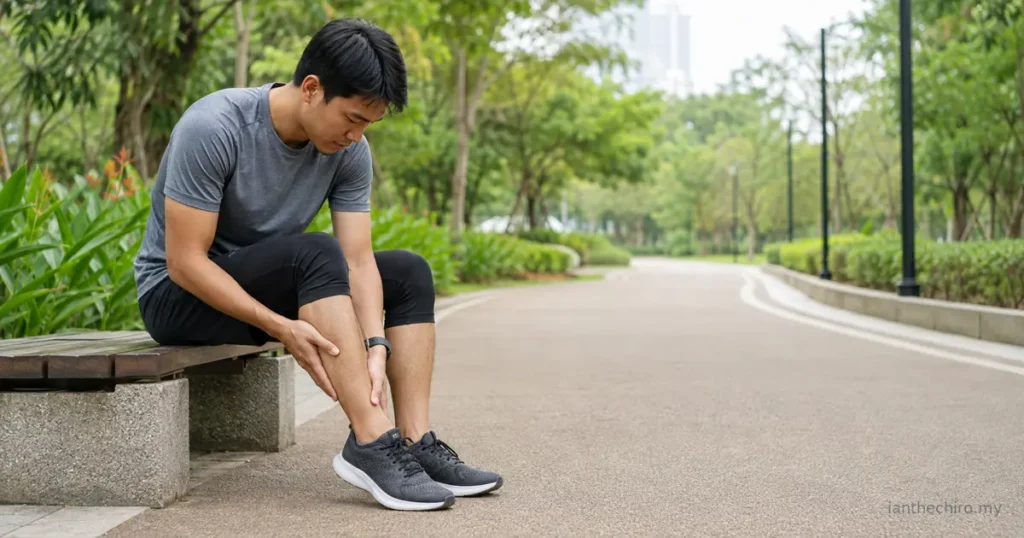
You increase your running distance, add a few hill sessions, and begin to notice an ache along the inside of your shin. At first, it settles after warming up. A week later, one spot feels sharper and even walking is uncomfortable. Is it still “shin splints”, or could it be a stress fracture?
The question of shin splints vs stress fracture matters because the two problems can overlap early, but they do not always need the same response. A broad load-related shin irritation may improve with sensible training changes and rehabilitation. A bone stress injury may need running to stop, medical assessment and a more protected return.
At Ian The Chiro in Cheras, Kuala Lumpur, sports injury assessment begins with the full pattern rather than one home test. Location, tenderness, walking tolerance, recent training, recovery and bone-health factors all help shape the next step. This guide is general education and cannot diagnose your individual pain.
Quick Answer: Shin Splints vs Stress Fracture
Shin splints usually describe medial tibial stress syndrome, a load-related pain pattern spread along a broader section of the inner shin. A stress fracture is a more advanced injury within the bone-stress spectrum and often produces a smaller, more clearly localised painful area.
Features that lean more towards shin splints include:
- tenderness across a longer area of the inner shin
- pain linked mainly with running or repeated impact
- symptoms that ease when training demand is reduced
- little or no pain during ordinary walking or at rest
Features that raise more concern for a bone stress injury include:
- one small area of marked bony tenderness
- pain appearing earlier as training continues
- discomfort with walking, hopping or daily activities
- pain that persists after exercise or occurs at rest
- swelling over a focal area
No single sign confirms the diagnosis. Symptoms exist on a spectrum, and early bone stress injuries can be subtle. If the pain is focal, progressive or affecting walking, stop testing it with more running and arrange an assessment.
What Do “Shin Splints” and “Stress Fracture” Mean?
The everyday labels sound as though they describe two completely separate conditions. In reality, both can involve how the tibia and surrounding tissues respond to repeated load.
What are shin splints?
“Shin splints” most commonly refers to medial tibial stress syndrome, or MTSS. Pain is usually felt along the posteromedial border of the tibia, meaning the inner-back edge of the shin bone. It is often associated with running, jumping, marching or a sudden increase in repetitive impact.
The pain is thought to involve a load-related response of the tibia and nearby tissues rather than a literal splintering of the shin. The area may be tender, but the tenderness tends to cover a longer section rather than one tiny point.
What is a bone stress injury or stress fracture?
Bone continually remodels in response to load. When repeated loading exceeds the rate at which bone can repair and adapt, a bone stress injury can develop. This spectrum ranges from an early stress reaction to a visible fracture line.
The term “stress fracture” is often used broadly, but not every bone stress injury has a fracture line. That distinction matters because an early injury may not appear on an ordinary X-ray, even though the bone is already struggling with load.
Most running-related tibial bone stress injuries occur on the posteromedial side and are considered lower risk when managed appropriately. An injury on the front edge of the tibia can be higher risk and may need stricter protection or specialist input.
Where Does the Pain Usually Sit?
Location is one of the most useful clues, but it should not be interpreted alone.
With shin splints, tenderness commonly follows a broader strip along the lower or middle inner shin. People may describe an area several centimetres long rather than one exact point. Both shins can be affected, although one side may be worse.
With a stress fracture, the pain is more likely to be sharply localised. You may be able to point to one small spot with a fingertip. Swelling can occur, but its absence does not rule the injury out.
Pain at the front of the tibia deserves particular caution because some anterior tibial stress injuries have a higher risk of delayed healing. Pain at the outer shin, deep calf, behind the knee or near the ankle may also suggest another cause.
The existing guide to shin pain after running explains how muscle, tendon, nerve and exercise-related pressure problems can overlap in the same region.
When Does the Pain Appear?
Timing can show whether the shin is tolerating impact or becoming progressively less tolerant.
An early shin-splint pattern may hurt at the beginning of a run, ease as you warm up and return afterwards. As irritation increases, the pain may last longer or begin earlier. This warm-up response is common, but it is not proof that continuing is safe.
A bone stress injury may initially hurt only near the end of a run. With continued loading, the pain can appear earlier, remain after the session and begin affecting walking. More advanced presentations may ache at rest or at night.
A worsening sequence matters more than one isolated run. Pain that moves from “only after 8 km” to “after 2 km” and then to walking discomfort is a reason to stop impact and get assessed.
Does the Size of the Tender Area Tell Them Apart?
Clinicians often consider whether tenderness is diffuse or focal. A longer tender area along the inner shin leans towards medial tibial stress syndrome. A small, sharply tender point increases concern for a bone stress injury.
However, measuring the sore area at home is not a definitive test. People press with different force, the exact boundary can be hard to judge, and both conditions may coexist along the tibial stress continuum.
Repeatedly poking the area can also make it feel more irritable. Use location as one clue, then combine it with walking tolerance, symptom progression, training history and examination findings.
The most important difference is not whether you can tolerate one more run today. It is whether the shin is adapting to load or becoming less able to handle it.
Can a Hop Test Diagnose a Stress Fracture?
Online advice often suggests hopping on the painful leg. If hopping hurts, the conclusion is said to be a stress fracture; if it does not, the bone is supposedly fine.
That is too simple. Hopping can reproduce pain in several lower-leg conditions, and some bone stress injuries may not be identified reliably by one clinical test. Research evaluating common examination tests has found that individual tests do not offer enough certainty to diagnose or exclude tibial bone stress injury by themselves.
Do not keep repeating hops to prove that the pain is serious. If ordinary walking is painful, the area is focally tender or symptoms are progressing, extra impact adds load without answering the question safely.
What Else Can Mimic Shin Splints or a Stress Fracture?
Exercise-related shin pain has a wider differential diagnosis. A 2023 scoping review of exercise-induced leg pain described several overlapping conditions and emphasised using history and examination to distinguish them.
Muscle or tendon overload
The tibialis anterior, tibialis posterior, soleus and other lower-leg tissues can become painful after a change in running load. Muscle-related pain may feel broader or more connected to a particular resisted movement, but location alone is not enough.
Chronic exertional compartment syndrome
This typically causes tightness, pressure, cramping, weakness or altered sensation that appears predictably with exercise and eases after stopping. The pattern often feels different from one fixed tender point on the bone.
Nerve-related or referred pain
Burning, tingling, numbness or electric pain may come from local nerve irritation or a source higher in the leg or spine. The pinched nerve and nerve pain guide explains why sensory symptoms need a different assessment from ordinary post-run soreness.
Circulation-related symptoms
Rare vascular causes can produce exertional pain, cramping, coldness, colour change or altered pulses. These patterns need medical investigation rather than routine muscle treatment.
Calf strain, Achilles pain and ankle or knee problems can also be felt near the shin. If the location is unclear, the broader hip, knee, ankle and heel pain guide helps explain how nearby regions may contribute.
Why Does the Difference Matter?
The difference changes how much impact is sensible and whether imaging or medical referral should be considered.
With uncomplicated shin splints, some people can continue a reduced amount of pain-monitored activity while addressing training load and lower-limb capacity. Complete rest is not automatically required.
With suspected bone stress injury, continuing to run may allow an early stress reaction to progress. The safer response is usually to stop painful impact, protect the area appropriately and clarify the diagnosis.
Pain intensity is not a reliable severity scale. A runner can have a meaningful bone stress injury without dramatic pain, especially early. Conversely, very uncomfortable shin pain does not automatically mean the bone is fractured.
The aim is not to frighten every runner with shin pain. It is to recognise the patterns where “run through it and see” becomes a poor gamble.
Can You Keep Running With Shin Pain?
Consider the trend, not only whether you can finish the session.
A modified run may be reasonable when pain is mild and broad, your stride remains normal, walking is comfortable, symptoms do not increase through the session, and the shin returns near baseline by the next day. Even then, reduce the provoking load and monitor carefully.
Stop running and arrange assessment when:
- pain is clearly focal over the bone
- symptoms worsen as the run continues
- pain begins earlier with each session
- walking, stairs or hopping are painful
- you limp or change your stride
- pain persists at rest or at night
- swelling appears over one area
When in doubt, missing a few runs is usually less costly than extending a bone injury for several weeks.
When Should Shin Pain Be Checked Promptly?
⚠️ Stop impact and seek prompt medical assessment if shin pain is strongly focal, follows a rapid worsening pattern, affects normal walking, occurs at rest or at night, or is accompanied by focal swelling. Seek urgent care after major trauma, for severe unrelenting pain, marked swelling, inability to bear weight, a cold or pale foot, progressive numbness or weakness, or fever with an acutely painful area.
These features do not prove a fracture, but they change the safety and referral decision. A clinician may recommend imaging or specialist review before rehabilitation continues.
How Is Shin Pain Properly Assessed?

A useful assessment begins with the loading story. Important questions include:
- When did the pain begin, and was there a specific training change?
- Is the tenderness broad or localised?
- Does pain occur during running, afterwards, during walking or at rest?
- Has the threshold changed across recent sessions?
- Are there previous bone stress injuries or recurrent shin problems?
- Has recovery, sleep, nutrition, body weight or menstrual function changed?
- Are there medicines or medical conditions that may affect bone health?
The examination may assess walking, the exact tender region, swelling, ankle and knee movement, calf strength, balance and carefully selected impact tasks. It should also screen for nerve, compartment and circulation-related patterns where relevant.
A normal-looking shin does not settle the diagnosis. The purpose of assessment is to combine clues, decide whether imaging is necessary and select the safest level of activity.
When Is Imaging Useful?
Imaging is not automatically needed for every case of broad, improving shin pain. It becomes more relevant when the presentation suggests a bone stress injury, symptoms are focal or progressive, walking is painful, recovery is not following the expected course, or the diagnosis will change management.
Plain X-rays are often the initial test for suspected stress fracture, but early bone stress changes may not be visible. If clinical concern remains after normal or unclear radiographs, MRI can show bone marrow and cortical changes and help grade the injury without ionising radiation.
The 2024 review of return-to-running after tibial bone stress injury also notes that imaging findings can lag behind clinical recovery. Radiological healing is especially important for high-risk sites, while lower-risk injuries are often progressed using symptoms, examination and functional criteria.
An MRI result still needs interpretation in context. Imaging can show bone changes in athletes who do not have the same pain pattern, and the picture should not replace the history and examination.
What Should You Do First?
If you are unsure whether the problem is shin splints or bone stress, start by reducing the activity that reproduces pain. Do not use repeated runs as a diagnostic test.
Useful early steps include:
- pause running and jumping if walking or focal bone tenderness is present
- keep comfortable daily movement within a non-worsening range
- note the exact location and when symptoms appear
- review recent changes in distance, speed, hills, surface and footwear
- avoid taking pain medication simply to complete training
- arrange assessment if symptoms are focal, progressive or not settling
For broad, mild symptoms, lower-impact training may be possible if it does not provoke the shin. Cycling, swimming or other options are not automatically safe for every person, but they can help maintain fitness when suitably chosen.
The guide on whether to rest or keep moving when something hurts explains why relative rest is usually more useful than an all-or-nothing rule.
How Does Rehabilitation Differ?
Both conditions require the provoking load to be understood, but the starting point and progression may differ.
Rehabilitation for shin splints
Management usually involves reducing the aggravating impact, then rebuilding capacity progressively. Depending on the findings, this may include calf and foot strengthening, balance, ankle or hip capacity, and gradual exposure to running-specific load.
Shoes, surface and technique may influence symptoms, but no single correction fits everyone. A training spike, insufficient recovery or low lower-leg capacity is often more useful to address than chasing one “faulty” foot position.
Rehabilitation for a bone stress injury
The first priority is allowing the bone to recover without repeatedly exceeding its tolerance. The amount of protection depends on the injury’s location, severity and walking symptoms. Some people need only removal of painful impact; others may need temporary offloading, medical management or specialist review.
Rehabilitation also addresses contributors such as training progression, strength, nutrition, energy availability and recovery. Bone recovery is not just a waiting period. The later stages must rebuild the ability to tolerate repeated impact before normal running resumes.
Hands-on treatment may help a separate joint or muscle problem, but it does not heal a stress fracture by pushing the bone back into place. Dry needling may be considered for selected muscular contributors, but it is not a treatment for an injured tibial cortex.
When Can You Return to Running?
Return should be based on criteria rather than a promised date. Before running resumes after a tibial bone stress injury, clinicians commonly look for comfortable walking, resolution of relevant bony tenderness, adequate strength and tolerance of functional loading. Higher-risk injuries may also need evidence of radiological healing.
Running often restarts with short walk-run intervals. Distance is usually rebuilt before speed, hills and harder sessions. The 2024 review found that return-to-run decisions should be individualised and that the popular “10% rule” is not universally suitable.
With shin splints, the progression may begin sooner, but the same principle applies: the shin should tolerate the current step before the next one is added. Monitor symptoms during the session, later that day and the following morning.
The goal is not zero awareness at every stage. It is a stable, non-worsening response that allows load to build without the pain threshold moving backwards.
What Makes These Problems More Likely to Return?
Recurrence rarely comes down to one weak muscle or one pair of shoes. Common contributors include:
- sudden increases in running distance, speed, hills or frequency
- returning too quickly after time away
- low calf or lower-limb capacity relative to training demand
- limited recovery between hard sessions
- repeatedly changing several training variables at once
- inadequate energy intake for the amount of exercise performed
- previous bone stress injury
- low bone density or health factors affecting bone metabolism
Foot shape, ankle movement and running mechanics may be relevant for some people, but they should not be treated as automatic causes. The clinical question is whether a factor meaningfully changes load, capacity or the rehabilitation plan for this runner.
For a runner in Kuala Lumpur, practical load changes might include a switch from treadmill running to repeated road hills, an increase in badminton or futsal on top of running, or several hard sessions compressed around work. The body responds to total load, not only kilometres recorded in a running app.
What Should You Avoid?
Avoid these common traps while the diagnosis is unclear:
- running repeatedly to see whether the pain has disappeared
- using a hop test over and over
- aggressively pressing or foam-rolling a focal bony area
- masking pain to complete a race or hard session
- assuming new shoes alone will fix the problem
- stretching harder because the shin feels “tight”
- returning at the previous distance as soon as walking feels normal
- ignoring low energy intake, weight change or menstrual disruption
Myth correction: shin splints do not become a stress fracture simply because you failed to stretch enough. Bone stress develops through an interaction of load, recovery and individual risk factors. Stretching may feel useful for some muscular contributors, but it cannot make an overloaded bone safe to run on.
How Ian The Chiro Approaches Shin Pain
The first task is to decide whether the presentation behaves like a broad medial tibial stress syndrome pattern, a more focal bone stress injury, another lower-leg problem or a condition that needs medical referral.
The consultation considers your pain map, progression, walking tolerance, training changes, previous injuries, recovery and relevant bone-health factors. Movement, strength and carefully chosen loading tests are used only when appropriate.
Treatment is not automatic. A lower-risk mechanical presentation may involve education, load adjustment, exercise rehabilitation and selected hands-on care. A suspected stress fracture, high-risk tibial site, compartment syndrome, circulation problem or another medical concern is referred for the appropriate assessment.
This assessment-first approach helps avoid two unhelpful extremes: treating every sore shin as a fracture, or treating every focal bone problem as a tight calf.
When Should You Arrange a Consultation?
If shin pain is becoming more localised, appearing earlier during activity, affecting your walking or returning whenever you rebuild training, it is worth clarifying the pattern before testing it with another run.
A chiropractic consultation at Ian The Chiro can assess whether the presentation looks suitable for conservative care or should be referred for medical imaging or specialist input. The aim is not to force a label during one painful test. It is to understand the likely tissue involved, protect what needs protecting and plan the next stage safely.
Common Questions About Shin Splints vs Stress Fracture
Can shin splints turn into a stress fracture?
They are not simply two fixed stages of the same condition, but both sit within a broader load-related picture around the tibia. Continuing to overload a painful shin can allow bone stress to progress, so a worsening or increasingly focal pattern should be reassessed.
Can you have shin splints and a stress fracture at the same time?
Yes, overlapping tenderness and bone stress changes are possible. That is one reason the diagnosis should not be based on one point of tenderness or one home test alone.
Does pain in both shins mean it is only shin splints?
No. Bilateral pain can occur with shin splints, but it does not exclude bone stress injury. The location, progression, walking symptoms, training history and risk factors still matter.
Will a stress fracture always show on an X-ray?
No. Early bone stress changes may not appear on plain radiographs. When suspicion remains, a clinician may recommend MRI or another imaging pathway based on the presentation.
Is swelling always present with a stress fracture?
No. Focal swelling increases concern, but many bone stress injuries have little visible change. A normal-looking shin should not overrule progressive focal pain.
How long should I rest for shin splints?
There is no universal number of days. The right reduction depends on pain severity, walking tolerance and what training triggered the symptoms. The broader shin pain after running guide explains how to rebuild load rather than relying on complete rest alone.
Can massage or dry needling tell me which condition I have?
No. Temporary relief after muscle treatment does not exclude bone stress. Assessment must consider focal tenderness, impact tolerance, progression and whether imaging is needed.
What type of clinician should assess possible stress fracture?
A doctor or suitably trained musculoskeletal clinician can begin the assessment. If a bone stress injury is suspected, medical imaging or sports-medicine and orthopaedic input may be needed depending on the site and severity.
What is the safest rule if I am unsure?
If pain is focal, progressive, present during walking or occurring at rest, stop painful impact and get assessed. If symptoms are broad and mild, reduce the provoking load and monitor the response rather than pushing through unchanged training.