
You reach overhead to put something on a shelf and feel pain along the outside of your shoulder. You can still raise your arm, but it hurts. Another person falls onto an outstretched hand and suddenly struggles to lift the same arm at all. Both might hear the words “rotator cuff”, yet the next decision could be quite different.
Comparing rotator cuff tendinopathy vs tear is really about the history of how symptoms began, what strength and movement remain, and whether the injury needs imaging or timely specialist assessment. A painful shoulder does not prove there is a tear, and a tear visible on a scan is not always the main reason someone hurts.
Our shoulder, elbow and wrist pain assessment page explains why the first step is understanding the whole presentation rather than choosing a procedure from a symptom label. This guide focuses specifically on what separates common tendon-related pain from a possible structural tear, including the situations where waiting for exercise alone may not be wise.
Rotator Cuff Tendinopathy vs Tear: The Main Difference
The rotator cuff is a group of four muscles and their tendons that help move and control the shoulder. Tendinopathy describes a tendon-related pain and function problem, often associated with repeated loading or reduced tolerance for particular tasks. It does not automatically establish that the tendon is torn.
A rotator cuff tear means there is a structural discontinuity in one or more cuff tendons. A tear can involve part of the tendon thickness or extend through its full thickness. Some tears occur with a distinct injury, while others are associated with gradual tendon changes and may cause little or no pain.
The distinction is between a painful tendon presentation and a structural finding, not between a “mild problem” and an “always serious problem”. Either can limit daily function, and tendinopathy and partial tearing may overlap in one shoulder. That is why symptoms, examination and imaging cannot be treated as interchangeable labels.
What Does Rotator Cuff Tendinopathy Usually Feel Like?
A common story is a gradual ache around the outer shoulder or upper arm after more gym sessions, painting, carrying equipment, swimming or repeated overhead work. The arm may feel comfortable at rest but hurt when lifted sideways, lowered slowly or used repeatedly.
You might notice that the first few repetitions feel acceptable, then discomfort increases as the shoulder tires. A short reduction in the irritating load may ease symptoms, only for them to return when you immediately resume the same demanding activity. The problem often behaves like a capacity-and-loading issue rather than a sudden loss of a particular movement.
Painful Movement Does Not Automatically Mean Damage
A tendon and the surrounding tissues can be sensitive without a new tear. Pain may alter how much force you produce, how confidently you lift and how smoothly you move. It is possible to have pain during a resistance exercise while the tendon remains structurally continuous.
Aching after a busy day or discomfort when lying on the shoulder can fit tendinopathy, but neither is exclusive to it. Our shoulder pain when lifting your arm article explores the timing and location of movement-related pain. Here the additional question is whether weakness seems proportional to pain or there is an unusual loss of function.
What Does a Rotator Cuff Tear Actually Mean?
Tears vary considerably. Their location, depth, size, how recently they happened and whether muscles have been affected all matter. Two people whose MRI reports both say “rotator cuff tear” may have very different symptoms and treatment needs.
Partial-Thickness and Full-Thickness Tears
A partial-thickness tear involves only part of a tendon’s depth. A full-thickness tear passes through the entire thickness at the affected point, but it does not necessarily mean the entire tendon has detached. The number of tendons involved and the size of the defect can also vary.
Some partial tears are managed initially with rehabilitation, particularly if they are not associated with major weakness. A full-thickness tear after a sudden injury may require a more urgent specialist opinion, especially in an active person who has lost substantial function. But even a full-thickness tear does not automatically mean surgery.
Acute Traumatic and Gradual Tears
A fall, strong pull, heavy lift or sudden overhead movement can produce an acute injury. By contrast, tendon changes and tearing may develop gradually, particularly with age or longstanding load exposure.
The event matters because a new inability to raise the arm after trauma raises a different level of concern from an older scan finding in a person who can still perform normal tasks. A tear’s clinical importance depends on the person and the function lost, not the word “tear” alone.
Did the Shoulder Change Suddenly After an Injury?
A sudden change in ability is one of the most useful details to report. Imagine a recreational badminton player who has developed gradually increasing shoulder pain across several weeks of extra smashes. That story can fit load-sensitive tendon pain, although it does not rule out a tear.
Now compare a person who falls, catches their weight with one arm and immediately finds that raising or holding the arm is much harder than before. Marked weakness following trauma deserves prompt medical evaluation for a substantial rotator cuff injury or another acute problem, such as fracture or dislocation.
An audible pop is not required for a tear, and hearing one does not confirm a tear. A bruise or swelling may be absent even when an important injury is present. The key question is what you can do now compared with just before the event.
Our shoulder pain after badminton guide discusses how gradual training-load changes and sudden sporting incidents lead to different immediate decisions. New, significant functional loss after trauma should not be managed as a routine overuse flare without assessment.
Is Weakness More Important Than Pain?
Pain intensity can be surprisingly misleading. Someone with irritated tendons may report severe pain but still generate useful strength when tested in a comfortable position. Another person may feel only modest discomfort yet be unable to raise the arm or resist an ordinary movement.
Pain-Limited Strength
When a shoulder hurts, your nervous system may reduce effort and you may stop lifting early. This is often called pain inhibition. The result can feel like weakness even without a major tear.
A clinician might compare several arm positions, how symptoms change when a load is reduced and whether the movement becomes stronger when pain is less provocative. None of these observations proves the tendon is intact, but they help explain why one weak-looking home test is insufficient.
A New Loss of Function
A more concerning pattern is an obvious sudden reduction in the ability to lift, rotate or hold the arm after an injury. Someone who could previously reach their hair may now be unable to bring the hand there without using the other arm. That deserves assessment even if the pain is settling.
A persistent difference in strength, repeated dropping of the arm or inability to perform essential work tasks may also make structural injury more relevant. The combination of onset, objective strength and practical function is more useful than pain severity by itself.
Can Passive Movement Help Separate These Conditions?
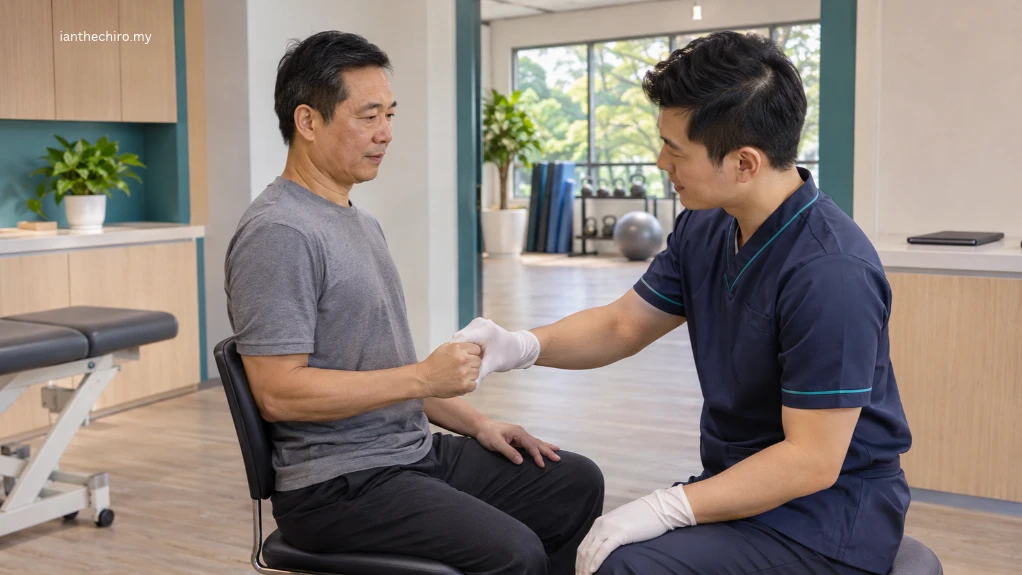
Active movement means raising or rotating the arm yourself. Passive movement means the arm is moved carefully by an examiner while you relax. With common cuff-related pain, passive movement may remain relatively available even when active lifting is painful.
A substantial tear may produce a larger gap between what you can lift actively and what the shoulder can physically move through with help. Yet pain, guarding and other shoulder disorders may cause similar observations. A clinician needs to assess this safely rather than rely on an improvised partner test.
Marked restriction of both active and passive movement may point towards a broader stiff-joint problem, including frozen shoulder. That issue is addressed in our frozen shoulder vs rotator cuff pain comparison. The purpose here is to recognise that a stiff joint and a weak or painful tendon are not the same assessment question.
Do not ask a friend to force your arm overhead or into external rotation after a recent injury. If the shoulder cannot move comfortably, the next step is an examination, not an aggressive test of its limit.
Does Night Pain Mean a Rotator Cuff Tear?
Not necessarily. Rotator cuff tendinopathy, partial tearing, full-thickness tearing, frozen shoulder and other causes of shoulder discomfort can all disturb sleep. Lying on the affected side compresses sensitive tissues and may become uncomfortable even when no significant tear is present.
Night pain becomes more informative when combined with the rest of the story. Did it follow a fall? Is the shoulder becoming distinctly weak? Has the available movement narrowed across weeks? Is the pain severe regardless of position, with fever or systemic illness?
For people whose main difficulty is sleeping comfortably, our shoulder pain at night guide explores positioning and symptom patterns in more detail. A pillow supporting the arm may improve comfort, but a good night’s sleep does not prove the tendon has healed or exclude a tear.
Night pain is a reason to describe the problem, not a test that identifies the diagnosis.
Can Clicking, a Painful Arc or a Home Test Prove a Tear?
You may have seen videos recommending an empty-can test, a drop-arm test or resisting shoulder rotation. These movements can provide information in a clinical examination, especially when combined with a detailed history and other findings. But a single painful or weak test does not reliably identify a tendon tear.
A click can occur without an injury. Pain through the middle of lifting can occur in several cuff-related presentations. One test may look positive because the person is guarded, tired or in pain, while a different movement is relatively comfortable.
The 2025 AAOS rotator cuff injuries guideline supports a combination of examination findings instead of relying on one test for diagnostic accuracy. The 2025 rotator cuff tendinopathy clinical practice guideline similarly emphasises history, physical assessment, functional impact and consideration of other shoulder and neck problems.
The more useful self-observation is ordinary function: Can you reach a cupboard, hold a light object near shoulder height, get dressed and move without new symptoms below the elbow? Keep the observation brief. Repeatedly testing the most painful position can provoke the shoulder without making the diagnosis more certain.
When Does Ultrasound or MRI Actually Help?
Not every sore shoulder needs imaging on the first visit. For typical gradual cuff-related pain without significant trauma or major functional loss, the initial decision can often be based on history, physical examination and a plan for appropriately dosed activity.
The 2025 rotator cuff tendinopathy clinical practice guideline advises against routine imaging solely to confirm tendinopathy at the beginning of care. It also supports considering imaging when symptoms have not improved after an adequate period of appropriate nonsurgical care, or earlier when the presentation suggests significant structural injury.
What Can a Scan Confirm and What Can It Not?
Diagnostic ultrasound and MRI can help identify structural rotator cuff abnormalities. The 2025 AAOS guideline on rotator cuff injuries considers imaging a useful addition to clinical examination when identifying a tear would alter decisions.
However, scans can show tendon changes or tears in people who have no shoulder pain. Conversely, a patient may be in considerable discomfort without a major tear visible. The report needs to be read alongside symptoms, strength, movement and goals. A word such as “partial tear” is not a personal recovery prediction.
Ultrasound may be a reasonable first investigation for a suspected cuff disorder when an experienced operator is available; MRI can be particularly relevant when a specialist needs more detail about an injury or additional structures. X-rays do not show rotator cuff tendons directly, but they may be indicated after trauma or when bony disease is suspected.
The best reason to request a scan is that its result could change management, such as referral timing, exercise restrictions or a possible surgical discussion. Routine scanning merely to confirm an already manageable sore shoulder is less useful.
What Can You Do Before the Diagnosis Is Confirmed?
If there has been no significant injury or warning sign, keep the arm involved in comfortable daily activities while temporarily modifying tasks that repeatedly escalate pain. For example, lower a frequently used shelf item, reduce heavy overhead pressing and split prolonged painting or cleaning into shorter blocks.
Avoid swinging between complete immobility and forcing through sharp pain. Comfortable shoulder movement can help maintain confidence and reduce unnecessary guarding. Sleep may be easier with a pillow supporting the arm and avoiding direct pressure on the painful side.
If the symptoms followed a distinct fall or forceful pull and the arm is now substantially weaker, do not test heavy lifts, vigorous stretches or repeated hanging exercises to see whether it “comes good”. Arrange prompt medical assessment and protect the shoulder from provocative loads until the injury is clarified.
Our guide to whether to rest or keep moving when something hurts discusses the broader principle of adjusting activity without treating every uncomfortable movement as harmful. What is sensible for a gradual overload episode may not be suitable immediately after a suspected traumatic tear.
How Does Rehabilitation Differ for Tendinopathy?
When the pattern fits uncomplicated rotator cuff tendinopathy, the central goal is gradually rebuilding the shoulder’s capacity for the tasks that matter. Exercise is not just a generic list of stretches. The starting range, resistance and frequency should reflect how irritable the shoulder is and what the person needs to return to.
A person who feels pain with heavier lateral raises may begin with lighter, controlled work that is tolerable and progresses over time. Someone who needs overhead strength for badminton may eventually require higher-speed tasks and endurance, not just a pain-free movement test in the clinic.
The 2025 tendinopathy guideline supports an active rehabilitation programme with patient education and activity modification. Individual exercises may include comfortable isometric or dynamic strengthening of the rotator cuff and surrounding shoulder muscles, but the programme is adjusted according to function and response.
Track whether reaching, carrying, lifting and sleep are becoming easier, not merely whether the shoulder feels loose for an hour after treatment. Repeated flares after the same workload indicate a need to reconsider the dose or assessment.
Manual techniques may sometimes help short-term symptoms or movement. They cannot replace the adaptation needed for lifting, work or sport, and dry needling or a chiropractic adjustment does not repair a torn cuff tendon.
Can a Rotator Cuff Tear Improve Without Surgery?
Yes, some people with partial-thickness tears or chronic full-thickness tears improve in pain, strength and daily function with rehabilitation and activity changes. The decision depends on symptoms, tear characteristics, age, activity needs, other health considerations and the response to treatment.
A person with a small imaging finding who can steadily rebuild movement and manage ordinary life may not need the same pathway as a young manual worker who suddenly cannot raise the arm after a fall. An operation is not automatic, but neither should a potentially significant traumatic tear be left without a timely specialist opinion.
Rehabilitation can improve the performance of the shoulder even when a structural tear remains visible on imaging. This distinction matters: better function does not always mean a tendon has anatomically reattached, and a persistent defect on a scan does not automatically mean treatment has failed.
If a clinician identifies a significant recent tear or persistent disability despite appropriate conservative care, medical or orthopaedic review can help weigh the available options. The question should be framed around useful strength and function, expected demands and informed choice, rather than assuming that every tear must be repaired or every tear should simply be exercised.
⚠️ When Should Shoulder Pain Be Medically Assessed Promptly?
Get prompt medical assessment after a fall, sudden heavy pull or other traumatic event if you develop marked new weakness, cannot actively raise the arm or lose important daily function. Do not attempt to diagnose the size of a possible tear at home or wait weeks for a routine strengthening plan to work.
An obvious deformity, severe pain after trauma, a hot swollen joint with fever, rapidly worsening neurological symptoms, major numbness or a cold or pale arm requires urgent assessment. Chest pressure, shortness of breath, faintness or pain associated with exertional chest symptoms is an emergency, not a shoulder-rehabilitation problem.
For a more gradual presentation, arrange an assessment if weakness or pain is progressively limiting dressing, sleep, carrying or work, or if reasonable load changes are not helping. A new pattern of shoulder pain that is severe, constant and not influenced by activity may also need a broader medical review.
Choose the Next Step Based on Injury and Function
If shoulder pain appeared gradually with increasing activity and you retain useful strength, a measured approach to restoring tolerance may be appropriate. If meaningful strength suddenly disappeared after an injury, the priority is clarifying the injury through medical assessment before loading the shoulder heavily.
At Ian The Chiro in Cheras, Kuala Lumpur, a chiropractic consultation can help review your history, assess relevant shoulder and neck findings, and decide whether conservative care or medical referral makes sense. The objective is to understand what is limiting you, explain your options and support long-term function without promising that one hands-on procedure will fix a tear.
Frequently Asked Questions About Rotator Cuff Tendinopathy and Tears
Can rotator cuff tendinopathy turn into a tear?
Tendon changes and tearing can occur over time, but a period of tendinopathy does not mean a tear is inevitable. Symptoms alone cannot tell you whether a tendon has changed structurally. The useful focus is activity tolerance, strength, injury history and whether new loss of function requires reassessment.
Is a partial rotator cuff tear worse than tendinopathy?
Not necessarily. A partial tear describes a structural finding; tendinopathy describes a clinical tendon-related problem. Some partial tears cause little disability, while painful tendinopathy can seriously restrict work or sport. The severity of the symptoms and the functional demands matter more than the label alone.
Can I have a rotator cuff tear and still lift my arm?
Yes. Some people retain useful movement with a partial or full-thickness tear, especially when other muscles compensate. The ability to raise the arm does not rule out a tear. Conversely, being unable to raise it because of pain does not confirm one. Recent trauma with significant weakness warrants prompt assessment.
Does shoulder pain that wakes me up mean I need an MRI?
No. Night pain can occur with tendinopathy, tears, frozen shoulder and other presentations. Imaging is considered when the history and examination suggest it may change care, such as after trauma with substantial weakness or persistent disability. Sleeping position and daytime function also help explain the pattern.
Should I stop all shoulder exercises if I suspect a tear?
After a recent injury with new weakness, avoid heavy exercises and seek assessment first. With gradual symptoms and no warning signs, comfortable movement may be reasonable. Strengthening type and dose should match the likely injury and your current function.
Will a rotator cuff tear always need surgery?
No. Some partial and chronic full-thickness tears respond to rehabilitation. Acute traumatic tears or major persistent weakness deserve specialist review. Surgery depends on function, injury features, goals and clinical findings.