

You sit through a meeting, drive across Kuala Lumpur, work at your desk, or spend an evening on the sofa.
Your hip feels reasonably comfortable at first. Then it starts aching, tightening, or feeling uncomfortable. When you finally stand, the first few steps may feel stiff or painful.
This can leave you wondering:
“Why do I have hip pain after sitting?”
The answer is not always as simple as having “tight hip flexors” or sitting with poor posture.
Pain may be felt around the groin, front of the hip, outer hip, buttock, or upper thigh. It may begin while you are still sitting, appear when you stand up, or only become noticeable once you start walking.
These differences matter because hip pain after sitting is a symptom pattern, not a diagnosis. The hip joint, surrounding muscles and tendons, lower back, nerves, previous injuries, daily workload, and sitting habits may all need to be considered.
At Ian The Chiro in Cheras, Kuala Lumpur, the goal is not to blame one muscle or assume that everyone with sitting-related hip pain needs the same treatment. The first step is to understand how your symptoms behave and whether conservative care is appropriate.
This article provides general education and cannot diagnose your individual case. New, severe, unusual, or worsening symptoms should be assessed appropriately.
Quick Answer: Why Does My Hip Hurt After Sitting?
Hip pain after sitting may occur because staying in one position temporarily increases stiffness or sensitivity around the hip, lower back, or surrounding tissues.
Possible contributors include:
- temporary stiffness after remaining in one position
- irritation or sensitivity within the hip joint
- muscle or tendon-related symptoms around the hip
- arthritis-related pain and stiffness
- pain referred from the lower back or involving a nerve
- previous injuries or recent changes in training, walking, driving, or work demands
Where the pain is felt, when it begins, how long it lasts, and whether there is stiffness, clicking, weakness, numbness, or travelling pain can provide useful clues.
However, no single symptom confirms the cause by itself.
The way your hip pain behaves after sitting may provide useful clues, but it does not identify one exact structure or diagnosis on its own.
What Happens to Your Hip While You Sit?
Sitting places the hips in a flexed position, meaning the thighs are brought closer towards the trunk.
This is a normal position. Sitting itself is not automatically harmful, and there is no single sitting posture that everyone must maintain perfectly.
However, remaining in the same position for a long time may temporarily reduce movement and place sustained pressure on certain areas. If the hip, surrounding tissues, or lower back are already sensitive, the position may gradually become uncomfortable.
The effect may also depend on:
- how long you remain seated
- whether the chair is low, deep, firm, or poorly supportive
- whether you lean towards one side
- whether you sit with your legs crossed
- how much hip movement the position requires
- what activity you performed before sitting
- whether the symptoms are already irritated
- how often you change position
Someone who feels pain after 20 minutes of sitting may have a different problem from someone who only feels stiff after a three-hour drive.
That is why the sitting duration and the exact point at which symptoms begin are useful parts of an assessment.
What Causes Hip Pain After Sitting?
Several different patterns may produce pain during sitting or when standing afterward.
1. Temporary stiffness after staying still
Some hips feel stiff after remaining in one position but loosen after a few minutes of walking.
This does not necessarily mean the joint is damaged. Movement may simply feel uncomfortable when the area first begins loading again.
The pattern may be influenced by joint sensitivity, surrounding muscle tension, reduced movement tolerance, or arthritis-related stiffness.
It is still worth paying attention if the stiffness is becoming more frequent, lasting longer, or affecting normal activities.
2. Hip joint sensitivity
The hip is a ball-and-socket joint. Sitting keeps it in a flexed position, while lower chairs, deep sofas, and bringing the knees closer towards the chest require more hip flexion.
For some people, this position aggravates symptoms felt deep in the front of the hip or groin.
Hip joint-related symptoms may also appear with:
- deep squatting
- getting into or out of a car
- tying shoes
- bringing the knee towards the chest
- twisting on the affected leg
- prolonged driving
- sitting in a low chair
- crossing the legs
These symptoms may occur with non-arthritic hip problems, arthritis-related changes, or other joint-related conditions.
Pain during these movements does not confirm a labral tear, hip impingement, or arthritis by itself. A diagnosis should not be made from one painful movement alone.
3. Muscle or tendon irritation
Muscles and tendons around the hip help control the pelvis and move the leg during walking, running, climbing stairs, squatting, and standing up.
Symptoms may become more noticeable after sitting if these tissues were already irritated by training, repeated movement, prolonged standing, or a recent increase in activity.
Depending on the area involved, discomfort may be felt around the:
- front of the hip
- groin
- outer hip
- buttock
- upper thigh
- area where the buttock meets the back of the thigh
The pain may feel tight, aching, pulling, or tender. However, the sensation of tightness does not prove that the muscle simply needs to be stretched.
4. Outer hip tendon sensitivity
Pain over the outer side of the hip may involve the gluteal tendons or other tissues around the greater trochanter, which is the bony area on the side of the hip.
This pattern may feel worse with:
- lying on the painful side
- crossing the legs
- standing with most of the weight on one leg
- climbing stairs
- walking uphill
- prolonged walking
- getting up after sitting
- pressure against the outer hip
The area may also be tender when pressed.
Outer hip pain is sometimes described as “bursitis”, but the surrounding tendons may also be involved. The label should not be assumed without assessment.
5. Hip osteoarthritis
Hip osteoarthritis becomes more common with age, although not every person with age-related changes on an X-ray experiences significant pain.
Symptoms may include:
- pain around the groin or front of the thigh
- stiffness after sitting or resting
- reduced hip movement
- difficulty putting on shoes or socks
- discomfort when walking or climbing stairs
- reduced tolerance for standing or activity
Some people feel stiff during the first few steps after standing, then loosen as they continue moving. Others notice that longer walks or more demanding activity make the pain worse.
A large 2015 study involving more than 5,000 people found that hip pain and X-ray findings often did not match. Many people with frequent hip pain did not show hip osteoarthritis on their X-rays, while many with X-ray changes did not experience frequent pain. This is why scan findings should be considered alongside the person’s symptoms and physical function.
6. Pain referred from the lower back
Pain felt near the hip does not always come from the hip joint.
The lower back may refer discomfort into the buttock, outer hip, groin, or upper thigh. Sitting may aggravate some lower-back-related pain patterns, particularly when symptoms also involve:
- lower back stiffness or pain
- pain spreading through the buttock
- symptoms travelling farther down the leg
- tingling, numbness, or burning
- changes with bending or straightening the back
- relief when changing spinal position
This is one reason an assessment may need to include both the hip and lower back rather than examining the painful spot alone.
7. Nerve-related irritation
Nerve-related symptoms may feel different from a local hip ache.
Possible features include:
- tingling
- numbness
- burning
- electric or shooting pain
- unusual sensitivity
- pain travelling down the thigh or leg
- weakness or reduced control
These symptoms may come from the lower back, pelvis, or another area along the nerve pathway.
Not every travelling pain is sciatica, and not every numb area means a nerve is severely damaged. However, neurological symptoms deserve appropriate screening, especially if they are worsening or accompanied by weakness.
8. Previous injury or recent activity changes
A previous hip, back, knee, or ankle injury may affect how someone moves and loads the lower body.
Symptoms may also begin after:
- increasing running distance
- returning to the gym after a break
- adding more squats, lunges, or lower-body training
- playing a new sport
- walking much farther than usual
- changing work demands
- spending more time driving
- suddenly becoming less active
- recovering from another lower-limb injury
Sitting may not be the entire cause. It may simply be the position in which an already-sensitive area becomes more noticeable.
Does the Location of the Pain Matter?
Yes. Pain location can help guide the assessment, although it cannot confirm a diagnosis by itself.
Pain in the groin or front of the hip
Pain felt deep in the groin or front of the hip may be associated with the hip joint, hip flexor region, adductors, or other nearby tissues.
It may feel worse with deep hip bending, getting out of a car, squatting, tying shoes, or rising from a low chair.
Clicking, catching, or restricted movement may also be relevant, especially if these symptoms are painful or began after an injury.
Pain over the outer hip
Outer hip pain may involve the gluteal tendons or surrounding tissues.
It may feel worse after lying on that side, crossing the legs, walking, climbing stairs, or standing with the body shifted over one hip.
Direct pressure against the side of the hip may also feel uncomfortable.
Pain around the buttock or back of the hip
Pain around the buttock may come from local muscles, tendons, the lower back, the sacroiliac region, or nerve-related structures.
The assessment should consider whether symptoms change with sitting, bending, walking, lifting, training, or moving the lower back.
Pain travelling down the leg
Pain that travels into the thigh or farther down the leg may require neurological screening, particularly when accompanied by numbness, tingling, burning, or weakness.
The source may not be the hip joint itself.
Why Does My Hip Hurt When I First Stand Up?
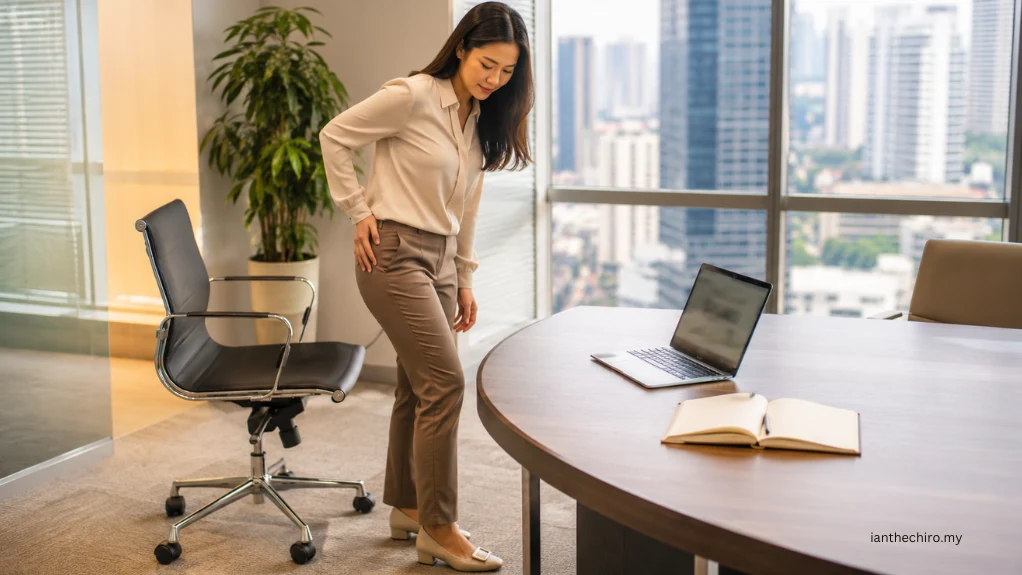
Standing up changes the hip from a flexed, relatively unloaded position into a position that must accept body weight and help move you forward.
The first few steps may feel uncomfortable if the hip or surrounding tissues have become stiff or sensitive while sitting.
Useful details include:
- whether the pain appears before standing or only afterward
- whether it improves after a few steps
- whether it worsens the longer you walk
- whether you need to push through your arms to stand
- whether one leg feels weaker
- whether the hip catches or gives way
- whether pain appears every time or only after prolonged sitting
Pain that quickly settles with movement may behave differently from pain that becomes progressively worse as you continue walking.
Both patterns may deserve assessment if they keep returning or limiting normal activity.
Is It Just Tight Hip Flexors?
Not necessarily.
Hip flexor tension may contribute to some cases, particularly when discomfort is felt at the front of the hip. However, describing every case as “tight hip flexors” may oversimplify the problem.
A muscle may feel tight because it is:
- working harder than usual
- fatigued
- guarding a sensitive area
- responding to reduced movement
- irritated by a recent activity increase
- compensating for another movement limitation
Stretching may feel relieving for some people, but repeatedly forcing a painful area into a deeper stretch may aggravate certain hip-joint or tendon-related symptoms.
The better question is not simply, “Which muscle is tight?”
It is:
“Why does this area keep feeling tight, and what happens when it is loaded, moved, or stretched?”
Are Weak Glutes Causing the Pain?
Reduced hip strength or endurance may contribute to some recurring hip-pain patterns, but “weak glutes” should not be treated as a diagnosis.
Strength may appear reduced because a movement is painful, the muscles are not accustomed to the task, or pain is temporarily changing how the area is being used.
Strengthening can be useful when exercises are appropriately selected and progressed. However, giving everyone the same glute exercises may overlook hip-joint sensitivity, tendon-related symptoms, lower-back contribution, recent workload, previous injuries, or another relevant factor.
Is Poor Sitting Posture the Cause?
Posture may influence symptoms, but there is no single perfect sitting position that guarantees a pain-free hip.
Even a position that looks “correct” may become uncomfortable if it is held for too long.
Instead of trying to sit perfectly all day, it is often more practical to:
- change position periodically
- avoid remaining shifted onto one side for hours
- use a chair height that allows the feet to rest comfortably
- avoid a very low seat if deep hip bending aggravates the pain
- alternate between sitting, standing, and walking when possible
- observe which positions consistently worsen or ease the symptoms
The goal is not rigid posture. The goal is finding positions your body currently tolerates and varying them before discomfort keeps building.
What Can You Try for Hip Pain After Sitting?
If the symptoms are mild, non-urgent, and improving, a few practical changes may help.
Break up long periods of sitting
Stand, walk briefly, or change position before the discomfort becomes intense.
There is no universal interval that suits everyone. Someone who becomes uncomfortable after 30 minutes may need more frequent movement than someone who only becomes stiff after several hours.
Adjust the chair or seat
A very low or deep seat places the hip into more flexion.
You can experiment with:
- a slightly higher chair
- keeping both feet supported
- avoiding prolonged leaning towards one side
- reducing time spent in very soft sofas
- changing position instead of holding one posture rigidly
The aim is to identify whether a small change meaningfully affects the symptoms.
Keep moving within a tolerable range
Complete rest is not always necessary.
Gentle walking and comfortable hip movement may help when the main problem is temporary stiffness. However, movement should not be forced through sharp pain, increasing weakness, or progressively worsening symptoms.
Review recent activity changes
Consider what changed before the pain began.
This may include:
- more running or walking
- heavier gym training
- a new lower-body exercise
- longer working hours
- more driving
- reduced sleep or recovery
- a previous injury becoming irritated again
Sometimes sitting receives all the blame even though the area was already overloaded by something else.
Avoid repeatedly forcing painful stretches
A stretch is not automatically helpful simply because the area feels tight.
If a movement causes pinching in the groin, sharp pain, numbness, or symptoms that remain worse afterward, stop forcing it and get the pattern assessed.
Track the pattern
For several days, note:
- where the pain is felt
- how long you can sit before it begins
- which seats feel better or worse
- what happens when you stand
- how quickly walking changes the symptoms
- whether there is clicking, stiffness, weakness, or travelling pain
- what activities occurred earlier that day
This information can make an assessment more useful.
When Should Hip Pain After Sitting Be Assessed?
Consider getting assessed if the pain:
- keeps returning
- is gradually worsening
- affects walking, sleep, work, driving, or exercise
- regularly appears after short periods of sitting
- causes painful clicking, catching, or giving way
- is accompanied by numbness, tingling, or weakness
- began after a fall, collision, or sports injury
- has not improved with reasonable changes to activity and sitting habits
- leaves you unsure whether the hip or lower back is responsible
You do not need to wait until the pain becomes severe before asking for an assessment.
⚠️ When Should You Seek Urgent Medical Care?
Seek urgent medical care if your hip pain follows a significant injury, you cannot bear weight, the hip looks visibly out of place, or the area is hot and swollen while you feel feverish or generally unwell.
You should also seek prompt medical assessment for sudden severe hip pain without an obvious injury, rapidly worsening leg weakness, major or spreading numbness, or new loss of bladder or bowel control.
How Hip Pain After Sitting Is Assessed
A useful assessment should do more than press on the painful area.
The first step is understanding:
- where the pain is felt
- when it began
- how long you can sit before symptoms appear
- whether pain occurs during sitting or after standing
- which positions or chairs aggravate it
- what happens during the first few steps
- whether symptoms spread
- whether there is clicking, catching, weakness, or numbness
- what activities or injuries preceded the problem
Depending on the presentation, the physical assessment may include:
- hip movement
- lower-back movement
- relevant orthopaedic tests
- neurological screening
- strength and control checks
- walking observations
- balance or single-leg tasks
- sitting-to-standing movement
- movements that reproduce the symptoms
No single physical examination test should be treated as a perfect answer. A 2025 systematic review of 15 studies found that the accuracy of tests used for several non-arthritic hip conditions varied considerably. This supports considering the test results alongside the person’s symptoms, physical function, history, and other assessment findings rather than using one positive test as a diagnosis.
Do You Need an X-Ray or MRI?
You usually do not need to arrange an X-ray or MRI before your first consultation.
Many hip-pain patterns can first be evaluated through the history, physical examination, movement, function, and relevant clinical checks. If imaging is likely to clarify the diagnosis or meaningfully change the next step, the appropriate type of scan can then be considered.
Imaging may become more appropriate when there is:
- significant trauma
- suspected fracture or dislocation
- inability to bear weight
- concern about infection or another serious condition
- persistent loss of function
- an unclear diagnosis after appropriate assessment
- a result that would meaningfully change the treatment plan
If you already have an X-ray, MRI, ultrasound, or medical report, bring it to the appointment.
The scan should still be compared with your current symptoms. A structural finding does not always explain why the pain appears after sitting.
Can Chiropractic Care Help Hip Pain After Sitting?
It depends on what is contributing to the symptoms.
Some musculoskeletal hip-pain patterns may be suitable for conservative care, particularly when symptoms appear to be influenced by movement, activity, surrounding muscles, or lower-back contribution.
Depending on the assessment findings, care may involve:
- chiropractic adjustments when clinically appropriate
- dry needling when a relevant muscular contribution is identified
- exercise or movement advice
- gradual strengthening
- sitting and activity modifications
- training-load changes
- recovery guidance
- referral for medical assessment or imaging when needed
Not every person with hip pain needs an adjustment. Not every tight-feeling hip needs dry needling. Exercise is not automatically the complete answer either.
The most suitable approach depends on what the assessment finds.
How Ian The Chiro Approaches Sitting-Related Hip Pain
At Ian The Chiro in Cheras, the first visit begins with a consultation rather than assuming which treatment you need.
The assessment may include the hip, lower back, pelvis, relevant muscles, nerve function, walking pattern, strength, and movements that reproduce the pain.
The aim is to answer practical questions:
- Does the pain appear to be coming mainly from the hip?
- Could the lower back be contributing?
- Is there a muscle or tendon-related pattern?
- Does the area appear sensitive to a particular position or workload?
- Are there neurological symptoms?
- Is conservative care appropriate?
- Is medical review or imaging needed first?
If treatment is appropriate, it may be provided on the same day. If another next step makes more sense, treatment should not be forced.
Not Sure What Is Causing Your Hip Pain?
Hip pain after sitting can be frustrating because the symptoms may disappear once you move, only to return during the next meeting, drive, or period of desk work.
That does not mean the problem should automatically be blamed on your posture, hip flexors, or chair.
The location of the pain, how quickly it begins, what happens when you stand, and whether other symptoms are present all help determine what should be assessed.
If the pain is recurring, worsening, or affecting normal activity, a proper consultation can help clarify whether the hip, lower back, surrounding tissues, daily workload, or several factors together may be contributing.
If you would like the pattern properly assessed, you can book a chiropractic consultation at Ian The Chiro in Cheras, Kuala Lumpur.
Common Questions About Hip Pain After Sitting
Why does my hip hurt after sitting but improve after walking?
Remaining still may temporarily increase stiffness or sensitivity. When you stand and begin walking, movement and gradual loading may help the area feel more comfortable.
However, this pattern does not identify the cause by itself. Hip-joint sensitivity, arthritis-related stiffness, surrounding muscles or tendons, and lower-back contribution may all produce similar symptoms.
Can sitting for too long cause hip pain?
Prolonged sitting may aggravate hip pain, particularly when the area is already sensitive or the same position is maintained for a long time.
However, sitting is not always the only cause. Recent activity, previous injury, hip movement, lower-back symptoms, and overall load may also matter.
Should I stretch my hip flexors?
Gentle stretching may help some people, but not every front-of-hip pain pattern is caused by shortened hip flexors.
Avoid forcing a stretch that causes sharp pain, groin pinching, numbness, or symptoms that remain worse afterward. If the same tightness keeps returning, the area may need a broader assessment.
Can lower back problems feel like hip pain?
Yes. The lower back may refer pain into the buttock, outer hip, groin, or thigh.
Lower-back contribution becomes more relevant when symptoms also change with spinal movement or involve travelling pain, tingling, numbness, or burning.
Why does my hip hurt when I get out of the car?
Getting out of a car combines prolonged sitting with hip rotation, weight transfer, and standing.
Pain during this movement may involve the hip joint, surrounding muscles or tendons, movement sensitivity, or lower-back contribution. The movement can provide a clue but cannot confirm the diagnosis.
Is hip clicking after sitting serious?
Hip clicking is not always painful or harmful. Tendons and other structures may sometimes produce noise during movement.
Assessment becomes more relevant when clicking is painful, began after an injury, causes catching or locking, or is accompanied by reduced movement or giving way.
Should I stop exercising if my hip hurts after sitting?
Not automatically.
Some cases benefit from temporary changes to training volume, exercise selection, range, or resistance rather than stopping all activity. The correct adjustment depends on what movements aggravate the symptoms and how the hip responds afterward.
Can a chiropractor help determine why my hip hurts after sitting?
A chiropractor can assess mechanical and neuromusculoskeletal contributors involving the hip, lower back, surrounding muscles, movement, and nerve function.
Whether chiropractic treatment is appropriate depends on the findings. Some cases may be suitable for adjustments, dry needling, exercise advice, or load management, while others require medical review or referral.