
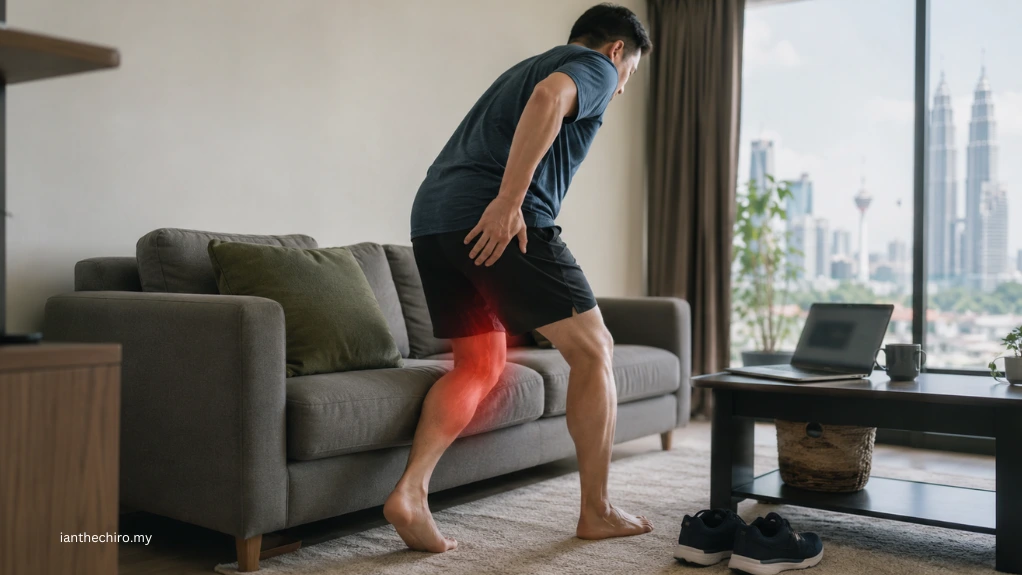
Pain travelling from the lower back or buttock into the thigh, calf, or foot can make people wonder whether they have sciatica, a slipped disc, a trapped nerve, or simply very tight muscles.
That uncertainty can also make treatment confusing.
If dry needling helps a painful or tight muscle, can it help sciatica too?
And if an MRI shows a slipped or herniated disc, can needling somehow treat the disc itself?
The answer requires an important distinction.
Dry needling may be useful when muscle tension, guarding, or sensitive muscle tissue is contributing to the overall pain pattern. However, it does not physically repair a slipped disc, push a disc back into place, or directly remove pressure from a spinal nerve.
Some people with lower-back and radiating leg pain may have both nerve-related symptoms and a muscular component. In those cases, dry needling may sometimes be one part of a broader treatment plan rather than the treatment for “sciatica” itself. Research on dry needling is more established for musculoskeletal and low-back pain than for clearly diagnosed sciatica specifically.
At Ian The Chiro in Cheras, Kuala Lumpur, the first question is therefore not simply, “Do you have sciatica?”
It is:
What appears to be contributing to your symptoms, and is there actually something dry needling can reasonably target?
This article is for general education and is not a diagnosis. New, severe, unusual, or progressively worsening neurological symptoms should be assessed appropriately before routine treatment.
Quick Answer: Can Dry Needling Help Sciatica?
Possibly, but it depends on what is contributing to the symptoms.
Dry needling for sciatica-like pain may be considered when the assessment suggests that muscle guarding, trigger-point-like sensitivity, or surrounding muscular pain is contributing alongside the nerve-related symptoms.
It may sometimes help with:
- local lower-back or buttock pain
- muscle guarding around a painful area
- sensitive muscle tissue
- movement that feels restricted partly because of muscular discomfort
- a muscular component occurring alongside radiating symptoms
However, dry needling does not:
- repair a slipped or herniated disc
- move a disc back into place
- directly decompress a spinal nerve
- guarantee that radiating leg pain will stop
- replace neurological assessment when weakness or numbness is progressing
Evidence specifically for sciatica remains limited, so dry needling is better viewed as a possible adjunct when a muscle-related component is present rather than as a treatment for the disc or nerve itself.
Dry needling may help a muscle-related part of the problem. It should not be confused with repairing a disc or directly releasing a compressed nerve.
What Is Sciatica?
Sciatica generally describes pain and other symptoms that follow the sciatic nerve distribution, commonly due to irritation or compression of a nerve root in the lower back.
Symptoms may include:
- pain travelling from the lower back or buttock into the leg
- burning, electric, or nerve-like pain
- tingling
- numbness
- altered sensation
- weakness in some cases
However, not every pain that travels into the buttock or leg is true sciatica.
Muscles and other musculoskeletal structures can also refer pain away from where the irritation originates. This is one reason assessment matters before choosing treatment. Ian The Chiro’s current back-pain and sciatica page similarly distinguishes sciatica-like symptoms from assuming that every travelling leg symptom has the same cause.
Is Sciatica the Same as a Slipped Disc?
No.
A “slipped disc” is a common informal term usually used to describe disc bulging or herniation.
A disc problem can irritate or compress a nearby nerve root and contribute to sciatica.
But the terms are not interchangeable.
Someone may have:
- a disc bulge without sciatica
- sciatica-like symptoms without a clinically important disc herniation
- a disc finding on MRI that does not fully explain the current symptoms
- back and leg pain involving several contributing factors
This is why treating the scan label alone is not enough.
The history, pain behaviour, neurological findings, movement, strength, function, and imaging where genuinely relevant need to make sense together. Current guidance for low-back pain and sciatica similarly emphasises assessment and selecting management according to the presentation rather than relying on one finding alone.
Why Might Muscles Matter When the Symptoms Feel Like Sciatica?
Pain can change how people move.
Someone with lower-back or leg pain may begin:
- guarding the lower back
- tightening around the buttock or hip
- avoiding one side
- walking differently
- reducing normal movement
- becoming sensitive to certain positions or loads
Muscular pain can then exist alongside the original nerve-related problem.
Muscle trigger points and other myofascial pain patterns can also refer discomfort away from the muscle itself, sometimes creating symptoms that overlap with or complicate radiating pain. Research examining needling and discogenic radiating pain has specifically discussed this potential overlap between myofascial trigger points and radicular-type symptoms.
That does not mean a tight muscle caused every case of sciatica.
It means that the muscle-related component may sometimes be worth addressing when the assessment supports it.
How Could Dry Needling Help?
Dry needling involves using thin needles in selected muscle or soft-tissue areas when muscle sensitivity, guarding, or trigger-point-like findings appear clinically relevant.
The immediate goal is usually not to “fix the nerve”.
Depending on the presentation, dry needling may be used to try to:
- reduce local muscular discomfort
- reduce guarding
- make a painful movement feel easier
- reduce sensitivity in selected muscle tissue
- make subsequent exercise or normal movement easier to tolerate
Research across chronic low-back pain suggests dry needling may provide short-term pain relief, particularly when used alongside other treatment rather than as a stand-alone solution. A 2023 systematic review and meta-analysis included eight randomised trials involving 414 people with chronic low-back pain. It found improvements in short-term pain intensity when dry needling was combined with other therapies, but did not find convincing improvement in disability.
That distinction matters.
Feeling less pain temporarily can be useful.
But it is not automatically the same as restoring strength, improving nerve function, rebuilding load tolerance, or addressing why the problem developed.
What Does the Research Say About Dry Needling for Sciatica?
The evidence needs to be interpreted carefully.
There is research supporting dry needling for certain musculoskeletal and low-back pain presentations, but the evidence specifically for properly defined sciatica is much thinner.
A 2016 randomised controlled trial studied 58 participants with discogenic lower-back pain and radiating symptoms. Twenty-nine received standard physical therapy, while 29 received the same programme with dry needling added. The dry-needling group showed greater improvements in pain and disability.
That study is relevant because the participants had radiating symptoms associated with discogenic back pain.
But one small trial does not establish dry needling as a proven treatment for every type of sciatica.
A 2021 review examining needling interventions specifically for sciatica found that the included research focused on acupuncture and identified no dry-needling studies that met its criteria. That highlights how limited the directly applicable dry-needling evidence remains when the question is narrowed from general lower-back pain to sciatica itself.
The practical conclusion is therefore more modest:
Dry needling may help selected people with a muscular component alongside lower-back and radiating symptoms, but it should not be sold as a proven way to correct the underlying cause of every sciatica case.
Can Dry Needling Fix a Slipped Disc?
No.
Dry needling does not physically repair a disc herniation.
The needle is not being inserted into the spinal disc to put it back into place, and the purpose of treatment is not to mechanically alter the shape of the disc.
If a disc appears relevant to the symptoms, treatment decisions should instead consider:
- the severity of the symptoms
- whether neurological changes are present
- how the symptoms are changing over time
- movement and activity tolerance
- strength
- function
- whether conservative care is appropriate
- whether medical review is required
Many disc-related presentations can be managed conservatively, while some require additional medical assessment or specialist input. Ian The Chiro’s current back-pain and sciatica pathway similarly treats dry needling as one possible option when muscle guarding or related muscular symptoms are relevant, rather than as a treatment that “repairs” the disc.
Can Dry Needling Release a Trapped Nerve?
Not in the way that phrase is commonly understood.
If a spinal nerve root is being irritated by disc material, inflammation, narrowing, or another spinal problem, needling a nearby muscle does not directly remove that compression.
However, someone can have nerve-related symptoms and painful muscular guarding at the same time.
Reducing the muscular component may make the person feel better or move more comfortably even though the dry needling has not physically changed the nerve root.
This distinction helps prevent temporary symptom relief from being misinterpreted as proof that a nerve has been “released”.
What If the Pain Is Mainly in the Buttock?
Buttock pain can occur with several different patterns.
It may accompany:
- lower-back pain
- sciatica
- referred muscular pain
- hip-related symptoms
- local muscle sensitivity
- other musculoskeletal problems
Feeling a tender or tight spot in the buttock does not prove that the muscle is compressing the sciatic nerve.
Likewise, experiencing temporary relief after needling that area does not prove the original diagnosis.
Where the symptoms travel, whether there is numbness or tingling, what movements affect them, whether weakness is present, and what the neurological examination shows can all influence the interpretation.
When Might Dry Needling Be Worth Considering?
Dry needling may be more reasonable when:
- muscle guarding appears to be contributing
- there are clearly sensitive muscular areas
- muscular discomfort limits otherwise useful movement
- local back or buttock pain accompanies the radiating symptoms
- the symptoms are stable enough for conservative care
- previous response suggests that reducing muscular discomfort helps function
- dry needling is being used to support a broader movement or rehabilitation plan
The key is that there should be a reason for choosing it.
“Someone has sciatica” is not, by itself, enough reason to needle them.
When Might Dry Needling Be Less Useful?
Dry needling may be a poor priority when the main problem appears to be something it cannot meaningfully address.
Examples include situations where:
- neurological weakness is progressing
- numbness is rapidly worsening
- symptoms require urgent medical investigation
- severe pain prevents basic function and the presentation is changing quickly
- the person has no meaningful muscle-related findings
- dry needling repeatedly provides only very brief relief without improving function
- another treatment or referral is more appropriate
- the person simply does not want needles
Treatment should not continue merely because dry needling is available.
Does More Muscle Tightness Mean You Need More Needling?
Not necessarily.
A muscle can feel tight for several reasons.
It may be:
- guarding because something hurts
- reacting to increased workload
- fatigued
- sensitive after reduced activity
- compensating for another problem
- simply feeling tight without being the main driver of symptoms
Repeatedly needling the same area without asking why the tightness keeps returning can turn treatment into temporary symptom management without addressing what matters.
If a muscle repeatedly becomes uncomfortable during sitting, lifting, running, gym training, or another task, the longer-term plan may need to improve the body’s ability to tolerate that task rather than repeatedly reducing the sensation of tightness.
Should Dry Needling Be Combined With Exercise?
Often, that may make more sense than relying on needling alone.
Dry needling may help reduce discomfort temporarily.
Exercise and gradual loading can address different goals, such as:
- strength
- endurance
- movement tolerance
- confidence
- capacity for work
- return to training
- tolerance for bending, lifting, sitting, or walking
The 2023 meta-analysis on chronic low-back pain found more favourable short-term pain outcomes when dry needling was used alongside other therapies, while improvements in disability were not clearly demonstrated. That supports using needling as a possible adjunct, rather than assuming the needle itself provides the complete rehabilitation programme.
What About Chiropractic Adjustments?
The same assessment-first principle applies.
Someone with sciatica-like symptoms does not automatically need:
- dry needling
- an adjustment
- both treatments
- either treatment
A chiropractic adjustment may sometimes be considered when joint movement or another mechanical finding appears relevant and treatment is appropriate.
Dry needling may be considered when a muscle-related component appears relevant.
Exercise, activity modification, monitoring, medical referral, or another direction may be more useful in other cases.
The treatment should follow the findings rather than the diagnosis label.
Ian The Chiro’s live back-pain pathway currently follows the same model: adjustments, dry needling, rehabilitation advice, load management, or referral are selected according to what the assessment suggests rather than automatically applied to every sciatica-like presentation.
How Quickly Should Dry Needling Help?
There is no reliable number of sessions that applies to everyone.
Some people may notice a change in discomfort or movement relatively quickly.
Others may notice little meaningful benefit.
The more useful question is whether the treatment is producing a result that matters.
For example:
- Does walking become easier?
- Can you sit longer?
- Is the leg pain becoming less intrusive?
- Can you return to useful exercise?
- Are flare-ups becoming less frequent?
- Is the improvement lasting longer?
- Are neurological symptoms stable or improving?
If the treatment repeatedly produces brief local looseness but the person’s function remains unchanged, the plan should be reconsidered.
Can Dry Needling Make Sciatica Worse?
Dry needling can cause temporary local soreness or sensitivity after treatment.
However, symptoms that become substantially more radiating, neurological, or progressively worse deserve reassessment rather than automatically being dismissed as a normal treatment reaction.
A person should not be told to simply “push through” progressively worsening numbness, weakness, or significant nerve-like pain because needling was performed.
Treatment response is information.
If the response is poor, the plan should change.
Do You Need an MRI Before Trying Dry Needling?
Not automatically.
A scan may be useful when the result is likely to change the clinical decision, particularly when the history or examination raises concern about a more significant neurological or structural problem.
But an MRI should not be required simply because someone has back pain travelling into the leg.
Likewise, already having an MRI that shows a disc bulge does not automatically prove that dry needling is appropriate.
The imaging still needs to be interpreted alongside the current symptoms and examination. NICE guidance for low-back pain and sciatica similarly recommends against routine imaging in non-specialist settings unless the result is likely to change management.
When You Should Be Checked Medically First
Most lower-back and leg pain is not a medical emergency.
However, some patterns should be assessed medically before routine dry needling or hands-on treatment.
⚠️ Seek Medical Attention for Back-Pain and Nerve Warning Signs
Seek urgent medical attention for new loss of bladder or bowel control, difficulty emptying the bladder, numbness around the groin or saddle area, rapidly progressive leg weakness, major trauma, or severe symptoms that are rapidly worsening or distinctly unusual.
You should also get medically assessed when symptoms occur alongside fever, unexplained illness, significant unexplained weight loss, a relevant history of cancer or serious infection, or another medical condition that could change what treatment is appropriate.
Do not repeatedly stretch, manipulate, massage, or needle an area simply to see whether serious or progressively worsening symptoms disappear.
What Should an Assessment Look At?
A useful assessment should look beyond whether an MRI says “slipped disc” or whether a muscle feels tight.
Depending on the presentation, relevant information may include:
- how the symptoms began
- where the pain travels
- whether the leg symptoms go below the knee
- numbness or tingling
- strength changes
- walking tolerance
- sitting tolerance
- bending and lifting
- coughing or straining where clinically relevant
- symptom changes with different movements or positions
- lower-back and hip movement
- muscular tenderness or guarding
- neurological findings
- work and training demands
- previous injuries
- previous treatment response
- existing MRI or medical reports
- warning signs
The aim is to determine whether the symptoms appear primarily nerve-related, muscular, joint-related, disc-related, load-related, or involve several factors together.
Only then does the question “Would dry needling help?” become useful.
How Ian The Chiro Approaches Sciatica-Like Symptoms

At Ian The Chiro, dry needling is not recommended simply because someone says they have sciatica or shows an MRI containing the words “disc bulge”.
First, what do the symptoms actually look like?
Where does the pain travel? Is there numbness, tingling, or weakness? What makes it worse? What makes it easier?
Second, does the neurological pattern matter?
If the findings suggest that medical assessment should come first, dry needling is not used as a substitute for that.
Third, is there a muscle-related component worth treating?
Some people have substantial lower-back or buttock guarding alongside their radiating symptoms. Others do not.
Fourth, what would dry needling actually be expected to achieve?
If the goal is to reduce a muscular component so that movement, exercise, or normal activity becomes easier, it may be reasonable.
If the expectation is that needling will push a disc back into place or permanently decompress a nerve, that expectation needs to be corrected.
Fifth, is the treatment helping?
Progress should be judged by meaningful changes in pain, movement, daily activity, and function rather than simply whether the muscle feels looser for a few hours.
The goal is not to use every available treatment.
The goal is to use the treatment that makes sense for the problem in front of us.
What Not to Do
Try to avoid:
- assuming every pain travelling down the leg is sciatica
- assuming every MRI disc bulge explains the symptoms
- expecting dry needling to repair a slipped disc
- believing a temporary reduction in pain proves a nerve has been “released”
- repeatedly needling the same tight area without reviewing why it keeps becoming painful
- ignoring worsening numbness or weakness
- repeatedly testing painful movements after treatment
- stopping all activity indefinitely without a clear reason
- relying only on passive treatment when strength or activity tolerance also needs attention
- continuing dry needling indefinitely when it is not producing meaningful progress
Dry needling may have a role in some cases involving lower-back and radiating leg symptoms.
But the label “sciatica” does not tell you whether needling is the right treatment.
The more useful question is whether the assessment identifies a muscle-related component that dry needling can reasonably address, while the nerve-related symptoms are assessed and managed appropriately.
Common Questions About Dry Needling for Sciatica
Does dry needling help sciatica?
It may help some people when muscle guarding or sensitive muscle tissue contributes alongside the sciatica-like symptoms. Evidence directly specific to sciatica remains limited, so dry needling should not be presented as a universal treatment for nerve-root irritation.
Can dry needling fix a slipped disc?
No. Dry needling does not repair, reposition, or push a slipped or herniated disc back into place.
Can dry needling release a trapped nerve?
Not directly. Needling a muscle does not physically decompress a spinal nerve root. It may help a muscular component occurring alongside nerve-related symptoms in selected cases.
Can tight muscles cause pain that feels like sciatica?
Muscular referred pain can sometimes travel into the buttock or leg and overlap with sciatica-like symptoms. Proper assessment is needed because travelling pain alone does not identify its source.
Can I have dry needling if my MRI shows a disc bulge?
Possibly. The MRI finding alone neither confirms nor rules out dry needling. The decision depends on the symptoms, neurological findings, examination, medical history, and whether a muscle-related component appears worth treating.
Is dry needling better than chiropractic adjustments for sciatica?
Neither treatment is automatically better. Dry needling and adjustments address different clinical findings, and some patients may need neither. The assessment should determine what, if anything, is appropriate.
Should dry needling be combined with exercise?
It often makes sense to consider exercise or gradual loading when strength, movement tolerance, endurance, or return to activity needs improvement. Dry needling should not be expected to build those capacities by itself.
How many dry needling sessions are needed for sciatica?
There is no predetermined number that applies to everyone. The plan should be reviewed according to the person’s response and whether meaningful function is improving.
Is soreness after dry needling normal?
Temporary local soreness can occur. However, substantially worsening radiating pain, progressive numbness, weakness, or other unusual symptoms should be reassessed rather than assumed to be a routine reaction.
Do I need a consultation before dry needling for sciatica?
Yes. Radiating leg symptoms can have different causes, and dry needling is only useful when there is something appropriate for it to target. Assessment also helps identify when neurological or medical evaluation should take priority.