
Your run felt normal, but later that day the back of your ankle began to ache. The next morning, the first few steps felt stiff. It warmed up as you moved, so you ran again, only for the soreness to return afterwards.
Achilles pain after running often behaves differently from a sudden ankle sprain. It may build gradually, ease during activity and then become more noticeable later. That pattern can be confusing because feeling better once warmed up does not necessarily mean the tendon is ready for the same training load.
The Achilles tendon connects the calf muscles to the heel bone and transfers substantial force during running. Symptoms can develop when training demand rises faster than the tendon and calf can adapt. Ian The Chiro’s sports injury assessment and rehabilitation page explains how training history, recovery and physical capacity are considered together.
However, pain near the Achilles is not always tendinopathy. The exact location, onset, swelling, strength and injury mechanism help determine whether another problem needs attention.
This article is general education, not a diagnosis. Sudden severe pain, a snap or loss of push-off strength needs prompt medical assessment.
Quick Answer: Why Does Achilles Pain After Running Happen?
Achilles pain after running may occur when the tendon is exposed to more load than it can currently tolerate. This often follows a change in distance, speed, hills, jumping, footwear, surface or recovery.
Possible contributors include:
- midportion Achilles tendinopathy
- insertional Achilles tendinopathy near the heel bone
- a sudden increase in running or jumping volume
- reduced calf strength or endurance
- limited recovery between demanding sessions
- irritation of nearby tissue, including the paratenon or heel bursa
- a partial or complete tendon tear after a sudden event
Running is not automatically damaging the tendon. The issue is whether the amount, speed and type of load match its present capacity.
The response over the following 24 hours is often useful. Mild symptoms that settle back to baseline differ from pain and stiffness that progressively accumulate across the week.
What Does the Achilles Tendon Do While You Run?
The Achilles tendon links the gastrocnemius and soleus calf muscles to the heel. During running, this muscle-tendon unit helps absorb and release energy, control the ankle and push the body forward.
Every stride creates repeated loading. Faster running, hills, acceleration and jumping generally increase the demand. The tendon is designed to tolerate load, and appropriate loading is also how it adapts.
Problems can arise when the change in demand is too large for the current capacity. A runner may cope with three easy sessions but flare after adding hill repeats, a longer run and badminton in the same week.
The tendon is not a fragile rope that must never be stressed. It is living tissue that needs enough recovery and progressively appropriate load.
Is This Achilles Tendinopathy?
It could be, but the word should not be applied to every pain behind the ankle.
Achilles tendinopathy usually involves pain and reduced function associated with tendon loading. Common features include:
- localised pain during or after running
- stiffness with the first steps in the morning
- pain during calf raises, hopping or stairs
- tenderness along the tendon
- symptoms that warm up, then return after activity
- reduced calf strength, endurance or confidence
The 2024 clinical practice guideline for midportion Achilles tendinopathy recommends tendon-loading exercise as first-line care, with the programme progressed according to tolerance.
Diagnosis still depends on the whole presentation. A tendon can look thickened on a scan without being painful, and pain can come from other nearby structures.
What makes tendinopathy different from a temporary post-run ache?
A healthy calf can feel generally tired after an unfamiliar run. That soreness is usually spread through the muscle, appears after a clear increase in effort and settles as the body recovers.
Tendinopathy is more likely when pain is repeatedly localised to the tendon and linked with tendon-loading tasks. Morning stiffness, discomfort during calf raises and a predictable response to running may form part of the pattern.
Duration alone does not confirm it. A runner can have an irritable tendon for a short period, while another person may have long-standing structural changes without pain. The history, examination and response to load need to agree.
Can health conditions or medication affect the tendon?
Training load is important, but it is not the only consideration. Age, previous tendon symptoms, metabolic health and some inflammatory conditions may influence tendon health or recovery.
Certain medicines, including fluoroquinolone antibiotics, have recognised associations with tendon injury. Corticosteroid exposure can also be relevant in some contexts. Do not stop prescribed medication on your own. Tell the assessing clinician what you take and discuss concerns with the prescriber.
Pain in both Achilles tendons, marked swelling, symptoms in several joints or an unusual pattern deserves broader medical consideration rather than being treated as a simple running error.
Where Is the Pain Located?
Location helps distinguish common patterns.
Midportion Achilles pain
Midportion symptoms are usually felt several centimetres above the heel bone. The area may feel thickened or tender. Running, hopping and repeated calf raises often provoke it.
Insertional Achilles pain
Insertional symptoms are felt where the tendon attaches to the back of the heel. Deep ankle bending, hills or footwear pressing against the heel may be uncomfortable. Exercise selection may need modification because lowering the heel far below a step can compress the irritated insertion.
Pain beside or around the tendon
Pain around the tendon may involve the paratenon, a thin tissue layer that helps the tendon glide. Some people notice creaking or swelling around the tendon.
Pain underneath or in front of the Achilles
A heel bursa or another structure near the insertion can become irritated. Pain may also come from the heel bone, ankle joint or nerves. The separate guide to heel pain in the morning covers plantar heel pain and other causes that are often felt underneath the foot rather than along the Achilles.
Why Can Pain Feel Better During the Run?
Some tendon symptoms have a warm-up effect. Pain and stiffness may reduce after the first few minutes as the area becomes warmer and movement feels easier.
That temporary change can be reassuring, but it can also lead runners to underestimate the total load. The tendon may become sore later that day or stiffer the next morning.
Use three time points:
- How does the tendon feel during the run?
- How does it respond in the hours afterwards?
- Is it back near its usual baseline the next morning?
A run that feels tolerable during the session can still be too much if symptoms keep accumulating afterwards.
The aim is not to demand zero sensation at all times. It is to find a dose that does not produce a worsening trend.
What Training Changes Commonly Trigger Achilles Pain?
Symptoms often follow a change rather than one inherently bad activity.
Common changes include:
- increasing weekly distance quickly
- adding speed work or sprints
- introducing hills or stairs
- returning after illness, travel or a long break
- changing from treadmill to road or trail
- adding court sport, skipping or plyometrics
- changing shoes while also increasing training
- reducing sleep or recovery during a busy period
The total matters. A modest running increase may become a large overall spike when combined with gym calf work, football or long hours standing.
The general article on whether to rest or keep moving when something hurts explains why useful modification sits between complete avoidance and blindly pushing through.
Which Physical and Running Factors Matter?
Do calf strength and endurance matter?
Yes. The calf muscles and Achilles tendon work as a unit. If the calf cannot produce or repeat enough force for the task, running demand may exceed current capacity sooner.
Useful comparisons may include:
- how many controlled single-leg calf raises each side can perform
- whether full height can be reached and maintained
- whether the knee-bent and knee-straight positions differ
- how symptoms respond to slower, heavier calf loading
- whether hopping is comfortable and controlled
Strength is not the only factor, and a simple side-to-side comparison has limits. Both sides may be underprepared, or the runner’s sport may require far more than a basic calf raise test.
Being able to walk without pain does not prove the calf-Achilles unit is ready for repeated running contacts.
Are running form, shoes or foot shape to blame?
Not usually in a simple, isolated way.
Running form changes force distribution, but no single style guarantees an injury. Evidence linking specific biomechanical variables to running injuries is inconsistent across populations. A runner should not be told that one foot angle or amount of pronation is the sole cause without stronger context.
Shoes can affect comfort and load. A sudden switch to a lower heel-to-toe drop, minimalist shoe or racing shoe may ask more of the calf and Achilles, especially when combined with higher mileage. That does not make the shoe universally bad.
Foot shape, ankle movement, stride pattern, strength and training history may all matter. The useful question is not whether your foot looks perfect. It is whether a modifiable factor is meaningfully connected to your symptoms and running demands.
Should You Stop Running Completely?
Not always. Complete rest may reduce symptoms temporarily but does not rebuild running tolerance.
Running may be modified when:
- pain remains mild and controlled
- gait does not become increasingly altered
- symptoms settle promptly afterwards
- morning stiffness is stable or improving
- the weekly trend is not worsening
Modification might mean shorter runs, fewer sessions, flatter routes, slower pace or temporarily replacing one run with cycling.
Stop and seek assessment when pain is sharp or severe, you cannot push off normally, symptoms rapidly worsen, or the tendon feels as if it has suddenly torn.
The goal is to preserve useful activity while removing enough aggravating load for recovery and rehabilitation to progress.
How can you monitor the 24-hour response?
A simple record can be more informative than judging one isolated run.
Note:
- pain before, during and after the session
- stiffness during the first steps the next morning
- swelling or thickening
- calf-raise comfort and strength
- distance, pace, hills and other sports
- whether symptoms return to baseline
If morning stiffness becomes longer, pain increases at the same workload or the tendon remains sore for longer, the current dose may be too high.
One flare does not necessarily mean the programme has failed. Reduce the provoking dose, check what else changed and observe the trend.
What Does Achilles Rehabilitation Usually Involve?
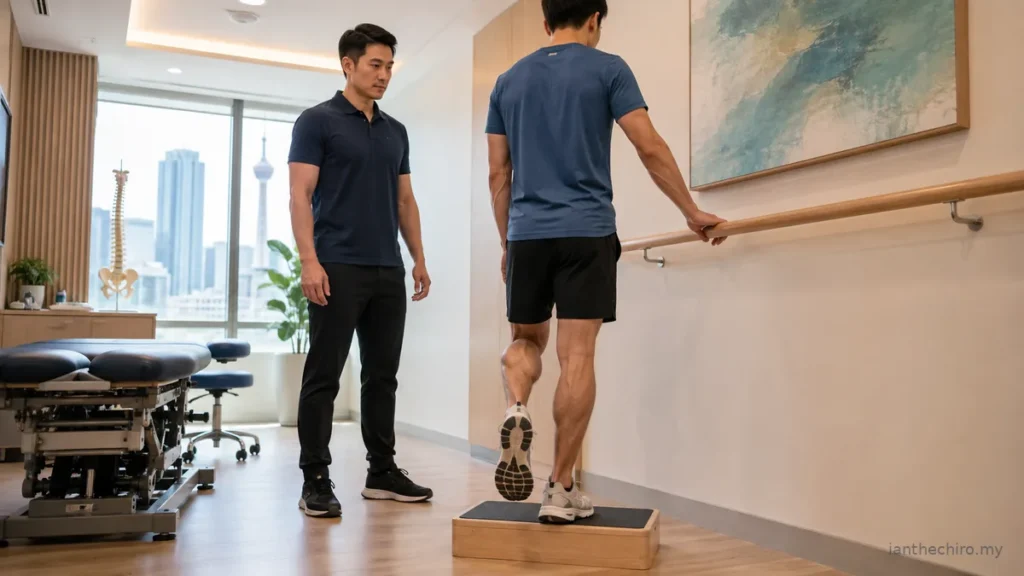
Rehabilitation commonly centres on progressive tendon and calf loading. The starting point depends on irritability, location and strength.
A progression may include:
- isometric calf holds where useful for early tolerance
- double-leg calf raises
- single-leg calf raises
- knee-straight and knee-bent calf work
- progressively heavier resistance
- faster calf work, hopping and landing
- graded return to running, hills and speed
Exercise may be performed on flat ground for insertional symptoms before deeper heel-lowering positions are introduced, if appropriate.
The guideline evidence does not support one magical repetition scheme for everyone. Heavy slow resistance and eccentric programmes can both be useful. The principle is progressive loading, not loyalty to one famous heel-drop routine.
Pain rules also need individualisation. Some discomfort may be acceptable during tendon rehabilitation, but sharp pain, deteriorating technique or a worsening 24-hour response suggests the dose needs adjustment.
When can you start running again?
Return to running depends on function, not time alone.
Useful signs may include:
- walking and stairs are comfortable or manageable
- morning stiffness is stable and short-lived
- calf raises can be performed with useful height and control
- hopping is tolerated when relevant
- recent loading has not produced accumulating symptoms
- confidence is returning
The first run may use a short run-walk format on flat ground. Progress one main variable at a time, such as total duration before speed or hills.
A practical sequence is:
walking → run-walk → easy continuous running → longer easy running → hills or speed → full training.
Your sequence may differ, but jumping from rest straight back to the previous programme often recreates the same mismatch.
Running readiness is not based on one perfect test. A person may have enough capacity for a ten-minute easy run but not for intervals, hills or a long event. The programme should create small, measurable exposures that the tendon can recover from.
If symptoms increase, return to the last well-tolerated step rather than abandoning rehabilitation. Check whether the change came from running, calf exercise, another sport or the combination.
What About Stretching, Massage and Foam Rolling?
Gentle calf movement or stretching may feel useful when the area is stiff, but stretching is not automatically the main treatment for Achilles pain.
Strong dorsiflexion stretching can compress an irritated insertion against the heel bone. If this reproduces sharp insertional pain, repeatedly forcing it is unlikely to help.
Massage or foam rolling may reduce calf tightness temporarily. Avoid aggressive pressure directly over a highly irritable tendon. Short-term relief can support movement, but it does not replace progressive loading.
Dry needling targets selected muscle tissue, not the tendon itself. It may be considered when calf muscle pain or guarding is relevant, but it does not repair or strengthen the Achilles. The comparison of adjustment, dry needling and exercise explains their distinct roles.
Heat or ice may be used for short-term comfort if either feels helpful. Neither determines whether the tendon is healing, and neither replaces appropriate loading. Avoid very hot or cold applications directly against the skin.
When Might Imaging Be Useful?
Imaging is not required for every gradual-onset Achilles problem. History and examination often provide enough information to begin conservative care.
Ultrasound or MRI may be considered when:
- a partial tear is suspected
- there was a sudden injury or marked loss of strength
- symptoms are unusual or not improving as expected
- another structure may be involved
- the result would change referral or treatment
Scans must be interpreted carefully. Tendon thickening or structural change does not always match pain severity.
The American College of Radiology guidance for chronic ankle pain outlines when radiography, ultrasound or MRI may be appropriate depending on the suspected condition. Imaging should answer a clinical question, not simply provide a picture.
When Is Achilles Pain Urgent?
Get prompt medical assessment if you experience:
- a sudden snap, pop or feeling of being kicked in the back of the ankle
- immediate weakness or inability to push off
- difficulty walking after a sudden event
- a visible gap or marked change in tendon contour
- rapidly increasing swelling or bruising
- severe pain after trauma
- a cold, pale or numb foot
A complete rupture is sometimes less painful after the first moment than expected. Do not use low pain as proof that the tendon is intact if push-off strength suddenly disappears.
Seek timely review for a hot, red and very swollen area, fever, unexplained calf swelling, or symptoms that persist despite sensible modification.
How Is Achilles Pain Assessed?
Assessment begins with the training story. Useful details include weekly mileage, recent changes, hills, speed, footwear, other sports, recovery and the exact 24-hour response.
The physical examination may compare:
- tendon location, swelling and tenderness
- ankle and foot movement
- calf strength and endurance
- double-leg and single-leg calf raises
- walking, squat and step tasks
- hopping or running where safe
- signs that suggest rupture or another diagnosis
The hip, knee and trunk may be checked when they are relevant to running, but this does not mean every Achilles problem begins elsewhere.
Assessment should connect the symptom pattern to function and load, not hunt for a single imperfect movement to blame.
Running observation may be useful when symptoms are genuinely running-specific and it is safe to reproduce the task. The goal is not to grade the runner’s form as good or bad. It is to see whether pace, stride, fatigue or another modifiable feature consistently changes the symptoms.
The clinician should also explain what has been ruled in, what remains uncertain and what would trigger imaging or referral. A clear working diagnosis can be updated as the tendon responds to the plan.
Which Treatments Might Be Considered?
Exercise and load management are usually central for Achilles tendinopathy. Education helps the runner understand what can continue, what needs temporary modification and how progression will be judged.
Manual therapy or joint mobilisation may sometimes help ankle or foot movement when a relevant restriction is present. A chiropractic adjustment is joint-directed care. It does not push the tendon or heel bone back into place and should not replace tendon loading. Learn more about the purpose of chiropractic adjustments.
Dry needling may be considered for selected calf muscle symptoms. It is a different modality with a different target. Bracing, heel lifts or footwear changes may help some presentations, but none should be automatic.
Injection and surgical decisions fall outside routine conservative care and require appropriate medical discussion. Treatment should match the diagnosis, severity, goals and response.
Shockwave therapy is sometimes considered for persistent tendinopathy, usually alongside a loading programme rather than instead of one. Suitability depends on the tendon location, prior care and clinical context.
No passive treatment can substitute for the repeated force capacity required by running. Hands-on care may help selected symptoms or movement restrictions, but the runner still needs a graded path from calf loading to energy-storage tasks and running.
What Should You Avoid While It Settles?
Avoid changing several variables at once. If you simultaneously change shoes, add hills and start a new calf programme, it becomes difficult to understand the response.
Also avoid:
- repeatedly testing painful sprints
- forcing deep heel drops for insertional pain
- resting until pain disappears, then returning at full volume
- assuming a thick tendon is permanently damaged
- relying only on massage or passive treatment
- ignoring sudden weakness or rupture signs
A tendon does not need to be punished into adaptation. It needs a load it can recover from, repeated consistently enough to become stronger.
Ian The Chiro’s Approach to Achilles Pain After Running
Ian The Chiro uses an assessment-first approach. The aim is to determine whether Achilles pain after running fits a load-related tendon pattern, whether another structure may be involved and whether the presentation needs medical investigation.
Where chiropractic care is suitable, the plan may include education, running modification, progressive calf and tendon exercise, and selected hands-on care. The emphasis is on rebuilding the capacity needed for the person’s actual activity.
A recreational jogger, trail runner and badminton player may share the same painful area but need different end-stage preparation. The plan should reflect pace, terrain, footwear, jumping, change of direction and the time available for recovery.
When Should You Book an Assessment?
Consider an assessment if pain keeps returning, morning stiffness is worsening, calf strength is reduced, or you cannot progress running without repeated flare-ups.
A chiropractic consultation with Ian The Chiro starts by checking the history, tendon region, movement and functional capacity before discussing whether care is suitable.
The aim is not to promise an instant fix. It is to understand what the tendon and calf currently tolerate, identify anything that changes the plan and build a sensible route back to running.
Frequently Asked Questions
Can I run through mild Achilles pain?
Sometimes a modified run is reasonable when pain stays mild, gait remains normal and symptoms return near baseline by the next morning. A worsening trend, limping or increasing stiffness means the dose should be reduced and reviewed.
Why is my Achilles stiff the morning after running?
Morning stiffness is common with Achilles tendinopathy and may reflect how the tendon responded to the previous day’s load. The duration and weekly trend are often more useful than one isolated morning.
Is Achilles tendinopathy the same as a tear?
No. Tendinopathy is a load-related pain and function problem. A tear involves disruption of tendon fibres and may be partial or complete. Sudden loss of push-off strength after a snap requires prompt assessment.
Should I stretch an irritated Achilles?
Gentle stretching may feel comfortable for some people, but strong stretching is not always useful. Deep ankle bending can aggravate insertional pain, so the location and response matter.
Are heel drops the best Achilles exercise?
They are one option, not the only option. Progressive calf loading can use eccentric, heavy slow resistance, isometric and faster exercises according to stage and tolerance.
Does a thick Achilles tendon mean permanent damage?
Not necessarily. Tendon shape and symptoms do not match perfectly. Function, pain behaviour and load tolerance matter alongside any imaging finding.
Can changing running shoes help?
Shoes may change comfort and Achilles demand. A gradual transition may help when moving to a lower-drop or unfamiliar shoe, but footwear alone rarely explains or resolves every case.
How long does Achilles pain take to improve?
Recovery varies with symptom duration, severity, training demand and rehabilitation consistency. Tendon adaptation usually takes sustained progression rather than a few symptom-free days.
Can a chiropractor help with Achilles pain?
A chiropractor may assess the tendon region, calf strength, ankle movement and running-related tasks, then provide suitable education, exercise and selected hands-on care. Referral is needed when rupture or another condition is suspected.