
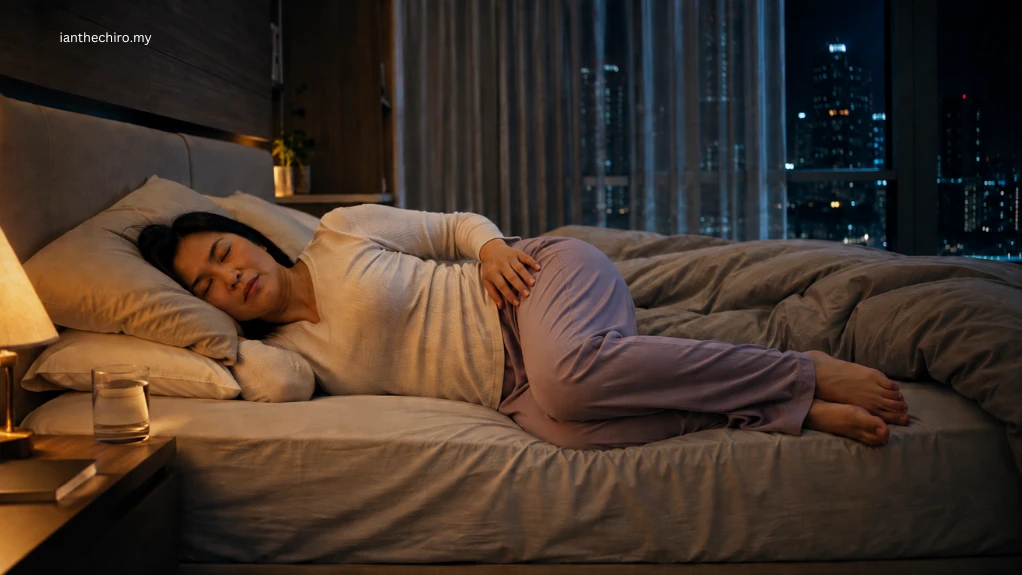
You settle into bed feeling reasonably comfortable.
Then you roll onto one side.
Within minutes, the outside of the hip begins to ache. Perhaps the pressure feels sharp enough to make you turn over. Maybe the upper hip hurts even though it is not touching the mattress. Or you keep switching sides because neither position remains comfortable for long.
Hip pain when sleeping on your side can happen for several reasons.
Pain directly over the outer hip commonly raises the possibility of greater trochanteric pain syndrome, which may involve the gluteal tendons and nearby tissues. But symptoms felt in the groin, buttock, thigh, or alongside tingling and numbness create different questions.
The mattress and sleeping position can influence how much pressure or compression the area experiences. They do not automatically explain why the hip became sensitive in the first place.
At Ian The Chiro in Cheras, Kuala Lumpur, hip pain at night is therefore not automatically labelled as “bursitis”, a tight IT band, arthritis, or a bad mattress. The useful question is:
Where is the pain, which side hurts, what else aggravates it, and why has that position become difficult to tolerate?
This article is for general education and is not a diagnosis.
Quick Answer: Why Does My Hip Hurt When I Sleep on My Side?
Hip pain when sleeping on your side may be related to:
- greater trochanteric pain syndrome or gluteal tendon sensitivity
- irritation involving the bursa or other tissues around the outer hip
- pressure or compression aggravating an already-sensitive area
- hip osteoarthritis or another joint-related problem
- pain referred from the lower back
- nerve-related symptoms affecting the buttock, hip, or thigh
- a recent injury or increase in walking, running, hiking, gym, or sport
The sleeping position is only one part of the pattern.
Outer-hip pain that is tender when pressed behaves differently from deep groin pain and stiffness.
Pain that appears only with direct pressure behaves differently from burning, tingling, numbness, or pain travelling down the leg.
Side sleeping may expose a sensitive hip, but it does not identify the diagnosis or prove that the mattress caused the problem.
Why Can Side Sleeping Make Hip Pain More Noticeable?
Side sleeping can affect the lower and upper hips differently.
The lower hip receives direct pressure
When you lie on one side, the outer hip presses against the mattress.
If the tissues around the greater trochanter are already sensitive, direct pressure may reproduce the pain quickly.
This can make the hip feel bruised, tender, or sharply uncomfortable even if ordinary sitting feels fine.
The upper hip may move inward
The upper leg may drop across the midline towards the mattress, particularly if the knees are stacked without support.
This places the upper hip into adduction and can increase compression around the outer hip in some people.
That is one reason the upper hip can sometimes hurt even though it is not the side pressed against the bed.
Pelvic rotation, the weight of the upper leg, and how long the position is held may also influence the symptoms.
A pillow between the knees and ankles sometimes makes this position more comfortable by supporting the upper leg.
If the pain continues regardless of how the leg is supported, another part of the pattern may need attention too.
Remaining still can make symptoms build
During the day, you regularly change position.
At night, the hip may stay under the same pressure or in the same angle for much longer. An area that tolerates brief pressure may become uncomfortable after 20, 40, or 60 minutes.
These details are useful, but they still do not prove which tissue is responsible.
Where Exactly Is the Hip Pain?
“Hip pain” can describe several different areas.
Pain directly over the outer hip
This may involve the gluteal tendons, bursa, or other tissues around the greater trochanter.
The area may feel tender when pressed and may also hurt during walking, stairs, hills, running, standing on one leg, or getting up after sitting.
If sitting or standing after sitting is also a consistent trigger, the separate guide to hip pain after sitting explains how the pattern may differ.
Pain in the groin or front of the hip
Groin or front-of-hip pain creates more reason to consider the hip joint itself, although muscles and tendons around the front of the hip can also produce symptoms there.
Stiffness, reduced movement, clicking, catching, and pain during several weight-bearing activities may change the assessment.
Pain in the buttock or back of the hip
Buttock pain may involve local muscles or tendons, the lower back, the sacroiliac region, or referred symptoms.
If the pain travels, burns, tingles, or comes with numbness or weakness, a nerve-related pattern becomes more relevant.
Pain spreading down the outer thigh
Outer-hip pain can sometimes spread down the side of the thigh without being a nerve problem.
But symptoms travelling below the knee, altered sensation, tingling, numbness, or weakness raise different questions from local tenderness over the outer hip.
The location helps narrow the possibilities. It does not confirm the diagnosis by itself.
Could It Be Greater Trochanteric Pain Syndrome?
Yes, particularly when the pain is centred over the outer hip.
Greater trochanteric pain syndrome, often shortened to GTPS, is an umbrella term for pain around the greater trochanter on the side of the hip.
The pattern may involve the gluteus medius or gluteus minimus tendons, the nearby bursa, and other surrounding tissues.
Common features may include:
- pain when lying on the affected side
- tenderness when pressing the outer hip
- pain during prolonged walking
- discomfort on stairs or hills
- pain while standing on one leg
- symptoms after increasing running, hiking, gym, or sport
- discomfort when sitting with the legs crossed or standing with the hip pushed out to one side
Not everyone has every feature.
And lateral hip pain should not be diagnosed from side-sleeping pain alone. The history and examination still need to make sense together.
Is Outer-Hip Pain Always “Bursitis”?
No.
Trochanteric bursitis has traditionally been used as a broad label for pain over the outer hip.
The bursa can be involved, but current understanding recognises that the gluteal tendons are often relevant too. That is why greater trochanteric pain syndrome is usually a more useful umbrella term than assuming one inflamed bursa explains every case.
This distinction matters because repeatedly trying to calm one supposedly inflamed spot may not address the wider loading pattern.
The area may also be painful for reasons unrelated to either the bursa or gluteal tendons.
The label should follow the assessment, not replace it.
Could Hip Osteoarthritis Cause Pain While Sleeping?
It can.
Hip osteoarthritis may cause pain and stiffness around the groin, front of the thigh, buttock, or wider hip region. Symptoms may become noticeable during walking, standing, putting on shoes, getting in and out of a car, or moving the hip through reduced ranges.
Some people also experience pain that disturbs sleep.
However, pain when lying on one side does not automatically mean that the hip joint is wearing away.
Outer-hip tenderness and pressure-sensitive pain may fit a different pattern from deeper groin pain accompanied by progressive stiffness and reduced movement.
Age alone does not diagnose arthritis either.
Symptoms, movement, function, examination findings, and imaging where clinically relevant still need to be interpreted together.
Could the Pain Be Coming From the Lower Back or a Nerve?
Sometimes.
The lower back can refer pain into the buttock, outer hip, groin, or thigh.
Nerve-related symptoms may include:
- burning
- tingling
- numbness
- electric or shooting pain
- pain travelling below the knee
- heaviness or weakness
- symptoms that change with spinal position
This does not mean every painful hip is secretly a back problem.
A hip that is sharply tender only when pressed against the mattress behaves differently from symptoms that travel through the leg or change when the lower back moves.
But when nerve-like symptoms are present, the assessment should not stop at the side of the hip.
What If the Pain Started After Walking, Running, Hiking, Gym, or Sport?

Look at what changed before the night pain began.
There may not have been one dramatic injury.
Instead, you may have:
- increased walking distance
- added hills or stairs
- started running again
- increased lower-body gym volume
- added more lunges, split squats, or single-leg exercises
- gone hiking after a period of lower activity
- returned to sport after a break
The hip may tolerate the activity while you are moving, then become more noticeable when you lie on it later.
That does not prove the activity damaged the hip.
It may mean the total demand increased faster than the area was prepared to tolerate or that an existing sensitive area was repeatedly loaded.
The useful question is not only what happened in bed.
It is also what the hip was asked to do during the day.
Is My Mattress Causing the Hip Pain?
The mattress can influence comfort, but it is rarely possible to diagnose the problem from mattress firmness alone.
A firmer surface may create more noticeable pressure over the lower hip.
A softer mattress may allow the pelvis to sink or the body to remain in an uncomfortable position for some people.
But there is no single mattress firmness that fixes every painful hip.
If changing beds or adding a topper immediately changes the symptoms, pressure distribution is probably relevant.
That still does not prove the mattress created the underlying problem.
If the same hip also hurts during walking, stairs, running, standing on one leg, or pressing the area, focusing only on the bed is unlikely to explain everything.
What Can I Change About My Sleeping Position?
The best modification is the one that reduces symptoms without creating a new problem elsewhere.
You could try:
- temporarily avoiding direct pressure on the more painful side
- placing a pillow between the knees and ankles when lying on the other side
- keeping the upper leg supported rather than allowing it to drop across the body
- lying on your back with a pillow under the knees if that is comfortable
- using a pressure-relieving mattress topper as a trial
- changing position before the pain becomes intense
These are experiments, not mandatory rules.
A pillow does not “realign” the hip or cure a tendon.
It may simply reduce a position that is currently aggravating the area and help you sleep while the wider problem is addressed.
Temporarily modifying side sleeping is different from believing you must avoid that position forever.
The longer-term goal is usually to improve the hip’s tolerance, not to build an increasingly complicated pillow fortress around it.
Should I Stretch or Massage the Outer Hip?
It depends on what the symptoms represent.
Gentle movement or massage may temporarily reduce discomfort around the gluteal muscles in some cases.
But repeatedly pressing directly into a very tender outer hip can also aggravate it.
Aggressive stretches that pull the painful leg across the body may increase compression around the outer hip rather than “release” it.
That does not mean hip adduction is dangerous.
It means a strongly provocative stretch is not automatically therapeutic just because the area feels tight.
If massage provides relief for an hour but the hip becomes painful every night, the response may be useful without proving that tight muscles were the entire problem.
Would Strengthening Help Side-Sleeping Hip Pain?
It may, particularly when gluteal tendon capacity and daily loading appear relevant.
The aim is not simply to make the glutes burn.
Exercise needs to match the current irritability of the hip and gradually prepare it for activities such as walking, stairs, running, hiking, lifting, or sport.
Depending on the case, rehabilitation may involve:
- isometric hip work
- progressive hip-abductor loading
- bridge variations
- supported single-leg exercises
- step-ups or step-downs
- squat or split-squat variations
- gradual return to walking, hills, running, or sport
The answer is not automatically 100 clamshells because the pain sits on the side of the hip.
Some side-lying exercises may themselves be uncomfortable when the lower hip is pressure-sensitive. Exercise selection and position can be adjusted rather than forcing the same movement.
A 2025 systematic review of medium- or high-quality randomised trials found moderate-strength evidence that education combined with exercise produced meaningful short-term improvements in pain and function for gluteal tendinopathy, with smaller effects over medium- and longer-term follow-up.
That supports using a progressive, individualised plan rather than relying only on temporary pressure relief or one passive treatment.
Do I Need an X-Ray, Ultrasound, or MRI?
Not automatically.
Many cases can first be assessed through the symptom history, pain location, hip and lower-back examination, strength, neurological findings, and the activities that reproduce the symptoms.
Imaging becomes more useful when there is a specific question that could change management.
For example, it may be considered following meaningful trauma, when a fracture or significant joint problem is suspected, when symptoms are unusual or progressively worsening, or when the presentation does not respond as expected.
When imaging is clinically warranted for chronic hip pain, the American College of Radiology identifies hip and pelvic radiographs as the usual initial imaging, with ultrasound, MRI, or other investigations selected according to the suspected condition and earlier findings.
An MRI or ultrasound can show tendon, bursal, joint, and other structural findings.
That does not mean every finding explains the pain.
The scan should answer a useful clinical question rather than replacing the assessment.
For a broader explanation of when imaging may and may not be useful before care, see whether you need an X-ray before seeing a chiropractor.
When Should Hip Pain at Night Be Checked Medically?
Positional pain that appears when you lie on one hip is different from severe, unrelenting pain that does not change with position.
Some patterns deserve earlier medical assessment.
⚠️ Seek Medical Attention for Hip-Pain Warning Signs
Seek prompt medical assessment after a significant fall or injury if you cannot walk or bear weight normally, the hip appears deformed, or the pain is severe. A hot, swollen or increasingly painful hip accompanied by fever, chills or feeling systemically unwell also requires medical assessment.
Pain that is progressively worsening, unrelenting regardless of position, or accompanied by unexplained weight loss, night sweats, a history of cancer, substantial weakness, widespread numbness, or other unusual symptoms should also be assessed rather than repeatedly blamed on the mattress.
New loss of bladder or bowel control, numbness around the saddle region, or rapidly worsening leg weakness requires urgent medical attention.
If the pain is non-urgent but persists, repeatedly interrupts sleep, or begins limiting normal activity, start with a proper consultation.
What Should an Assessment for Side-Sleeping Hip Pain Look At?
A useful assessment should look beyond whether lying on the hip hurts.
Depending on the presentation, it may consider:
- the exact pain location
- whether the lower hip, upper hip, or both sides hurt
- how long you can lie in the position before symptoms appear
- tenderness around the outer hip
- groin, buttock, thigh, or lower-back symptoms
- tingling, numbness, burning, or weakness
- walking, stairs, hills, squatting, and single-leg activities
- hip movement and strength
- lower-back movement and neurological findings
- recent changes in training, walking, work, or activity
- previous hip, lower-back, or lower-limb injuries
- the sleeping surface and position
- medical history and warning signs
The goal is not to identify one supposedly weak muscle from your sleeping position.
It is to understand what has become sensitive, what else loads it, and what needs to change for the hip to tolerate normal activity and sleep more comfortably again.
How Ian The Chiro Approaches Hip Pain When Sleeping on Your Side
At Ian The Chiro, side-sleeping hip pain is not automatically labelled as bursitis, arthritis, weak glutes, a tight IT band, or poor sleeping posture.
First, where exactly is the pain?
Outer-hip tenderness creates a different starting point from deep groin pain, buttock pain, or symptoms travelling down the leg.
Second, which hip hurts in which position?
Pain in the lower hip may be influenced by direct pressure. Pain in the upper hip may behave differently when the leg is supported with a pillow.
Third, what else reproduces the symptoms?
Walking, stairs, running, sitting, standing on one leg, crossing the legs, lower-body training, and lower-back movement may help clarify the wider pattern.
Fourth, what changed before the pain began?
A new mattress may matter, but so might a hiking trip, increased gym volume, longer walks, a fall, returning to sport, or no obvious change at all.
Fifth, does anything suggest another direction is needed?
Significant trauma, inability to bear weight, unusual progressive night pain, fever, neurological changes, or other warning signs may require imaging, medical assessment, or referral rather than routine conservative care.
Treatment is then selected according to the findings.
Depending on the case, this may involve sleeping or activity modifications, exercise and progressive loading, movement advice, chiropractic adjustments or other selected hands-on care where appropriate, dry needling when a relevant muscular component is present, or referral when another direction makes more sense.
The goal is not simply to help you find one tolerable sleeping position for tonight.
It is to understand what the hip needs so that sleep, walking, training, and normal daily activity become easier to tolerate again.
What Not to Do
Try to avoid:
- assuming every outer-hip pain pattern is bursitis
- assuming the hip is wearing away because side sleeping hurts
- blaming the mattress without considering what else aggravates the hip
- forcing yourself to remain on the painful side all night
- repeatedly pressing or rolling directly over an increasingly tender area
- aggressively pulling the painful leg across the body because the IT band feels tight
- performing large volumes of random glute exercises through worsening pain
- stopping all walking or lower-body activity indefinitely without a clear reason
- relying only on pillows, massage, needling, or hands-on treatment without reviewing progress
- ignoring significant trauma, inability to bear weight, fever, progressive weakness, or unusual unrelenting pain
Hip pain when sleeping on your side often becomes easier to understand when the sleeping position is considered alongside pain location, daytime activities, tenderness, hip function, lower-back or neurological symptoms, and recent changes in workload.
The bed may expose the problem.
It does not automatically explain the whole problem.
Common Questions About Hip Pain When Sleeping on Your Side
Why does my hip hurt only when I sleep on my side?
Side sleeping places direct pressure on the lower outer hip and may position the upper hip in adduction. An already-sensitive tendon, bursa, joint, muscle, or referred pain pattern may therefore become more noticeable in that position.
Why does the outside of my hip hurt in bed?
Outer-hip pain may involve greater trochanteric pain syndrome, including sensitivity around the gluteal tendons or nearby bursa. Tenderness, walking tolerance, stairs, hills, single-leg activity, and recent workload changes can provide additional clues.
Is side-sleeping hip pain always bursitis?
No. The bursa may be involved, but gluteal tendon sensitivity, local pressure, hip-joint problems, lower-back referral, nerve symptoms, and other conditions may also cause pain around the hip.
Why does my upper hip hurt when I lie on the other side?
The unsupported upper leg may drop across the body, placing the hip into adduction and increasing compression around the outer hip. Supporting the knees and ankles with a pillow may make the position more comfortable for some people.
Should I put a pillow between my knees?
You can try it. A pillow between the knees and ankles may support the upper leg and reduce an aggravating position. It is a comfort modification, not proof that the hip was misaligned or a complete treatment by itself.
Is a hard or soft mattress better for hip pain?
There is no single ideal firmness for every person. A hard surface may increase direct pressure, while a very soft surface may feel poorly supported. A topper or different surface can be tested, but persistent symptoms still deserve a wider assessment.
Should I stop sleeping on the painful side?
Temporarily avoiding direct pressure may help an irritable hip settle and improve sleep. That does not mean the position must be avoided permanently. The wider goal is to address the relevant pain and loading pattern.
Should I stretch a painful outer hip?
Gentle movement may feel helpful, but aggressively pulling the leg across the body may increase compression around a sensitive outer hip. Avoid forcing a stretch that clearly worsens the pain or leaves the area more irritated afterward.
Can strengthening help hip pain at night?
It may help when gluteal tendon or muscle capacity is relevant. Exercise should match the hip’s current tolerance and progress towards the walking, stairs, gym, running, or daily activities the person needs.
Can lower-back problems cause hip pain while sleeping?
Yes. The lower back may refer pain into the buttock, outer hip, groin, or thigh. Travelling pain, tingling, numbness, weakness, or symptoms affected by spinal movement make lower-back or nerve involvement more relevant.
Do I need an MRI for hip pain when sleeping on my side?
Not routinely. Imaging is more useful when the result is likely to change management, such as after significant trauma, with suspected fracture or joint disease, unusual progressive symptoms, or a presentation that does not behave as expected.
When should I get side-sleeping hip pain assessed?
Consider assessment when the pain persists, worsens, repeatedly disturbs sleep, limits walking or exercise, or occurs with groin pain, reduced movement, numbness, tingling, or weakness. Seek medical assessment sooner after major trauma, if you cannot bear weight, or if the hip is hot and swollen with fever or other unusual symptoms.