

You may feel reasonably comfortable when you first get up, start work, enter a queue, cook, shop, or attend an event.
Then the discomfort begins.
Perhaps it starts as an ache across the lower back. One side may feel tight or compressed. You may find yourself shifting your weight, leaning against a counter, placing one foot on something, or looking for somewhere to sit.
Once you sit down, walk around, or bend forward, the pain may ease. When you stand still again, it gradually returns.
This can leave you wondering what lower back pain when standing too long actually means and whether something is being damaged while you remain upright.
Standing-related back pain can involve sustained load, reduced movement variety, muscle fatigue, joint or tissue sensitivity, the hips, nerve-related symptoms, recovery, or several factors acting together. The pattern matters more than standing alone.
At Ian The Chiro in Cheras, Kuala Lumpur, lower-back pain is not diagnosed from one aggravating position. The first step is to understand where the pain is felt, how long standing takes to provoke it, what relieves it, whether symptoms travel, and whether anything suggests that medical assessment is needed first.
This article is for general education and is not a diagnosis. New, severe, unusual, or worsening symptoms should be assessed appropriately.
Quick Answer: Why Does Lower Back Pain When Standing Too Long Happen?
Lower back pain when standing too long may occur when remaining upright and relatively still exceeds what the area currently tolerates.
Possible contributors include:
- staying in one position with limited movement for a prolonged period
- muscle fatigue or reduced endurance around the trunk, hips, or legs
- an extension-sensitive lower-back pattern
- a recent increase in standing, walking, work, lifting, or training
- joint, muscle, tendon, disc, or other tissue sensitivity
- hip stiffness, hip pain, or altered load through one leg
- nerve-related symptoms or lumbar spinal stenosis in some cases
- poor sleep, stress, illness, or incomplete recovery from a previous flare-up
The symptom does not identify one structure or diagnosis by itself.
More useful questions include:
- Does standing still hurt more than walking?
- Does leaning forward or sitting relieve it?
- Is the pain local, one-sided, or travelling into the leg?
- Does changing weight from one leg to the other help?
- Is there numbness, tingling, heaviness, or weakness?
- Did the pattern begin after a change in work, training, footwear, or activity?
- Is your standing tolerance improving, stable, or getting worse?
The answers can help narrow down what may be contributing and what should happen next.
Your back does not need one perfect standing posture. It needs enough movement, capacity, and recovery to tolerate the positions and activities your day requires.
Why Can Standing Still Hurt More Than Walking?
Standing and walking are not the same physical task.
When you walk, your weight continually shifts. The hips and legs move, the arms swing, the trunk rotates slightly, and different muscles contribute from one step to the next.
When you stand still, particularly while working at a counter, waiting in a queue, attending an event, or using a standing desk, the body may remain within a much smaller range of movement.
For some people, that reduced variation makes an already sensitive lower back more noticeable.
As discomfort builds, you may naturally shift onto one leg, unlock the knees, rest against a counter, change foot position, or briefly move the lower back. These are not necessarily bad habits. They may simply be attempts to vary the load and find a more comfortable position.
If walking feels better than standing still, the relief may come from movement variety rather than walking somehow putting the spine back into place.
What Can Lower Back Pain When Standing Too Long Mean?
Several patterns may produce similar symptoms. More than one may be present at the same time.
Prolonged standing may exceed your current tolerance
Every activity has a dose.
Standing for five minutes is different from standing for two hours. Standing after a good night’s sleep is different from standing after a long drive, heavy gym session, busy clinic shift, poor recovery, or several painful days.
Your current tolerance may be lower after:
- a recent lower-back flare-up
- illness or reduced activity
- a sudden increase in working hours
- a change from seated to standing work
- travel or prolonged driving
- a demanding workout or lifting session
- repeated bending, carrying, or household work
- poor sleep or high stress
In this pattern, the position is not automatically damaging. The duration and total workload may simply be greater than the area can comfortably manage right now.
The lower back may be sensitive to extension
Standing often places the hips and trunk in a more extended position than sitting.
Some people notice discomfort when they:
- stand very upright for a long time
- lean backwards
- reach overhead
- walk downhill
- lie flat with the legs straight
- perform repeated back-extension exercises
This may be described as an extension-sensitive pattern.
It does not confirm that a facet joint is compressed, that a vertebra has slipped, or that one specific structure is causing the pain. Several tissues and movement patterns may produce discomfort during extension.
The response still needs to be considered alongside age, activity, location of pain, neurological symptoms, previous injury, and other findings.
Muscles may be fatiguing or guarding
The muscles around the trunk, pelvis, hips, and legs help maintain an upright position.
If the demand continues beyond their current capacity, the lower back may begin to ache, tighten, burn, or feel tired.
This does not automatically mean that your core is weak or that one muscle has stopped working.
Fatigue may become more noticeable after reduced activity, a sudden increase in standing, physical work or training, repeated bracing, poor sleep, or insufficient recovery. Pain itself can also make the trunk and hips work more rigidly.
Stretching or massage may provide short-term relief, but the symptoms may return if the standing demand still exceeds your current capacity.
The hips or legs may be influencing the load
Standing requires the hips, knees, ankles, and feet to share load with the lower back.
The broader pattern may be relevant if you also notice:
- hip or groin pain
- buttock discomfort
- difficulty putting equal weight through both legs
- symptoms after an old ankle or knee injury
- pain that changes when one foot is elevated
- reduced tolerance for stairs, walking, or single-leg tasks
- a tendency to lean away from one side
This does not mean that uneven weight distribution is always the cause.
Small asymmetries are common. The useful question is whether changing hip or leg position consistently changes the symptoms and whether the area can tolerate the activities you need to perform.
Lumbar spinal stenosis may produce a different pattern
Lumbar spinal stenosis refers to narrowing around structures within the lower spine. It becomes more common with age, although a scan finding alone does not determine how much pain or limitation someone will experience.
A pattern sometimes associated with lumbar spinal stenosis includes:
- pain, aching, heaviness, tingling, or weakness in the buttocks or legs
- symptoms that build during standing or walking
- relief when sitting or bending forward
- improved tolerance when leaning over a shopping trolley
- reduced walking distance over time
- symptoms affecting one or both legs
Local lower-back pain after standing does not confirm spinal stenosis.
The pattern becomes more relevant when standing or walking repeatedly produces leg symptoms, particularly in an older adult, and flexion or sitting reliably provides relief.
Progressive weakness, worsening walking ability, or changes in bladder or bowel function or saddle sensation require prompt assessment.
A stress injury or spondylolisthesis may need consideration in selected cases
Back pain that is aggravated by standing or extension can occasionally involve a pars stress injury or spondylolisthesis.
This deserves more consideration when symptoms occur in a younger athlete involved in repeated back extension, rotation, jumping, gymnastics, diving, cricket fast bowling, weightlifting, or similar activity.
It may also be relevant after trauma or when pain is persistent and does not follow the expected recovery pattern.
Standing pain alone cannot diagnose either condition. Imaging is not automatically required for everyone, but it may be considered when the history and assessment findings make a structural injury more likely and the result would change management.
Does Standing Pain Mean Your Posture Is Bad?
Not necessarily.
People can stand with different amounts of spinal curve, pelvic position, knee bend, and weight distribution without pain.
There is no single standing posture that everyone must hold throughout the day.
Trying to remain perfectly upright may actually make some people more uncomfortable because they begin bracing, squeezing, and monitoring every small movement.
A 2023 systematic review and meta-analysis of standing-induced lower-back pain examined 52 laboratory studies and theses involving 1,070 adults without a previous history of lower-back pain. Participants stood for more than 42 minutes and were classified according to whether they developed pain. Differences were reported in movement, muscle activity, posture, psychological measures, and other characteristics.
However, these were laboratory studies of people without previous lower-back pain. The findings cannot identify the cause of one patient’s symptoms or prove that one visible posture is harmful. The review also found several possible differences rather than one universal reason why standing becomes painful.
In practical terms, posture may be one part of the picture, but duration, movement variety, capacity, symptoms, recovery, and individual response usually matter more than trying to copy one supposedly ideal position.
Why Does Leaning Forward or Sitting Down Help?
Leaning forward or sitting changes the position and load through the lower back, hips, and legs.
It may also reduce how much the back muscles need to work and allow you to move out of a position that has become uncomfortable.
Relief with flexion can occur in several patterns. It does not automatically mean that you have lumbar spinal stenosis.
The stenosis pattern becomes more relevant when the relief is consistent and standing or walking also produces buttock or leg pain, heaviness, numbness, tingling, or weakness.
If only the local lower back aches after prolonged standing and improves with any position change, the main issue may be standing tolerance rather than one specific diagnosis.
Why Does Putting One Foot on a Stool Help?
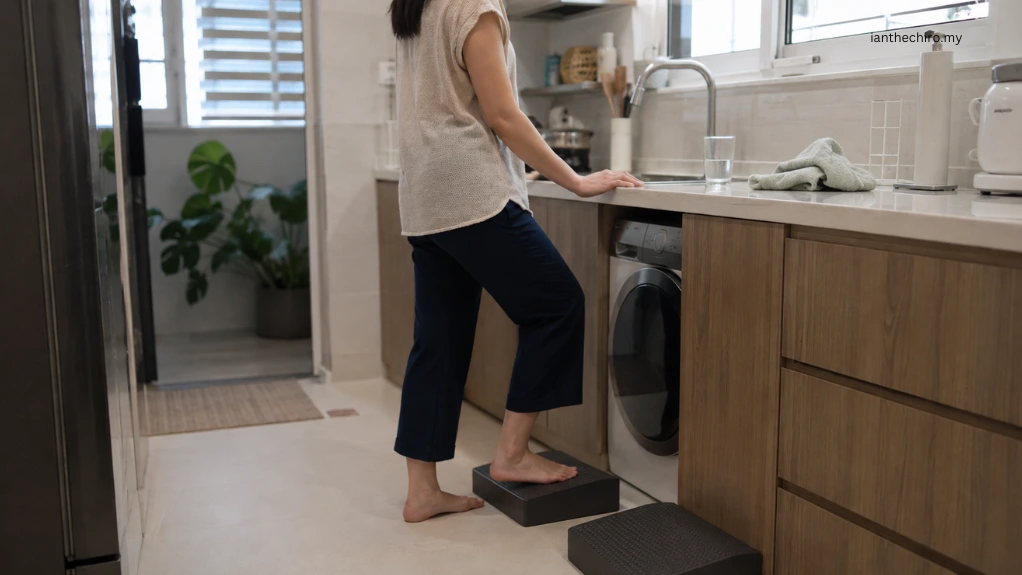
Placing one foot on a low step, rail, or stool changes the position of the pelvis and lower back. It also shifts some of the load between the legs.
This may temporarily feel more comfortable during cooking, washing dishes, counter work, or prolonged standing.
You can alternate feet rather than always elevating the same side.
Relief from a footrest does not prove that the hips are uneven or the pelvis is out of alignment. It simply shows that changing the position changes the symptoms, which may be useful practical information.
Is a Standing Desk Better for Lower-Back Pain?
A standing desk is not automatically better than a seated desk.
Replacing eight hours of sitting with eight hours of standing may exchange one prolonged position for another.
A more useful setup usually allows you to alternate between:
- sitting
- standing
- short walking breaks
- different foot positions
- tasks that require more movement
The best ratio is individual.
Someone currently developing pain after 15 minutes of standing should not force an hour because a generic rule says standing is healthier. Begin within a tolerable duration and adjust based on the response during and after the task.
What Can You Do if Standing Too Long Hurts Your Lower Back?
If the symptoms are mild, familiar, and not linked with warning signs, begin by changing the standing dose rather than trying to find a perfect posture.
Practical options include:
- alternate between standing, sitting, and walking before the pain becomes intense
- take short movement breaks instead of waiting until the back feels locked
- shift weight naturally rather than forcing equal pressure at all times
- use a low footrest and alternate sides when it feels helpful
- avoid locking the knees or bracing the entire body rigidly
- organise work so repetitive lifting or reaching is broken into smaller blocks
- use a comfortably supportive work surface and footwear
- consider an anti-fatigue mat when standing on a hard floor for long periods
- build standing time gradually after illness, injury, or reduced activity
- note whether walking, bending, sitting, or a particular position changes the symptoms
The aim is not to eliminate standing from your life.
The aim is to reduce unnecessary aggravation while rebuilding enough tolerance for work, cooking, commuting, shopping, exercise, and normal daily activity.
Should You Stretch Your Lower Back?
Gentle movement may help some people, but aggressive stretching is not always the answer.
Be cautious if a stretch:
- causes sharp or catching pain
- sends symptoms into the buttock or leg
- produces numbness, tingling, or burning
- feels better briefly but leaves the area worse afterward
- requires you to force the spine into an extreme position
- repeatedly aggravates the same extension-sensitive pattern
A tight feeling does not always mean that a muscle is physically shortened.
It may reflect fatigue, guarding, sensitivity, sustained loading, or the body’s response to pain. If stretching provides only a few minutes of relief before the pain returns during standing, the plan may need to address tolerance, movement, workload, and recovery instead.
Can Exercise Improve Standing Tolerance?
Exercise may help improve strength, endurance, movement confidence, and tolerance for daily activity.
Depending on the assessment, a programme may involve:
- trunk strength or endurance
- hip and leg strength
- movement-control exercises
- graded standing or walking exposure
- aerobic activity
- balance or single-leg control
- work-specific or lifting-specific preparation
The 2021 clinical practice guideline for acute and chronic lower-back pain supports exercise approaches that are matched to the presentation rather than relying on one universal routine. For chronic lower-back pain, the guideline includes trunk strengthening and endurance, multimodal exercise, aerobic exercise, aquatic exercise, and movement-control approaches among the available options.
This does not mean every person needs a complicated rehabilitation programme.
The appropriate starting point depends on what currently provokes the symptoms, how irritable the back is, what activities you need to tolerate, and whether neurological or medical features are present.
Do You Need an X-Ray or MRI?
Not automatically.
Many cases can begin with a history, movement assessment, neurological checks when relevant, and review of what aggravates or relieves the symptoms.
Imaging may be considered when:
- pain followed significant trauma
- a fracture, infection, cancer, or another serious condition is suspected
- there is progressive neurological loss
- symptoms suggest a structural stress injury
- walking or standing ability is progressively deteriorating
- severe symptoms are not following the expected course
- a specialist is considering a procedure or surgery
- the result is likely to change management
Scan findings also need to be interpreted carefully. Disc changes, arthritis, narrowing, and other age-related findings may appear in people who have no pain.
The NICE guideline advises against routine imaging for lower-back pain with or without sciatica in non-specialist settings. Imaging is generally considered in specialist care when the result is likely to change what happens next.
Can Chiropractic Care Help Lower-Back Pain That Is Worse When Standing?
It depends on the presentation.
A chiropractic consultation may be reasonable when the symptoms appear mechanically influenced and the assessment suggests that movement, joint sensitivity, muscle guarding, load tolerance, or related factors may be relevant.
Care may include:
- explanation and practical advice
- temporary activity or workload modification
- chiropractic adjustments or mobilisation when appropriate
- soft-tissue treatment or dry needling when relevant
- movement or exercise guidance
- gradual rebuilding of standing, walking, work, or training tolerance
- referral or imaging discussion when necessary
Not every patient needs an adjustment, and an adjustment should not be presented as permanently putting the spine back into place.
The NICE guideline advises that manual therapy may be considered for lower-back pain with or without sciatica, but only as part of a treatment package that includes exercise. This supports using hands-on care as one possible component rather than the entire strategy.
What Should a Lower-Back Assessment Include?
A useful assessment should look beyond how long you can stand.
It may consider:
- when the symptoms began and whether there was an injury
- the exact pain location and whether it travels
- how long standing takes to provoke symptoms
- whether standing still differs from walking
- what happens when you sit, bend, lean, or change foot position
- numbness, tingling, heaviness, weakness, or balance changes
- back, hip, knee, and ankle movement where relevant
- trunk and lower-limb strength or control where relevant
- work, lifting, sport, and daily standing demands
- previous episodes and treatment response
- sleep, stress, recovery, and general health
- warning signs that may require medical investigation
The assessment is not about performing every possible test. It is about selecting the checks that help distinguish an uncomplicated standing-sensitive pattern from a nerve-related, hip-related, injury-related, or medically concerning presentation.
When Should Lower-Back Pain Be Checked Medically First?
Most lower-back pain that develops during standing is not a medical emergency. However, the context and accompanying symptoms matter.
⚠️ When Should You Seek Medical Care First?
Seek urgent medical attention if lower-back pain is associated with new changes in bladder or bowel control, numbness around the saddle or genital region, rapidly worsening weakness in one or both legs, severe difficulty walking, or symptoms affecting both legs alongside neurological changes.
Prompt medical assessment is also important after major trauma, or when the pain occurs with fever, significant illness, unexplained weight loss, a history of cancer or serious infection, immune suppression, prolonged steroid use, new severe abdominal or pelvic pain, or pain that is unusually severe and progressively worsening. Persistent night pain that is unusual for you and does not change with position should also be assessed.
Do not repeatedly stretch, crack, massage, or exercise the back to test whether these symptoms disappear.
How Ian The Chiro Approaches Lower Back Pain When Standing Too Long
At Ian The Chiro in Cheras, the first visit begins with a chiropractic consultation rather than assuming that prolonged standing has compressed a joint or weakened the core.
The assessment first clarifies whether the pain is local or travelling, whether standing still differs from walking, whether sitting or bending provides relief, and whether neurological or medical features are present.
The next step is to determine what the back needs to tolerate. Someone who stands during retail work, healthcare, teaching, events, cooking, factory work, or public-transport commutes may require a different plan from someone whose symptoms appear only during gym training or weekend activities.
If conservative care is appropriate, the plan may combine symptom relief with practical changes and progressive movement or exercise. Chiropractic adjustments or dry needling may be considered when relevant, but neither is automatic.
If the pattern suggests lumbar spinal stenosis, a stress injury, progressive nerve involvement, hip pathology, or another condition requiring medical investigation, the next step may involve referral or imaging instead.
The goal is not to make you avoid standing forever. It is to understand why standing currently provokes the symptoms and help you regain useful tolerance where appropriate.
Want to Stand More Comfortably Without Guessing What Is Wrong?
Occasional discomfort after an unusually long day may settle with movement, recovery, and a temporary reduction in the aggravating workload.
However, assessment may be useful when lower back pain when standing too long keeps returning, reduces your ability to work or walk, causes you to sit down repeatedly, or begins travelling into the buttock or leg.
At Ian The Chiro in Cheras, Kuala Lumpur, the first step is a proper consultation to understand the symptom pattern and decide whether chiropractic care, exercise guidance, activity changes, medical referral, imaging, or another direction is appropriate.
Lower Back Pain When Standing Too Long: Frequently Asked Questions
Why does my lower back hurt when I stand for too long?
Your lower back may hurt during prolonged standing when the duration, position, or total workload exceeds what the area currently tolerates. Muscle fatigue, reduced movement variety, an extension-sensitive pattern, hip or leg contribution, joint or tissue sensitivity, poor recovery, or nerve-related symptoms may also be involved.
Is standing bad for lower-back pain?
Standing is not automatically bad for the lower back. The difficulty may be remaining relatively still for longer than you currently tolerate. Many people do better when they alternate standing with sitting, walking, and other comfortable movements instead of avoiding standing completely.
Why does my lower-back pain improve when I sit down?
Sitting changes the position and load through the lower back, hips, and legs and may reduce the effort required to remain upright. Relief with sitting can occur in several patterns and does not confirm one diagnosis, although it becomes more relevant to lumbar spinal stenosis when standing or walking also causes leg pain, heaviness, numbness, or weakness.
Why can I walk but not stand still?
Walking continually changes weight distribution and creates movement through the hips, legs, trunk, and arms. Standing still provides less movement variety, so an already sensitive or fatigued area may become noticeable sooner even though you can continue walking.
Does lower-back pain when standing mean I have spinal stenosis?
Not necessarily. Lumbar spinal stenosis becomes more plausible when standing or walking repeatedly produces buttock or leg symptoms that ease with sitting or bending forward, particularly in an older adult. Local back pain during standing alone cannot confirm stenosis.
Could a slipped disc cause pain when standing?
A disc-related problem can produce lower-back or leg symptoms, but standing pain alone cannot confirm a disc injury. Disc-sensitive presentations vary, and some people feel worse during sitting or bending instead. The location, neurological symptoms, aggravating movements, and assessment findings matter.
Should I squeeze my core while standing?
You do not need to brace your abdomen as hard as possible throughout the day. Constant bracing may increase fatigue and make standing feel more rigid. Some tasks require trunk tension, but ordinary standing should still allow comfortable breathing, natural weight shifts, and movement.
Can weak glutes cause lower-back pain when standing?
Hip strength or endurance may be relevant in some cases, but the symptom should not automatically be blamed on weak glutes. Standing-related back pain may involve several factors, and strength findings need to be interpreted alongside movement, workload, pain behaviour, recovery, and the activities you need to perform.
Will better shoes or an anti-fatigue mat fix the pain?
Comfortable footwear or an anti-fatigue mat may reduce discomfort for some people standing on hard surfaces, but neither can address every possible contributor. They are practical options to trial, not proof that the feet or floor caused the problem.
Should I stretch my hip flexors if standing hurts my back?
Gentle hip-flexor stretching may feel useful for some people, but front-of-hip tightness does not automatically mean shortened hip flexors are causing the back pain. Stop if the stretch creates sharp pain, groin pinching, leg symptoms, or a lasting aggravation.
Do I need an X-ray or MRI for lower-back pain when standing too long?
Not usually before an initial assessment. Imaging may be considered after trauma, with progressive neurological loss, when a serious condition or stress injury is suspected, or when the result is likely to change treatment or referral. Common scan findings do not always explain pain by themselves.
Can chiropractic care help lower-back pain when standing too long?
It depends on the cause and assessment findings. Chiropractic care may be considered when the pattern is suitable and movement, joint sensitivity, muscle guarding, or load tolerance appears relevant. A responsible plan may also involve advice, exercise, activity changes, or referral rather than relying only on adjustments.