
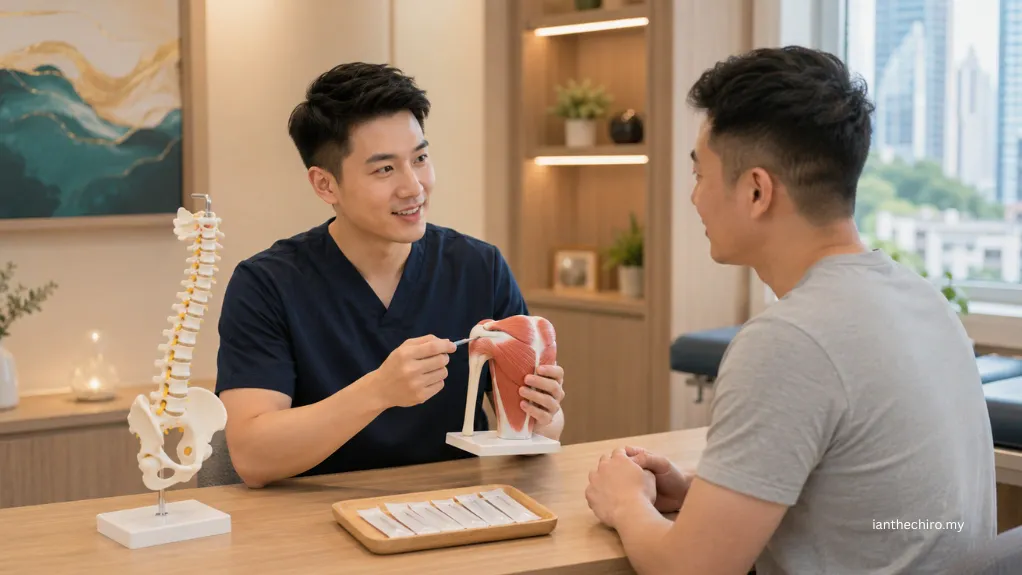
Dry needling and acupuncture can look similar at first glance.
Both use thin needles. Both may be used by people dealing with pain, tension, or stiffness. Both may involve needles being placed into the body for a short period of time.
So it is understandable if you are wondering whether they are the same thing.
The short answer is no. Dry needling and acupuncture may look similar from the outside, but they are usually based on different treatment frameworks, different assessment approaches, and different goals.
At Ian The Chiro in Cheras, Kuala Lumpur, dry needling is usually considered when muscle tension, trigger points, muscle guarding, or movement-related pain patterns may be contributing to a patient’s symptoms.
This article is for general education and is not a diagnosis. If you are unsure whether dry needling is suitable for your case, start with a proper consultation.
Quick Answer: Dry Needling vs Acupuncture
Dry needling and acupuncture both use thin needles, but they are not the same treatment.
Dry needling is usually used in a musculoskeletal setting. It often focuses on muscles, trigger points, muscle guarding, pain sensitivity, and movement-related symptoms.
Acupuncture is traditionally part of Chinese medicine. It uses specific acupuncture points and may be applied for pain, wellness, internal health concerns, stress, and broader body-system goals depending on the practitioner’s training and approach.
In simple terms:
- dry needling is usually muscle-focused
- acupuncture is usually point-system focused
- dry needling is commonly used for musculoskeletal pain
- acupuncture may be used for a wider range of concerns
- both involve needles
- the reasoning behind the needle placement is usually different
The best choice depends on what problem you are trying to address and what kind of assessment you need.
Why People Confuse Dry Needling and Acupuncture
The confusion is understandable.
From the outside, both treatments may involve:
- thin needles
- skin penetration
- treatment while lying down
- temporary soreness afterward
- pain-related goals
- a trained practitioner inserting needles into specific areas
This can make the two treatments look almost identical to patients.
But the needle is only one part of the treatment.
The bigger difference is the reasoning behind why the needle is placed there.
The needle may look similar, but the clinical reasoning behind dry needling and acupuncture is usually not the same.
What Is Dry Needling?
Dry needling is a technique where a thin needle is inserted into a muscle or related soft tissue area.
It is called “dry” because nothing is injected. There is no medication, fluid, or steroid being pushed into the body.
The Cleveland Clinic guide to dry needling explains dry needling as a treatment that uses thin needles to target trigger points in muscles, without injecting medication.
In many musculoskeletal clinics, dry needling is used when the assessment suggests that muscle tension, trigger points, muscle guarding, or sensitivity may be contributing to pain or movement restriction.
Dry needling may be considered for areas such as:
- neck tightness
- shoulder tension
- upper back tightness
- lower back muscle guarding
- glute or hip tightness
- calf tightness
- sports-related muscle tension
- recurring muscle tightness
- movement-related pain patterns
The goal is not simply to poke painful areas.
The goal is to decide whether a muscle or soft tissue component may be contributing to the problem, and whether dry needling is appropriate for that case.
What Is Acupuncture?
Acupuncture is a treatment approach that comes from traditional Chinese medicine.
The NCCIH guide to acupuncture describes acupuncture as a technique where practitioners insert fine needles into the skin to treat health problems, with origins in traditional Chinese medicine.
It involves inserting thin needles into specific points on the body. These points are usually chosen based on the practitioner’s system of assessment and treatment goals.
Acupuncture may be used for pain, but it may also be used for broader health and wellness concerns depending on the practitioner’s training, philosophy, and scope of practice.
This may include areas such as:
- pain management
- stress-related concerns
- general wellness
- headaches
- muscle discomfort
- internal health concerns
- sleep or relaxation support
Different acupuncturists may explain their approach differently. Some use a traditional Chinese medicine framework. Some may also explain treatment using modern pain science or nervous system concepts.
The key point is this: acupuncture is not only about muscle trigger points.
The Main Difference Is the Treatment Framework
The biggest difference between dry needling and acupuncture is not the needle.
It is the framework behind the treatment.
Dry needling usually asks:
- Which muscle may be contributing?
- Is there a trigger point?
- Is there muscle guarding?
- Is the area sensitive because of overload?
- Is movement being affected?
- Is dry needling appropriate alongside other care?
Acupuncture may ask different questions depending on the practitioner’s framework, such as:
- Which acupuncture points are relevant?
- What body system pattern is being treated?
- Is the goal pain relief, relaxation, wellness, or another concern?
- How does this fit into the broader Chinese medicine assessment?
This is why two practitioners may use similar-looking needles but make very different clinical decisions.
Dry Needling Is Usually More Muscle-Focused
Dry needling is commonly used when the problem seems to involve muscles or soft tissue sensitivity.
For example, someone may feel:
- a tight knot in the shoulder
- muscle tightness that keeps returning
- stiffness after gym training
- tension around the neck and upper back
- glute tightness after running
- calf tightness after sports
- lower back guarding after irritation
In these cases, dry needling may be considered if the assessment suggests that muscle tension or trigger points are part of the issue.
But dry needling is not automatically needed for every tight muscle.
Sometimes tightness is only a response to another issue, such as joint irritation, nerve sensitivity, poor load tolerance, stress, sleep issues, training overload, or repeated positions.
That is why assessment matters.
Acupuncture May Be Broader Than Muscle Pain
Acupuncture may also be used for pain, but its traditional framework is usually broader than muscle treatment alone.
An acupuncturist may choose points based on pain location, body system patterns, traditional Chinese medicine principles, or a combination of approaches.
This means acupuncture may be used for people looking for help with pain, stress, wellness, headaches, sleep-related concerns, or other issues depending on the practitioner’s scope.
Dry needling is usually narrower.
It is usually considered within a musculoskeletal pain and movement context.
That does not make one better than the other.
It means they are not trying to do the exact same thing.
Is Dry Needling Better Than Acupuncture?
Not necessarily.
The better question is not “which one is better?”
The better question is:
“What is the problem, and which approach fits the goal?”
Dry needling may make more sense if the issue appears to be strongly related to muscle tension, trigger points, guarding, or movement-related pain.
Acupuncture may make more sense if someone wants a broader traditional Chinese medicine approach, or if their goals are not purely musculoskeletal.
Some people respond well to dry needling. Some prefer acupuncture. Some may benefit from a completely different approach.
It depends on the case.
When Dry Needling May Make Sense
Dry needling may be considered when muscle involvement appears relevant.
This may include cases where there is:
- muscle tightness that keeps returning
- trigger point tenderness
- local muscle guarding
- movement restriction linked to muscle tension
- pain that feels muscular
- sports-related muscle tightness
- recurring neck or shoulder tension
- lower back tightness with muscle guarding
- discomfort that improves temporarily with massage but returns
Dry needling may be used as part of a broader plan. It is usually not the whole solution by itself.
For example, if your shoulder keeps tightening because of gym technique, desk posture, sleep, or training load, needling the muscle may help symptoms temporarily, but the bigger pattern still needs to be addressed.
When Dry Needling May Not Be the Right First Step
Dry needling is not suitable for everyone.
⚠️ Dry Needling May Not Be Suitable for Every Case
Dry needling may not be the right first step if there is infection around the area, unexplained swelling, significant bleeding risk, certain medical conditions, severe needle fear, unusual symptoms, worsening neurological symptoms, major trauma, or pain that has not been assessed properly.
You should also tell your practitioner if you:
- are taking blood-thinning medication
- bruise or bleed easily
- are pregnant
- have a history of fainting with needles
- have a needle phobia
- have immune system concerns
- have had recent surgery
- have a complex medical history
- feel unwell on the day of treatment
This does not automatically mean dry needling can never be done.
It means the decision needs to be made carefully.
Does Dry Needling Hurt More Than Acupuncture?
It depends on the person, the area being treated, and the technique used.
Dry needling may sometimes create a deep ache, twitch response, cramp-like feeling, or temporary soreness. Some people describe it as uncomfortable but manageable. Others find certain areas more sensitive.
Acupuncture may also cause different sensations, such as aching, heaviness, tingling, warmth, or mild discomfort, depending on the points used and the practitioner’s technique.
Neither treatment should feel like something you are being forced to tolerate.
If you are nervous, sensitive, or uncomfortable, say so before treatment.
What Happens After Dry Needling?
After dry needling, some people feel temporary soreness around the treated area.
Possible short-term effects may include:
- muscle soreness
- mild bruising
- temporary tenderness
- tiredness
- a heavy feeling in the treated area
- temporary increase in symptoms
- improved movement or reduced tightness in some cases
This usually settles, but you should be told what to expect and what to do afterward.
Aftercare may include:
- gentle movement
- avoiding aggressive training immediately after
- drinking enough water
- monitoring your response
- avoiding repeatedly testing the area
- telling the clinic if symptoms feel unusual or concerning
Can Dry Needling and Acupuncture Both Help Pain?
Both dry needling and acupuncture may be used by people seeking pain relief.
But the way they are chosen and applied may differ.
For dry needling, the decision is often based on whether the muscle or soft tissue seems to be contributing to the pain pattern.
For acupuncture, the decision may be based on acupuncture points, traditional Chinese medicine assessment, pain-related goals, or broader wellness goals.
The important thing is not just whether a needle is used.
The important thing is whether the treatment matches the person, the problem, and the goal.
Can Dry Needling Fix Muscle Tightness Permanently?
Not usually by itself.
Dry needling may help reduce muscle tension, sensitivity, or guarding in some cases. But if the same muscle keeps tightening because of repeated load, poor recovery, training errors, stress, sleep issues, or joint and nerve irritation, the tightness may return.
That is why dry needling should usually be paired with a broader plan.
That plan may include:
- identifying the trigger pattern
- modifying activity temporarily
- improving movement tolerance
- changing training load
- adding exercise where appropriate
- addressing recovery
- checking whether the tightness is a response to another issue
The goal is not to needle the same muscle forever.
The goal is to understand why it keeps becoming sensitive.
How Ian The Chiro Approaches Dry Needling
At Ian The Chiro, dry needling is not treated as a standalone magic fix.
The first step is to understand the pain pattern.
First, where is the symptom?
This includes whether the pain is local, spreading, recurring, sharp, dull, tight, or linked with movement.
Second, what seems to be contributing?
This may involve muscle guarding, joint restriction, training load, posture, work habits, sleep, stress, or nerve-related sensitivity.
Third, is dry needling suitable?
Some cases may be suitable for dry needling. Others may need chiropractic care, movement advice, exercise guidance, activity modification, or medical review first.
Fourth, what needs to change outside the session?
If the same habits or loads keep feeding the same muscle tension, dry needling alone may not be enough.
The aim is not to choose dry needling just because a muscle feels tight.
The aim is to decide whether dry needling actually makes sense for the case.
What Should You Ask Before Dry Needling?
If you are unsure, it is reasonable to ask questions.
Helpful questions include:
- Why do you think dry needling is suitable for my case?
- Which muscle or area are you targeting?
- What should I feel during treatment?
- What should I expect afterward?
- Are there any reasons I should avoid it?
- Is this part of a bigger plan?
- What should I do if the tightness returns?
- Are there non-needle options?
You do not need to understand every technical detail.
But you should understand why dry needling is being recommended.
What Not to Do
Try to avoid:
- assuming dry needling and acupuncture are exactly the same
- choosing treatment based only on the needle
- expecting dry needling to fix every pain problem
- ignoring symptoms that travel, worsen, or affect strength
- hiding medical history or medication use
- forcing yourself through treatment if you are uncomfortable
- treating every tight muscle as a trigger point
- repeating dry needling without understanding why symptoms return
- using dry needling as a replacement for proper assessment
Needles can be useful in the right case.
But the reasoning matters more than the tool.
Common Questions About Dry Needling vs Acupuncture
Is dry needling the same as acupuncture?
No. Dry needling and acupuncture both use thin needles, but they are usually based on different treatment frameworks. Dry needling is commonly used for muscle-related pain and trigger points, while acupuncture is traditionally based on Chinese medicine and specific acupuncture points.
What is the main difference between dry needling and acupuncture?
The main difference is the reasoning behind the needle placement. Dry needling usually focuses on muscles, trigger points, and movement-related symptoms. Acupuncture usually uses acupuncture points and may be applied for pain, wellness, or broader health concerns.
Is dry needling better than acupuncture for muscle pain?
Not always, but dry needling may be more directly focused on muscle tension and trigger points. The better choice depends on the problem, the assessment, the practitioner’s training, and your treatment goals.
Does dry needling hurt?
Dry needling may feel uncomfortable in some areas. Some people feel a deep ache, twitch, cramp-like sensation, or temporary soreness. If you are nervous or sensitive, tell your practitioner before treatment.
Does acupuncture hurt?
Acupuncture is often described as mild or tolerable, but sensations vary. Some people feel aching, tingling, heaviness, warmth, or mild discomfort depending on the points used and the technique.
Can dry needling help tight muscles?
Dry needling may help when muscle tension, trigger points, or guarding are part of the problem. But if the muscle keeps tightening because of load, stress, poor recovery, joint irritation, or nerve sensitivity, the bigger pattern still needs to be addressed.
Can dry needling help neck and shoulder tension?
It may help in some cases where muscle tension or trigger points are contributing. However, neck and shoulder tension can also involve posture, work habits, stress, sleep, training load, joints, or nerve irritation, so assessment matters.
Is dry needling safe?
Dry needling can be safe when performed by a trained practitioner after proper assessment. It may not be suitable for everyone, especially if there are bleeding risks, infection, severe needle fear, certain medical conditions, or symptoms that need medical review first.
Should I choose dry needling or acupuncture?
Choose based on your goal. If your issue feels more muscle, movement, or trigger-point related, dry needling may be worth considering. If you want a broader traditional Chinese medicine approach, acupuncture may be more suitable.
Do I need a consultation before dry needling?
Yes. A consultation helps decide whether dry needling actually makes sense for your symptoms, or whether another approach would be safer or more useful.