

You have been offered dry needling for a tight shoulder or an aching muscle. It sounds straightforward: a fine needle, a short treatment, then perhaps some temporary soreness. But you may be wondering what could go wrong, what your medical history changes, and whether it is sensible to have needles placed near your neck or back.
Is dry needling safe? It can be performed with an acceptable safety profile when a suitably trained clinician assesses the person, the body region and the risks before proceeding. It is still an invasive procedure, and safe practice does not mean risk-free practice. Our dry needling for muscle pain service explains how the clinic considers needling alongside other treatment options instead of treating every tender muscle with a needle.
This guide focuses on the safety decision itself: common minor effects, uncommon serious complications, medical reasons to avoid or modify the procedure, and symptoms that require attention afterwards. It is different from a guide to how needles feel or how to manage ordinary post-treatment soreness.
Quick Answer: Is Dry Needling Safe?
Most reported effects of dry needling are temporary and relatively minor, such as soreness, small bruises or slight bleeding. Serious complications are reported much less often, but they can occur. The chance and nature of harm depend partly on the body region, technique, clinician training, individual medical risks and how adverse events are recorded.
A 2026 systematic review of dry-needling adverse events found wide differences in reported frequencies across studies and research designs. That makes one universal percentage misleading. Surveys asking clinicians about their entire career also cannot be interpreted as the chance of harm from a single session.
The practical answer is neither “perfectly safe” nor “too dangerous for anyone.” It is whether this particular procedure, in this anatomical region, offers a worthwhile benefit for you after appropriate screening, consent and a discussion of alternatives.
What Actually Makes a Needling Session Safer?
Safety is not determined by how thin a needle looks. It comes from several decisions made before and during treatment.
First, there should be a reason to consider the procedure. A painful shoulder, for example, could involve muscle sensitivity, a joint problem, nerve-related symptoms or a medical condition. If the symptoms do not fit a situation where needling might help, avoiding an unnecessary needle is itself a safety decision.
Second, the practitioner must understand the local anatomy and be trained in safe techniques for that body region. Needling beside the lungs, major nerves or blood vessels presents different hazards from a low-risk superficial soft-tissue area. A method that is suitable for one person or muscle cannot simply be copied elsewhere.
Third, the clinician needs relevant health information: medication, infection, pregnancy, previous bleeding, recent operations, needle-related fainting and other concerns. An assessment and informed consent are safety measures, not just formalities before treatment.
Finally, the session should use appropriate infection-control practices, monitor how you respond and stop when the symptoms or situation are not right. You should be able to ask questions and withdraw consent without pressure.
Which Side Effects Are Common and Usually Temporary?
A small skin puncture can irritate nearby tissues, so some after-effects are expected. They are not automatically a complication requiring emergency care.
Local Soreness or Tenderness
The treated muscle can feel achy or more sensitive later that day or the next. It may resemble mild post-exercise soreness and usually settles. Soreness alone does not show that the clinician reached a particular trigger point, that the treatment was effective, or that stronger treatment would have helped more.
Small Bruises or Spot Bleeding
A tiny amount of bleeding when a needle is removed or a small bruise afterwards can occur. Light pressure is commonly sufficient for minor spotting. Tell your clinician about unusual bruising, a bleeding disorder, or blood-thinning medicines before the procedure rather than assuming a small needle cannot cause a problem.
Fatigue, Light-Headedness or Nausea
Some people become dizzy, sweaty, nauseated or faint during needle procedures. This can be a vasovagal response, which may occur even in someone without a serious medical illness. It matters because fainting can cause a fall if the person is standing or sitting unsupported.
Our guide on whether dry needling hurts explains the sensations during insertion and why the strength of a twitch or ache is not a measure of treatment quality. For later soreness and activity decisions, the separate what to expect after dry needling guide gives more detailed aftercare information.
A short-lived ache is different from worsening severe pain, spreading neurological symptoms or breathing difficulty. Those concerns need a different response.
What Serious Complications Should You Know About?
Serious adverse events are uncommon in reports, but they belong in an informed consent discussion when relevant to the proposed area. Understanding them should lead to better screening and safer decisions, not unnecessary fear.
Pneumothorax Near the Chest, Upper Back or Shoulder
A pneumothorax occurs when air enters the space around a lung. It has been reported after needling around the thorax, upper back and shoulder region. It may cause chest pain, shortness of breath, difficulty breathing or symptoms that develop after leaving the clinic. Appropriate needling technique and anatomical knowledge matter greatly in these areas.
Infection, Significant Bleeding or Tissue Injury
Skin penetration introduces an infection risk, particularly if needles, hands or the skin are not managed hygienically. Most visible bleeding is minor, but people with significant bleeding risks may face greater consequences. Injuries involving a blood vessel, nerve or other structure have also been reported.
Why a Reported Complication Does Not Give You a Personal Risk Number
Case reports establish that a complication is possible, not how likely it is for every patient. Studies group together different practitioners, body regions, techniques and reporting methods. The 2026 review noted that minor effects were common but the measured rates varied considerably, while major events were less frequent and still important.
Ask about the risks of the exact region proposed for you, rather than relying on a general claim that all dry needling has one safety rate.
When Should Dry Needling Not Go Ahead?
Some situations are a reason to stop, postpone or choose another approach before any needle is used. The decision is not simply a checklist of conditions that can be ignored with a lighter technique.
An active skin infection, open wound or suspicious lesion at the proposed site is a reason not to needle through that area. If you have a systemic infection, fever or feel acutely unwell, musculoskeletal needling should be deferred while the cause is considered. Severe bleeding risk, a significant recent operation near the intended region or inability to obtain valid informed consent can also make the procedure inappropriate.
A person who is highly distressed by needles, cannot remain safely positioned or is unwilling to proceed should not be pressured into treatment. Fear is not a failure to cooperate; consent is voluntary and can be withdrawn at any point.
The 2026 clinical decision-making consensus on dry needling groups situations into contraindications, precautions and reasons to modify or defer care. Its recommendations reflect expert agreement and clinical judgment, not a trial proving that one universal rule fits every patient. Some medical concerns need clearance or an alternative, and the exact decision depends on the body area and circumstances.
Pregnancy deserves specific care. High-risk pregnancy, early pregnancy and uncertainty about suitability should prompt deferral or appropriate medical advice rather than routine needling. A procedure should not be considered acceptable merely because another pregnant person had it elsewhere.
If screening raises an unresolved medical concern, delaying needling is a reasonable clinical decision. There is usually no reason to rush a non-urgent musculoskeletal procedure.
Which Medical Conditions Need Extra Precautions?
Other circumstances are important to disclose even when they do not always rule needling out. Patients should never stop or change prescription medication to make themselves eligible for treatment.
Blood Thinners and Easy Bruising
Anticoagulants or antiplatelet medicines can increase bleeding or bruising concerns. The medicine alone is not necessarily an absolute contraindication, but individual bleeding history, the specific medicine, the treatment depth and the target region matter. Significant bleeding disorders warrant particular caution and sometimes medical advice or a decision not to proceed.
Immune Suppression, Diabetes and Fragile Skin
A reduced ability to fight infection, poorly healing wounds, fragile skin or certain treatments that affect tissue healing change the benefit-risk calculation. A history of infection after a procedure is also relevant. A clinician may decide to avoid the site, modify the plan, defer needling or suggest a non-needle alternative.
Pregnancy, Recent Surgery and Implanted Devices
Tell the clinician about pregnancy or possible pregnancy, recent surgery, implanted devices and any restrictions from another treating doctor. Ordinary dry needling and electrical stimulation through needles are not the same procedure; electrical stimulation requires additional precautions around pacemakers and other electronic implants.
Previous Fainting, Needle Phobia or Altered Sensation
A history of fainting during blood tests, panic attacks, severe needle anxiety or altered ability to sense or report pain matters for safe positioning and monitoring. People with unusual nerve symptoms or a very sensitive pain presentation may also need a different assessment before any invasive soft-tissue treatment.
These factors do not all mean the same thing. Some require treatment to stop, others require modification, and some call for medical discussion. The important thing is to disclose them before treatment and understand how they affect the plan.
Why Does the Body Region Change the Safety Conversation?
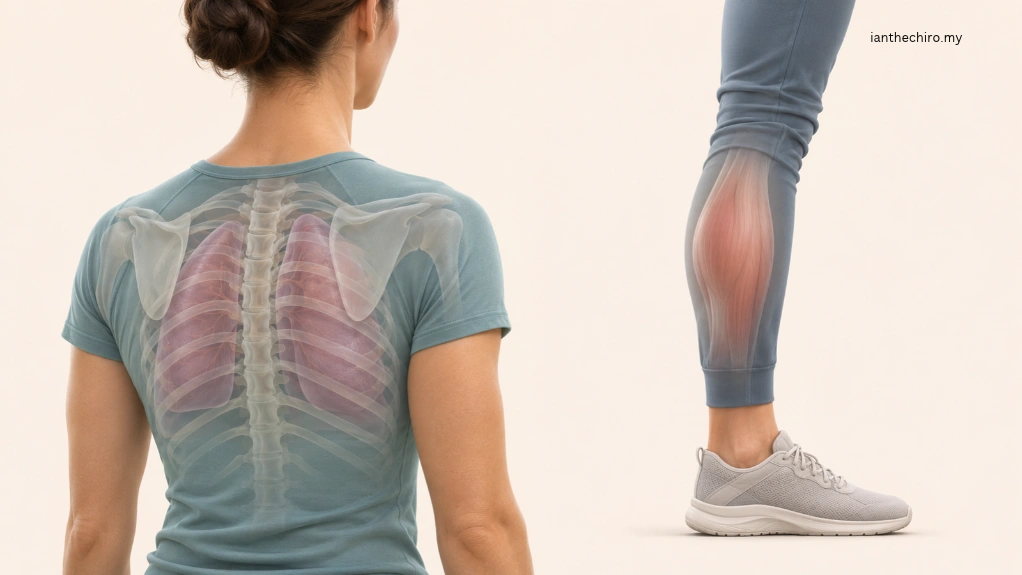
A needle directed into a calf muscle and a needle used near the upper chest do not have identical surrounding anatomy. The thorax, upper back, anterior neck and other regions with major nerves, blood vessels or organs require specialised anatomical knowledge and appropriate safeguards.
For someone considering needling around the upper trapezius, the safety conversation should include the proximity of the lung and relevant structures rather than treating it as identical to a superficial leg-muscle treatment. The question is not how many needles will be used, but why that location was selected and whether the clinician is qualified to treat it safely.
The same principle applies to the lower back, deep gluteal region and areas near important neurovascular structures: the reason, depth, surrounding anatomy and person-specific risk need to be considered together. The correct technique is a professional clinical judgment. It is not something patients should attempt to reproduce at home or through informal self-needling.
If a clinician cannot explain why a high-risk area is being treated or discuss the relevant precautions, that is a reason to reconsider. You do not need to accept needling in a higher-risk region just because that area feels tight.
What Should Happen Before the First Needle?
You should be able to explain your main complaint and understand what the clinician is trying to improve. A proposed outcome might be easier neck rotation, less discomfort when lifting or improved tolerance for a particular movement. Merely finding a tender spot is not enough to justify an invasive procedure.
A suitable pre-treatment conversation includes your symptoms and medical history, the intended region, known risks, likely temporary effects, alternatives and what to do if you feel unwell. The practitioner should clarify how the session will be adapted or stopped if necessary.
Sterile, single-use needles, appropriate hand hygiene, suitable skin preparation and safe disposal are basic procedural expectations. The treatment environment should allow stable positioning and access to assistance if someone becomes faint. Never accept the reuse of a disposable needle.
Consent is not a signature that removes your right to speak. During treatment, you can ask to pause, move, stop or use another approach. The practitioner should reassess how you feel and respond to unusual sensations rather than insisting on a powerful twitch or strong ache.
At Ian The Chiro in Cheras, the conversation should begin with suitability and a clear reason for treatment. Needling may be offered when the clinical findings support it, but an assessment may instead lead to exercise advice, hands-on care or a medical referral.
What If You Feel Dizzy or Unwell During Needling?
Speak up immediately if you feel faint, sweaty, nauseated, unusually weak or distressed. The clinician should stop needling, help you remain safely positioned and monitor your recovery. Getting up suddenly can increase the chance of falling.
Similarly, describe unexpected sharp, electric or spreading symptoms rather than silently waiting for them to pass. A strong sensation is not proof that a needle is working. You should not have to endure escalating pain to receive effective care.
If a person loses consciousness, has a seizure, develops breathing difficulty or has symptoms suggesting a medical emergency, appropriate emergency response is necessary. Ordinary reassurance and a glass of water are not substitutes for assessment when serious signs are present.
A safe session allows the patient to stop without having to justify the request. That principle is especially important for first-time patients or anyone who has previously felt faint during medical procedures.
⚠️ When Should You Get Medical Help After Dry Needling?
Seek urgent medical assessment for new chest pain, shortness of breath or difficulty breathing after dry needling near the chest, shoulder or upper back. A pneumothorax is one possible cause, and symptoms may not begin immediately. Do not treat breathing symptoms as routine muscle soreness or wait for a follow-up appointment.
Other concerns needing prompt medical attention include significant or persistent bleeding, rapidly increasing swelling, new pronounced weakness or numbness, or spreading redness, warmth and fever that suggest infection. Seek emergency help for severe or rapidly progressing symptoms, collapse or major breathing difficulty.
By contrast, a small bruise or mild local tenderness that settles without new concerning features is commonly manageable with simple aftercare. Our full guide to what to expect after dry needling covers everyday recovery questions, including gentle movement and how to adapt exercise while a treated area feels tender.
When unsure, tell the treating clinician what happened, where needles were used and when the new symptoms began. If a serious symptom is present, contact emergency medical services rather than trying to reach the clinic first.
Is the Potential Benefit Worth the Risk for You?
Dry needling may be considered for selected muscle-related symptoms, but a possible short-term improvement has to be meaningful enough to justify an invasive procedure. Your priority might be turning your neck more comfortably, returning to training or sleeping with less pain. A reduction in tenderness during a brief check is not the same as long-term improvement in daily life.
Ask what alternatives exist and how progress will be measured. If the symptoms might involve a nerve rather than a local muscle problem, our muscle pain versus nerve pain guide can help you understand why a different examination may be needed.
You may also want to ask whether a non-needle option can accomplish the same immediate goal. Our dry needling versus massage comparison explores the distinction between hands-on pressure and needle-based treatment, including why neither approach is right for every presentation.
No treatment is safer merely because it sounds more targeted. Needling is worth considering only when the indication is reasonably clear, the risks have been discussed and the expected benefit matches your preferences.
What If You Decide Against Dry Needling?
Declining needles is a valid care decision. Depending on the complaint, you may still benefit from guided exercise, movement modifications, education, load management or selected manual and soft-tissue techniques. These approaches have their own indications and limitations, but they avoid the skin-puncture risks of dry needling.
If you are unsure whether your goal is a musculoskeletal needle technique or a traditional acupuncture approach, our dry needling versus acupuncture guide explains the differences. They both involve needles, and neither should be treated as free of procedural risk.
A history of fainting, severe needle anxiety or an unresolved health concern may make a non-needle option particularly attractive. A practitioner should be able to explain what you gain and lose with each choice rather than framing needles as compulsory.
Make Safety Part of the Treatment Decision
The better question is not simply whether dry needling is safe in general. It is whether the treatment is appropriate for your symptoms, whether the specific region can be treated competently, and whether the precautions relevant to your health have been addressed.
At Ian The Chiro in Cheras, Kuala Lumpur, a chiropractic consultation can establish the symptom pattern and help decide whether dry needling, another conservative approach or medical referral makes sense. You should leave that conversation understanding the intended benefit, important risks and available choices, whether or not any needling takes place.
Frequently Asked Questions About Dry Needling Safety
Can dry needling cause an infection?
Yes, infection is a potential complication whenever the skin is punctured. Sterile single-use needles, appropriate hygiene and avoiding infected or open skin reduce avoidable risk. Contact a medical professional if redness, heat, swelling or pain worsens, particularly with fever.
Is dry needling safe if I take blood thinners?
It may require additional precautions and may be unsuitable in some circumstances. Tell the practitioner which medicines you take and about any bleeding history. Do not stop prescribed anticoagulants or antiplatelets just to receive dry needling; the clinician may defer the procedure or seek medical advice.
Can dry needling puncture a lung?
It is possible, particularly when needling near the chest, upper back or shoulder. Pneumothorax is an uncommon but serious reported complication. New chest pain or breathing difficulty after treatment needs urgent medical attention even if symptoms begin later.
Should I have dry needling during pregnancy?
Tell the clinician if you are pregnant or might be. Pregnancy stage, health risks, the intended body area and medical guidance change the decision. High-risk pregnancy and uncertainty about safety are reasons to defer treatment or seek appropriate advice, not to proceed routinely.
Is dry needling safer than acupuncture or an injection?
These are different procedures with different goals and methods. All forms of skin penetration carry risks, and safety cannot be ranked reliably from the name alone. Practitioner training, anatomical location, technique, screening and infection control matter more than a broad label.
What if I had no soreness after dry needling?
An absence of soreness is not a safety concern on its own and does not prove that the treatment was ineffective. Likewise, a strong ache does not establish that the treatment worked. Judge the session by meaningful symptoms, function and whether any unexpected reactions occur.