

Your wrist feels fine when you wake up.
Then you start working.
After an hour of typing, using the mouse, replying to messages, or switching between tabs, the wrist begins to ache.
Maybe it feels tight around the forearm. Maybe the pain sits on the thumb side of the wrist. Or perhaps the hand starts tingling and you immediately wonder:
“Is this carpal tunnel?”
Wrist pain when typing can happen for several different reasons.
The problem may involve local wrist or forearm tissues that are becoming sensitive to repeated use. In other cases, the symptom pattern may involve a tendon, the median nerve at the carpal tunnel, another nerve around the arm, or even symptoms influenced by the neck.
And sometimes the problem is less about one damaged structure and more about how much work the hand and wrist are being asked to tolerate, for how long, and how much opportunity they have to recover.
At Ian The Chiro in Cheras, Kuala Lumpur, wrist pain is therefore not automatically labelled as “carpal tunnel” simply because typing aggravates it. The clinic’s current upper-limb assessment pathway also considers the wrist together with grip, repeated hand use, the elbow, shoulder, neck, work routine, and neurological symptoms where relevant.
The useful question is:
What exactly hurts, what happens the longer you type, and is there anything about the symptom pattern that points towards a more specific problem?
This article is for general education and is not a diagnosis.
Quick Answer: Why Does My Wrist Hurt When Typing?
Wrist pain when typing may be related to:
- repeated wrist or forearm loading
- muscle or tendon irritation
- prolonged or awkward wrist positions
- symptoms associated with carpal tunnel syndrome
- pain or nerve symptoms influenced by the forearm, elbow, or neck
Typing itself does not tell you which one is responsible.
The type of symptom matters.
An ache around the forearm or wrist is different from numbness in particular fingers.
Pain on the thumb side of the wrist is different again from pain on the back of the wrist when you lean through your hand.
“My wrist hurts when I type” describes the activity that aggravates the problem. It does not tell you the diagnosis.
Where Exactly Does Your Wrist Hurt?
Before blaming the keyboard, it helps to get more specific.
Pain around the palm side of the wrist
Pain here may involve local soft tissues, flexor muscles and tendons, joint irritation, or nerve-related symptoms.
If the discomfort is accompanied by tingling or numbness into the thumb, index, middle, or part of the ring finger, carpal tunnel syndrome becomes more relevant.
Pain on the thumb side of the wrist
Pain around the thumb-side tendons may behave differently.
Some people notice discomfort with repeated thumb movements, gripping, lifting a phone, scrolling, pinching, or movements that combine the thumb and wrist.
A condition such as de Quervain tendinopathy is one possibility, but location alone is not enough to diagnose it.
Pain on the back of the wrist
This may become noticeable during typing, but it may be even more obvious when the wrist is bent backwards during push-ups, gym exercises, yoga, getting up from a chair, or leaning through the hand.
That pattern creates different assessment questions from classic carpal tunnel symptoms.
Pain on the little-finger side
The structures on the ulnar side of the wrist are different again.
Pain here may be influenced by gripping, twisting, loading through the hand, sport, previous injury, or local wrist structures.
Tingling, numbness, burning, or electric sensations
These symptoms deserve a more neurological interpretation.
The question becomes not only:
“Where does the wrist hurt?”
but also:
Which fingers are affected? Does the symptom travel? Is grip changing? Does it wake you at night? Does neck or arm position alter it?
Those details can change the direction of the assessment substantially.
Is Wrist Pain When Typing Carpal Tunnel Syndrome?
It can be, but not every typing-related wrist symptom is carpal tunnel syndrome.
Carpal tunnel syndrome occurs when the median nerve is compressed within the carpal tunnel at the wrist.
Symptoms may include:
- numbness or tingling in the thumb, index, middle, and part of the ring finger
- hand symptoms that are worse at night
- symptoms during certain sustained hand or wrist activities
- reduced hand function or grip in some cases
The newly revised 2026 clinical practice guideline for carpal tunnel syndrome emphasises the location and nature of hand symptoms as an important part of identifying the condition rather than diagnosing it from wrist pain alone.
If the complaint is purely an ache over the back of the wrist with no tingling or sensory change, carpal tunnel may be a less obvious explanation.
If there is numbness into the characteristic fingers, nighttime symptoms, and changes in hand function, it becomes more relevant.
Does Typing Actually Cause Carpal Tunnel Syndrome?
This is where the internet can make things unnecessarily dramatic.
Typing for a long time can certainly provoke hand or wrist symptoms in someone whose tissues or median nerve are already sensitive.
But saying:
“I type a lot, therefore typing caused my carpal tunnel syndrome”
is much harder to establish.
A 2015 meta-analysis examining computer use and carpal tunnel syndrome concluded that excessive computer use, particularly mouse use, may represent a minor occupational risk factor, rather than establishing ordinary keyboard use as a major standalone cause.
Research has also shown that wrist position during typing can influence pressure within the carpal tunnel, which is one reason sustained wrist positioning may matter when symptoms are already present.
So typing can matter.
But the keyboard is not automatically “damaging the nerve” every time your wrist aches.
The symptom pattern still needs to make sense.
Could the Muscles or Tendons Be the Problem Instead?
Yes.
Typing and mouse work involve relatively small movements, but they can still require the hand and forearm to perform them repeatedly for long periods.
Your fingers do not move themselves.
Muscles in the forearm help control the fingers and wrist, while multiple tendons cross the wrist into the hand.
If symptoms appear mainly after long working periods and feel more like aching, fatigue, local tenderness or tightness, particularly when accompanied by discomfort with gripping or resisted wrist movement, a local muscle or tendon component may be worth assessing.
That does not necessarily mean the tendon is inflamed or structurally damaged.
It may simply mean the amount, duration, or pattern of loading currently exceeds what that area comfortably tolerates.
Why Can the Mouse Be Just as Relevant as the Keyboard?
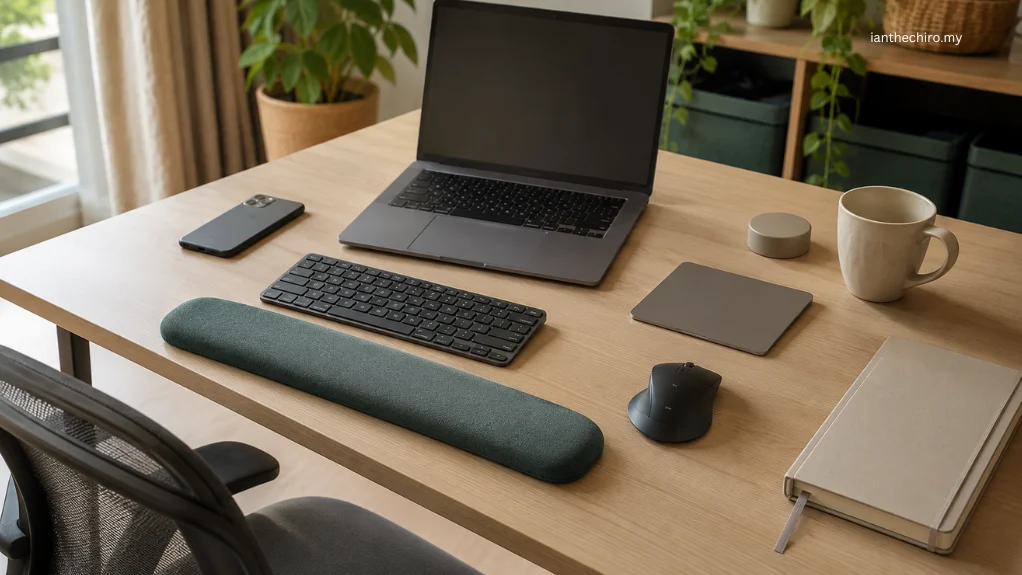
People often say:
“My wrist hurts from typing.”
But during an eight-hour workday, typing may only be part of what the hand is doing.
Mouse use can involve:
- repeated clicking
- scrolling
- small finger movements
- sustained gripping
- keeping the arm in one position
- repeatedly reaching away from the keyboard
For some people, symptoms are actually worse with the mouse than with the keyboard.
This is worth checking rather than treating all computer-related wrist pain as one activity.
Try noticing what happens during a normal workday.
Does the wrist hurt while actively typing?
Does it hurt more while using the mouse?
Does scrolling with one finger bother it?
Does the discomfort appear only after several uninterrupted hours?
Or does it also occur during gripping, gym training, carrying bags, or opening jars?
The answer can tell you much more than the word “typing”.
Do Wrist Position and Ergonomics Matter?
They can, but there is no single perfect workstation or wrist angle that guarantees you will never develop pain.
A wrist held in a very bent position for prolonged periods may be less comfortable, particularly when symptoms are already irritable. But replacing one rigid posture with another rigid posture is not necessarily the solution either.
A different keyboard, mouse, desk height, or forearm support may make computer work more comfortable for some people. The practical aim is to reduce unnecessary extremes, make the workstation reasonably comfortable, and allow some variation throughout the day.
A 2018 Cochrane review involving 15 randomised trials and 2,165 office workers found inconsistent evidence for many physical ergonomic interventions. Some combinations, such as an arm support with an alternative mouse, appeared helpful for certain outcomes, but simply changing equipment did not reliably prevent upper-limb problems.
In other words:
better ergonomics can help without being magical.
If changing your mouse or keyboard clearly reduces symptoms, that is useful. If you have bought several ergonomic devices and the wrist still hurts whenever you work for six uninterrupted hours, workload and the underlying symptom pattern deserve attention too.
Should I Rest My Wrist or Take More Breaks From Typing?
If typing currently aggravates the wrist, changing how long it stays under the same demand may be useful.
That does not necessarily mean setting an alarm every five minutes, and it does not mean avoiding all hand and wrist movement indefinitely.
A practical approach may involve shorter periods of computer work, varying tasks where possible, using voice input occasionally, or taking natural opportunities to move before returning to typing.
If two hours of uninterrupted computer work reliably aggravates the wrist but shorter periods do not, that gives you useful information about its current tolerance.
At the same time, the wrist still needs to tolerate normal activities such as gripping, carrying, lifting, phone use, exercise, and work.
The longer-term goal is therefore not complete rest. It is to find a manageable level of activity and gradually restore whatever capacity is actually limited.
Should I Stretch or Massage My Wrist and Forearm?
It depends on what the symptoms represent.
Gentle movement or massage may temporarily reduce forearm discomfort in some cases.
But repeatedly stretching an irritated nerve or aggressively pressing a painful tendon is not automatically helpful just because the area feels “tight”.
If stretching gives brief relief but the same symptoms return every hour during computer work, it is worth asking why the area continues to become irritated.
Likewise, temporary relief after massage does not prove that “tight muscles” were the entire problem.
The response can still be useful.
It just needs to be interpreted properly.
Would a Wrist Brace Help?
Sometimes, but this depends heavily on the diagnosis.
For carpal tunnel syndrome specifically, the 2026 clinical practice guideline recommends a wrist orthosis positioned near neutral and worn at night for short-term improvements in symptoms and function.
That does not mean everyone whose wrist hurts during typing should buy a carpal tunnel brace.
A brace intended for median-nerve symptoms may not address:
- thumb-side tendon pain
- pain on the back of the wrist
- forearm muscle discomfort
- another nerve problem
- symptoms coming from further up the arm
If you do not know what you are trying to treat, the brace becomes another experiment rather than a targeted intervention.
Could Wrist Pain Actually Be Coming From My Neck?
Sometimes.
Nerves supplying the arm and hand ultimately originate from the neck.
Neck-related nerve irritation can therefore produce symptoms further down the arm, including:
- tingling
- numbness
- burning
- altered sensation
- weakness
- changes in grip
- pain travelling into the forearm or hand
This does not mean every painful wrist is secretly a neck problem.
A wrist that is locally tender and hurts only during wrist loading may behave quite differently from hand symptoms that change when the neck or arm position changes.
But if typing-related discomfort occurs together with neck pain, shoulder-blade symptoms, travelling arm pain, numbness, or grip changes, the assessment should not stop at the wrist.
What If My Fingers Go Numb While Typing?
Pay attention to which fingers.
That can provide useful clues.
Carpal tunnel syndrome typically involves the median-nerve distribution, especially the thumb, index, middle, and radial side of the ring finger.
Symptoms mainly affecting the little finger and the other side of the ring finger raise different neurological questions.
Symptoms travelling from the neck or down the arm may raise different questions again.
You do not need to diagnose the nerve yourself.
The useful thing is to notice:
where the numbness starts,
where it travels,
what brings it on,
what relieves it,
and whether grip or hand control is changing.
Do I Need an X-Ray, Ultrasound, or MRI for Wrist Pain From Typing?
Not automatically.
Many typing-related wrist complaints can first be assessed from the history, symptom pattern, movement, strength, neurological findings, and the tasks that aggravate them.
Imaging becomes more relevant when there is a specific question it may help answer.
For example, the situation changes if there has been:
- significant trauma
- suspected fracture
- major swelling
- a persistent lump or mass
- substantial loss of movement
- unexplained or progressive weakness
- symptoms that do not fit a typical mechanical pattern
Nerve testing or other medical investigations may also be considered in selected cases when carpal tunnel syndrome or another neurological condition is suspected.
The scan or test should help answer a clinical question.
It should not replace the assessment.
When Should Wrist or Hand Symptoms Be Checked Medically?
Most typing-related wrist pain is not a medical emergency.
However, some patterns deserve earlier medical assessment.
⚠️ Seek Medical Attention for Wrist or Hand Warning Signs
Seek medical assessment after significant trauma if the wrist looks deformed, becomes severely swollen, or you cannot use the hand normally.
A hot, red, significantly swollen wrist or hand accompanied by fever or feeling systemically unwell also requires medical assessment.
New or progressively worsening loss of sensation, substantial weakness, loss of hand control, or symptoms affecting both hands alongside problems with walking, balance, or coordination should also be assessed rather than repeatedly treated as routine desk strain.
Arm or hand symptoms occurring together with chest pressure, difficulty breathing, sweating, faintness, or other possible cardiac symptoms should be treated as a medical issue rather than assumed to be a wrist problem.
What Should an Assessment for Wrist Pain When Typing Look At?
A useful assessment should look beyond whether typing hurts.
Depending on the presentation, it may consider:
- exactly where the pain or sensory symptoms are felt
- whether the symptoms are aching, sharp, burning, tingling, or numb
- which fingers are involved
- how long you can type before symptoms appear
- keyboard versus mouse use
- wrist and forearm movement
- grip and hand function
- tasks outside work that reproduce the symptoms
- recent changes in workload, training, or computer use
- the elbow, shoulder, and neck where relevant
- neurological findings
- previous wrist or upper-limb injuries
- medical history and warning signs
The aim is not to prove that typing is “bad for your wrist”.
It is to work out what is becoming sensitive and why that particular task is exposing the problem.
How Ian The Chiro Approaches Wrist Pain When Typing
At Ian The Chiro, wrist pain when typing is not automatically labelled as carpal tunnel syndrome, repetitive strain injury, or poor posture.
First, what exactly are you feeling?
A local wrist ache is different from numb fingers.
Second, where are the symptoms?
Thumb-side pain, pain on the back of the wrist, forearm tightness, and tingling into specific fingers create different assessment questions.
Third, what happens during the workday?
Does typing trigger it?
Does the mouse trigger it more?
How long can you work before symptoms begin?
Do breaks change anything?
Fourth, does anything outside computer work reproduce the symptoms?
Gripping, gym work, climbing, lifting, phone use, racquet sports, or pushing through the hand may reveal that the problem is not actually limited to typing.
Fifth, could another part of the upper limb be contributing?
Depending on the symptoms, the assessment may include the forearm, elbow, shoulder, neck, grip, and neurological function rather than examining the wrist in isolation. This is consistent with the clinic’s current shoulder, elbow, and wrist assessment pathway.
Treatment is then chosen according to what appears relevant.
Depending on the case, this may involve activity or workstation modifications, exercise and loading advice, selected hands-on care where appropriate, dry needling when a muscular component is relevant, or referral when nerve testing, imaging, medication, or another medical direction makes more sense.
The goal is not simply to help you survive the next hour at the keyboard.
It is to work out what your wrist and upper limb need so that normal work becomes easier to tolerate.
What Not to Do
Try to avoid:
- assuming every typing-related wrist problem is carpal tunnel syndrome
- assuming typing has permanently damaged the wrist because it hurts
- buying multiple ergonomic devices without working out what actually aggravates the symptoms
- forcing one supposedly “perfect” wrist posture all day
- repeatedly stretching or massaging an increasingly irritable area without reassessment
- wearing a brace indefinitely without knowing what problem it is meant to address
- ignoring progressively worsening numbness or weakness
- resting the hand completely for weeks without a reason or plan to rebuild activity
- treating only the wrist when symptoms clearly travel from further up the arm
Typing may expose a wrist problem.
It does not automatically explain the whole problem.
The location of the symptoms, their quality, how they change during the workday, and whether the rest of the arm or neck is involved are what help determine the appropriate next step.
Common Questions About Wrist Pain When Typing
Why does my wrist hurt when I type?
Typing may repeatedly load wrist and forearm tissues or aggravate an already sensitive tendon, joint, muscle, or nerve. The location and type of symptoms help determine which explanation is more likely.
Is wrist pain from typing always carpal tunnel syndrome?
No. Carpal tunnel syndrome is one possibility, particularly when numbness or tingling affects the median-nerve distribution. Local muscle, tendon, joint, or other nerve-related problems can also cause symptoms during computer work.
Which fingers go numb with carpal tunnel syndrome?
Carpal tunnel syndrome commonly affects sensation in the thumb, index finger, middle finger, and part of the ring finger. Symptoms in other distributions may require consideration of other nerve pathways.
Does typing cause carpal tunnel syndrome?
Typing can aggravate symptoms, and prolonged computer exposure may contribute some risk, but research does not support treating ordinary keyboard use as a major standalone cause of every carpal tunnel case.
Can using a mouse cause wrist pain?
Yes. Mouse use involves sustained positioning, clicking, scrolling, gripping, and repetitive hand movements. For some people, the mouse aggravates symptoms more than typing does.
What is the best wrist position for typing?
There is no single perfect posture that guarantees a pain-free wrist. Avoiding prolonged extreme positions and finding a comfortable workstation can help, but regular variation and overall workload also matter.
Should I use an ergonomic keyboard for wrist pain?
It may improve comfort for some people, but an ergonomic keyboard is not a guaranteed treatment. If symptoms persist, the underlying pain or neurological pattern should still be assessed.
Should I wear a wrist brace while typing?
That depends on the problem. Wrist orthoses have a role in conditions such as carpal tunnel syndrome, but a brace is not automatically appropriate for every type of wrist pain.
Can neck problems cause wrist or hand symptoms?
Yes. Nerve-related symptoms originating around the neck can travel into the arm or hand. Tingling, numbness, weakness, travelling pain, or symptoms influenced by neck position make this more relevant.
When should I get wrist pain from typing assessed?
Consider assessment when symptoms persist, progressively worsen, interfere with work or grip, repeatedly return despite modifying your workstation, or include numbness, tingling, or weakness. Seek medical assessment sooner after major trauma or for significant swelling, deformity, fever, progressive loss of sensation, or substantial weakness.