
You pick up a shopping bag, hold a dumbbell, open a jar, carry your laptop, or squeeze a tool.
The moment your grip tightens, pain appears around the elbow.
Perhaps it is a sharp pain on the outside. It may be an ache on the inside, discomfort at the front or back, or a pulling sensation that travels into the forearm. You may also notice that your grip feels weaker than usual.
This can leave you wondering whether you have tennis elbow, a damaged tendon, a trapped nerve, or something coming from the neck.
The location and behaviour of the pain can provide useful clues, but elbow pain when gripping or lifting is a symptom pattern rather than one diagnosis. Several muscles, tendons, joints, and nerves help transfer force from the hand through the elbow. A problem in one of these areas, or occasionally elsewhere in the upper limb, may make gripping or lifting uncomfortable.
At Ian The Chiro in Cheras, Kuala Lumpur, the aim is not to label every painful elbow as tennis elbow or assume that everyone needs the same treatment. The first step is to understand where the pain is felt, which tasks reproduce it, how the problem began, and whether conservative care is appropriate.
This article provides general education and cannot diagnose your individual case. New, severe, unusual, or worsening symptoms should be assessed appropriately.
Quick Answer: What Can Cause Elbow Pain When Gripping or Lifting?
Common possibilities include:
- lateral elbow tendinopathy, often called tennis elbow
- medial elbow tendinopathy, often called golfer’s elbow
- a strain or overload of the forearm muscles
- irritation involving the biceps, brachialis, or triceps area
- an irritated elbow joint or bursa
- nerve-related symptoms around the elbow, forearm, or neck
- pain referred from the neck, shoulder, wrist, or another nearby area
- an acute sprain, tear, fracture, or dislocation after an injury
Pain on the outside of the elbow during gripping often fits a lateral elbow tendon pattern, but that is not the only possible explanation. Pain on the inside may involve the wrist-flexor tendon region, while symptoms at the front, back, or into the hand can point towards a different pattern.
The most useful clues include the exact pain location, whether the pain is gradual or sudden, which wrist and elbow movements reproduce it, and whether you also have swelling, bruising, numbness, tingling, or true loss of strength.
Gripping pain can help narrow the possibilities, but it cannot confirm one diagnosis by itself.
Why Can Gripping Make the Elbow Hurt?
Gripping is not only a hand activity.
Several muscles that move and stabilise the wrist and fingers begin around the elbow. Their tendons attach near the bony points on the inside and outside of the joint. When you squeeze an object, these muscles help keep the wrist steady so the fingers can produce force.
Lifting usually adds more demand. The load may pull the wrist down, rotate the forearm, or create leverage through the elbow. A light object held close to the body may feel fine, while the same object held at arm’s length can feel much harder.
The demand also changes with:
- the weight and shape of the object
- how firmly you need to squeeze it
- whether the wrist is bent or kept more neutral
- whether the palm faces up, down, or sideways
- how far the load is from the body
- how quickly or repeatedly you lift
- how much recovery the area has had
- whether the tissues are already sensitive
This is why someone may be able to bend and straighten the elbow normally but still feel pain when shaking hands, turning a key, pouring from a kettle, doing a pull-up, or carrying a bag.
What Could Elbow Pain When Gripping or Lifting Mean?
The following patterns are common possibilities, but symptoms can overlap. An assessment may be needed when the cause is unclear or the problem is not settling.
1. Pain on the outside of the elbow: lateral elbow tendinopathy
Lateral elbow tendinopathy is commonly known as tennis elbow. You do not need to play tennis to develop it.
The pain is usually felt around the bony area on the outside of the elbow and may spread into the upper forearm. Gripping, lifting with the palm facing down, typing, using a mouse, turning a screwdriver, racket sports, and some gym exercises may reproduce it.
The wrist-extensor tendons are commonly involved. Symptoms may begin after a sudden increase in repeated gripping or lifting, but they can also develop gradually without one obvious injury.
The term tendinopathy is often more useful than simply calling it inflammation. Persistent tendon pain can involve changes in tissue capacity and sensitivity, not only an ongoing inflammatory process. This matters because complete rest or repeatedly trying to reduce inflammation may not address the full problem.
2. Pain on the inside of the elbow: medial elbow tendinopathy
Medial elbow tendinopathy is often called golfer’s elbow, although it can affect people who do not play golf.
Pain is usually felt around the bony point on the inside of the elbow. It may be aggravated by gripping, carrying, wrist bending, forearm rotation, pulling exercises, throwing, climbing, manual work, or racket sports.
The tendons that help flex the wrist and fingers attach in this region. Repeated or unfamiliar loading can exceed what the area currently tolerates.
Numbness or tingling into the ring and little fingers is less typical of a tendon-only problem and may suggest that the ulnar nerve also needs to be considered.
3. Pain at the front of the elbow: biceps or brachialis-related symptoms
The distal biceps tendon attaches near the front of the elbow and helps bend the elbow and rotate the palm upwards. The brachialis muscle is another strong elbow flexor.
Pain in this region may be more noticeable when lifting with the palm facing up, carrying a box, performing curls, pulling, or turning a tight handle.
A gradual ache after increased training may represent overload. A sudden painful pop, bruising, a change in the shape of the upper arm, or marked weakness when bending the elbow or turning the palm up requires prompt medical assessment because a significant biceps tendon injury may be present.
4. Pain at the back of the elbow: triceps, bursa, or joint irritation
Pain at the back of the elbow may involve the triceps tendon, the joint, or the small fluid-filled bursa over the tip of the elbow.
Pressing movements such as push-ups, bench press, or pushing up from a chair may aggravate a triceps-related pattern. Direct pressure from leaning on the elbow may irritate the bursa. Visible swelling over the elbow tip can occur with bursitis, although swelling that is hot, red, very painful, or accompanied by fever needs medical attention.
Pain at the back can also occur when the elbow is repeatedly forced into full straightening or after a direct impact.
5. Forearm muscle strain or temporary overload
Not every painful gripping episode is a long-standing tendon problem.
A new gym routine, prolonged tool use, moving house, gardening, climbing, or carrying more than usual may leave the forearm muscles sore or strained. The pain may be more spread out than a typical tendon pattern and can appear during the activity or later that day.
The timing, amount of bruising or swelling, and effect on strength help distinguish ordinary post-activity soreness from a more significant injury.
6. Nerve-related pain
Nerves travel from the neck through the arm and pass close to the elbow. Irritation can sometimes produce aching, burning, tingling, numbness, electric sensations, or weakness.
The ulnar nerve passes behind the inner side of the elbow and can produce symptoms towards the ring and little fingers. The radial nerve travels near the outer elbow and may sometimes resemble lateral elbow tendon pain. Symptoms from the neck may travel into the elbow, forearm, or hand even when the neck itself is not very painful.
Nerve symptoms require a different assessment from a straightforward local tendon problem. Persistent numbness, worsening weakness, or frequent dropping of objects should not be ignored.
7. Elbow joint irritation, arthritis, or injury
Joint-related problems may produce pain, swelling, stiffness, catching, locking, or difficulty fully bending or straightening the elbow. Arthritis becomes more relevant when stiffness and reduced movement are prominent, although it cannot be diagnosed from age or symptoms alone.
A fall, direct impact, forceful twist, or sudden heavy lift may cause a sprain, fracture, dislocation, or other acute injury. Significant swelling, deformity, severe pain, or an inability to use the arm requires medical assessment rather than trialling exercises at home.
Pain location helps organise the possibilities, but it does not confirm the cause. Nearby structures can create similar symptoms, and more than one factor may be present. The onset, aggravating grip or wrist position, swelling, movement, nerve symptoms, and changes over time all need to be considered together.
Is a Weak Grip the Cause or the Result?
Either is possible, and sometimes the relationship works both ways.
Pain can temporarily reduce how much force you are willing or able to produce. This may make the grip feel weak even when the muscles and nerves are capable of working normally. Avoiding use for a long time can then reduce capacity further.
In other cases, the current strength or endurance of the forearm may be insufficient for a new workload. The issue is not that the person is generally weak. The amount, frequency, speed, or novelty of the activity may simply exceed what the area has adapted to.
True neurological weakness is different from stopping because gripping hurts. If objects fall from your hand unexpectedly, finger control is changing, or weakness is worsening, the nerves and other medical causes should be assessed.
Why Might the Pain Have Started Now?
Elbow pain often appears after a change in demand rather than one obviously harmful movement.
Possible changes include:
- adding more pulling, curling, pressing, or racket training
- increasing weight, sets, repetitions, or training frequency
- returning to exercise after a break
- changing a golf club, racket, tool, mouse, or workstation
- starting a new manual job or home project
- carrying a baby, luggage, or shopping more often
- gripping harder because equipment is slippery, narrow, or awkward
- continuing the same workload with less sleep or recovery
- compensating for a sore wrist, shoulder, or neck
Sometimes the activity has not changed, but the body’s tolerance has. Illness, reduced recovery, another injury, stress, or a period of lower activity can alter what feels manageable.
This does not mean one imperfect technique or posture has damaged the elbow. The more useful question is whether the total demand has become greater than the area currently tolerates.
Can the Wrist, Shoulder, or Neck Contribute?
Yes, although the elbow should not automatically be blamed on another area.
The hand, wrist, elbow, shoulder, and neck work as a connected system. Limited or painful wrist movement may change how you grip. Shoulder discomfort or reduced capacity may make the forearm work harder during lifting. A nerve irritated closer to the neck can sometimes produce symptoms around the elbow or into the hand.
This is why a useful assessment may include more than pressing on the painful spot. Checking nearby movement, strength, sensation, and symptom reproduction can help distinguish a local elbow problem from a broader upper-limb pattern.
It does not mean every painful elbow requires neck or shoulder treatment. Those areas should only be included when the history and examination show that they are relevant.
Should You Stop Lifting or Exercising?
Not necessarily.
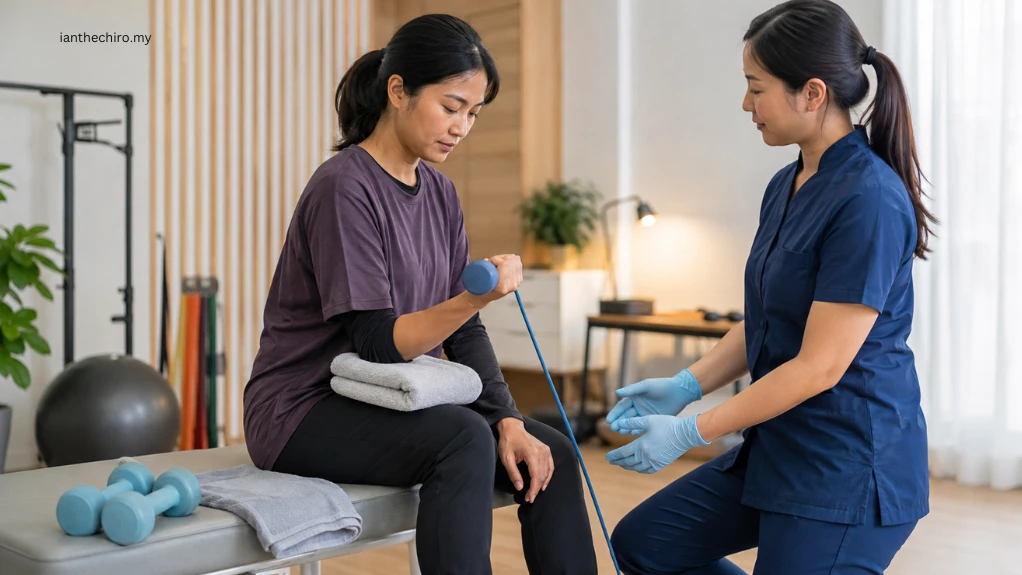
Complete rest may calm an irritable elbow in the short term, but prolonged avoidance can reduce strength and make the return to normal activity harder. Continuing exactly the same painful workload without adjustment may also keep aggravating the problem.
A more practical starting point is often to reduce the most provocative demand while keeping the arm moving within a tolerable range.
Depending on the task, this could mean:
- temporarily reducing weight, repetitions, or gripping duration
- keeping the load closer to the body
- using two hands for heavier or awkward objects
- choosing a grip or wrist position that is more comfortable
- spacing demanding tasks across the day or week
- using straps for selected gym lifts when appropriate
- avoiding repeated painful self-testing throughout the day
- gradually rebuilding the task as symptoms settle
Pain during rehabilitation does not always mean damage is occurring, but the response should be monitored. A task that causes a small, short-lived increase may be tolerated differently from one that produces sharp pain, steadily worsens each session, or leaves the elbow significantly more painful the next day.
Can Exercise Help Elbow Pain?
Exercise can be useful for many load-related elbow problems, especially when it is matched to the diagnosis, irritability, and activity goal.
A 2022 clinical practice guideline for lateral elbow pain recommends isometric, concentric, or eccentric resisted exercise for the wrist-extensor muscles in people with subacute or chronic lateral elbow tendinopathy. It also includes pain-free grip strength and upper-limb function among the useful ways to monitor progress.
A 2021 systematic review and meta-analysis of 30 trials involving 2,123 participants found that exercise produced better outcomes than passive interventions for lateral elbow tendinopathy. However, the average effects were small, the certainty of evidence was low or very low, and the exercise programmes varied considerably. This supports individualised, progressive loading rather than one universal tennis-elbow routine.
Depending on the presentation, rehabilitation may involve:
- isometric, concentric, or eccentric forearm loading
- grip-strength and endurance work
- wrist and elbow movement
- shoulder or upper-limb strengthening when relevant
- gradual practice of the painful work, sport, or gym task
- changes to total workload and recovery
The starting level matters. An exercise that is appropriate for a mildly irritable elbow may be too demanding during an acute flare or after a significant injury.
Do Braces, Straps, Massage, or Dry Needling Help?
Some people find that a counterforce strap, wrist support, massage, or dry needling provides short-term symptom relief. These options may make selected activities more comfortable, but they do not identify the cause or replace gradual rebuilding when reduced capacity is part of the problem.
A brace should not be painfully tight, cause numbness, or be treated as something the elbow must depend on permanently. Its value is practical: does it make an important task more tolerable without creating another problem?
Massage or dry needling may be considered when a relevant muscular contribution is found. Repeatedly pressing, scraping, or needling the most painful spot aggressively can also irritate the area. More intensity is not automatically more effective.
These tools are best viewed as possible parts of a broader plan rather than guaranteed tendon repairs.
When Should Elbow Pain Be Assessed?
Consider an assessment if:
- the pain is not improving after a reasonable period of self-management
- gripping or lifting is affecting work, exercise, or daily tasks
- symptoms keep returning when you resume normal activity
- your grip feels meaningfully weaker
- the elbow is becoming more stiff or swollen
- you have pain at rest or symptoms that repeatedly disturb sleep
- numbness, tingling, burning, or travelling pain is present
- you cannot identify how much activity is safe
- the pain followed an injury, even if the arm still moves
- you are unsure whether the problem is local to the elbow
The purpose of an assessment is not only to name the painful structure. It should clarify what you can currently tolerate, what may be contributing, and what the safest next step is.
⚠️ When Should You Seek Medical Care First?
Seek urgent medical assessment after an injury if the elbow or arm has changed shape, you heard a snap, the pain is severe, or it is difficult or impossible to move the arm.
Prompt medical care is also important if the elbow is hot, red, very swollen, and painful, particularly when you have a fever or feel unwell. Sudden or worsening loss of strength or sensation, marked numbness or tingling, or a hand that becomes pale or cold also requires medical attention.
Call emergency services if arm pain begins suddenly with chest pressure, heaviness, squeezing, shortness of breath, sweating, nausea, or other possible heart-related symptoms.
How Elbow Pain When Gripping or Lifting Is Assessed
The consultation should begin with the story of the problem, including:
- the precise location of the pain
- whether it began suddenly or gradually
- the gripping, lifting, work, gym, or sport tasks that reproduce it
- recent changes in training or daily workload
- symptoms at rest, during activity, and the following day
- swelling, bruising, clicking, locking, numbness, tingling, or weakness
- previous elbow, wrist, shoulder, or neck problems
- what you have already tried and how the elbow responded
Depending on the presentation, the physical assessment may include:
- elbow, wrist, forearm, shoulder, and neck movement
- local tenderness and swelling checks
- resisted wrist, finger, forearm, and elbow movements
- pain-free and maximum grip testing when appropriate
- comparison with the other side
- relevant orthopaedic tests
- sensation, reflex, and strength checks when nerve involvement is possible
- practical tasks related to your work, training, or daily activities
One positive test does not always prove a diagnosis. The findings should be interpreted together with the symptom history and the way the elbow responds to load.
Do You Need an X-Ray, Ultrasound, or MRI?
Usually, imaging is not required before an initial assessment of gradual, non-traumatic elbow pain.
Many common tendon and muscle-related presentations can first be evaluated through the history, movement, strength, grip, and relevant clinical tests. A scan finding also needs context because structural changes do not always explain the severity of pain or determine the treatment plan.
Imaging may be more appropriate when there is:
- significant trauma or suspected fracture or dislocation
- a sudden suspected tendon rupture
- substantial or unexplained swelling
- locking or a suspected loose body
- progressive neurological changes
- unusual symptoms or concern about another medical condition
- persistent symptoms when the result would change management
If you already have an X-ray, ultrasound, or MRI report, bring it to the consultation. It should be considered alongside your current symptoms and function rather than used in isolation.
Can Chiropractic Care Help Elbow Pain?
Chiropractic care may help some musculoskeletal elbow problems, but the appropriate plan depends on what the assessment finds.
For a load-related tendon presentation, education, activity modification, and progressive exercise may be central. Manual care may be used to help with short-term pain or relevant movement limitations, but it should not be presented as permanently realigning the elbow or repairing a tendon by itself.
Chiropractic adjustments may be considered when a clinically relevant joint or movement restriction is found in the elbow, wrist, shoulder, upper back, or neck. Dry needling may be considered when a relevant muscular contribution is identified. Neither treatment is automatically necessary for every painful elbow.
Care may involve:
- explaining the likely symptom pattern
- modifying aggravating loads without unnecessary fear or avoidance
- progressive forearm, grip, and upper-limb exercise
- manual treatment when clinically appropriate
- dry needling when a suitable muscular component is present
- guidance for returning to gym, sport, work, or daily lifting
- referral for imaging, medical review, or another type of care when indicated
The goal should be to help you use the arm more confidently and build the capacity required for your activities, not to make you dependent on repeated passive treatment.
How Ian The Chiro Approaches Elbow Pain
At Ian The Chiro in Cheras, the first visit begins with a chiropractic consultation rather than assuming that outer elbow pain is tennis elbow or that the neck must be adjusted.
The assessment considers whether the symptoms fit a local tendon, muscle, joint, or nerve-related pattern, whether another part of the upper limb is relevant, and what gripping or lifting demands the elbow needs to tolerate.
If conservative care is appropriate, the plan may combine symptom relief with progressive loading and practical guidance for returning to work, gym training, racket sports, climbing, typing, carrying, or other relevant activities.
Not every patient needs an adjustment or dry needling. Treatment should be selected according to the assessment, goals, and response, with medical referral or imaging recommended when necessary.
Want to Understand Why Your Elbow Hurts When You Grip or Lift?
Elbow pain during gripping or lifting does not always mean the tendon is torn or the joint is damaged. It may reflect a load-related tendon problem, muscle overload, joint irritation, nerve symptoms, an injury, or several contributing factors.
The location of the pain provides a starting point. The way it responds to wrist position, grip force, lifting direction, workload, and recovery helps build a clearer picture.
If the problem keeps returning, affects work or training, or comes with weakness, tingling, swelling, or reduced movement, a proper assessment can help clarify the likely cause and the safest way forward.
If you would like the pattern properly assessed, you can book a chiropractic consultation at Ian The Chiro in Cheras, Kuala Lumpur.
Elbow Pain When Gripping or Lifting: Frequently Asked Questions
Is elbow pain when gripping always tennis elbow?
No. Pain on the outside of the elbow during gripping commonly fits a lateral elbow tendinopathy pattern, often called tennis elbow, but pain can also involve the forearm muscles, elbow joint, nearby nerves, or symptoms referred from the neck or another part of the upper limb. The location, onset, associated symptoms, and examination findings all matter.
What is the difference between tennis elbow and golfer’s elbow?
Tennis elbow usually causes pain around the outside of the elbow and often involves the wrist-extensor tendon region. Golfer’s elbow usually causes pain around the inside and often involves the wrist-flexor tendon region. Neither condition is limited to the sport in its name, and pain location alone does not confirm the diagnosis.
Why does my elbow hurt when I lift with my palm down?
Lifting with the palm down can increase the demand on the muscles that stabilise and extend the wrist, which attach near the outer elbow. This may aggravate a lateral elbow tendon or muscle pattern, but a nearby nerve or joint problem can sometimes feel similar. An assessment is useful if the pain persists or the cause is unclear.
Can I continue going to the gym with elbow pain?
You may not need to stop all training, but repeatedly pushing through a steadily worsening pain is not a useful strategy. Temporarily reduce or change the most provocative lift, load, grip, range, or volume, then rebuild gradually. Sudden pain after a heavy lift, bruising, deformity, or marked weakness should be medically assessed before you continue.
How long does tennis elbow take to heal?
Recovery time varies. Some recent and mild cases improve within weeks, while persistent lateral elbow tendinopathy can take several months and may fluctuate as activity changes. The duration of symptoms, workload, tissue irritability, general health, and rehabilitation plan all influence progress, so a guaranteed timeline would be misleading.
Should I completely rest a painful elbow?
Short-term reduction of an aggravating task may help calm symptoms, especially after a flare, but prolonged complete rest can reduce capacity. Many load-related elbow problems benefit from keeping the arm moving and gradually rebuilding strength within a tolerable range. A suspected fracture, dislocation, tendon rupture, or other significant injury requires a different approach.
Will an elbow brace or strap fix the problem?
A brace or counterforce strap may make gripping more comfortable for some people, but it does not fix every cause of elbow pain or replace rehabilitation. It should not be painfully tight or cause numbness, and its usefulness should be judged by whether it improves an important activity without creating new symptoms.
Can massage or dry needling cure tennis elbow?
Massage or dry needling may provide short-term relief when a relevant muscular contribution is present, but neither should be promised as a cure or a way to repair a tendon instantly. Load management, progressive exercise, recovery, and the demands of the person’s work or sport may also need to be addressed.
Can elbow pain come from the neck?
Yes. Nerves from the neck travel into the arm, and neck-related irritation can sometimes produce pain, tingling, numbness, or weakness around the elbow, forearm, or hand. However, most elbow pain should not automatically be blamed on the neck. The symptom distribution and neurological examination help determine whether the neck is relevant.
When should I worry about elbow pain and weak grip?
Seek assessment if grip weakness is worsening, you are unexpectedly dropping objects, or weakness occurs with persistent numbness, tingling, severe pain, swelling, or reduced movement. Urgent medical care is appropriate after a significant injury, with deformity or a snap, or when the elbow is hot, red, swollen, and accompanied by fever or feeling unwell.
Do I need a scan for elbow pain when gripping?
Not usually at the start when symptoms developed gradually and there are no concerning features. History, movement, strength, grip, and relevant clinical tests are often enough to guide initial care. Imaging becomes more useful when there has been significant trauma, a rupture or fracture is suspected, neurological function is changing, or the result would meaningfully change management.
Can a chiropractor help with elbow pain when gripping or lifting?
A chiropractor may help when the symptoms are caused by a musculoskeletal problem suitable for conservative care. Depending on the assessment, this may include education, load modification, progressive exercise, manual care, dry needling, or attention to a relevant wrist, shoulder, upper-back, or neck contribution. Chiropractic care should not be presented as suitable for every elbow condition, and referral is appropriate when medical assessment or imaging is needed.