

If you are dealing with muscle tightness, neck tension, shoulder tightness, lower back guarding, or recurring aches, you may wonder whether you need dry needling or massage.
Some people book massages because the area feels tight. Some consider dry needling because the same muscle keeps tightening again and again. Others are unsure whether the issue is a muscle problem, joint problem, nerve issue, training load problem, posture-related issue, or stress-related tension.
If you are comparing dry needling vs massage, the better question is not always “which one is better?”
The better question is:
“What does my case actually need?”
At Ian The Chiro in Cheras, Kuala Lumpur, dry needling is not done just because a muscle feels tight. The first step is to understand your symptoms, assess the pattern, and decide whether dry needling, chiropractic care, exercise advice, activity modification, or another direction such as massage or physiotherapy makes sense.
This article is for general education and is not a diagnosis. If you are unsure what type of care suits your case, start with a proper consultation.
Quick Answer: Dry Needling vs Massage
Dry needling and massage are not the same thing.
Dry needling uses thin needles to target muscles or related soft tissue areas when muscle guarding, trigger points, sensitivity, or movement-related pain patterns may be contributing to symptoms.
Massage is a hands-on soft tissue approach that usually focuses on muscle tension, relaxation, soreness, and reducing local tightness or discomfort.
In simple terms:
- dry needling uses thin needles
- massage uses hands-on pressure
- dry needling may target deeper or more specific muscle sensitivity
- massage may feel more general, relaxing, or soothing
- both may help some people feel better
- both can be useful in the right case
- neither should replace proper assessment
If your main issue is general muscle tension or stress-related tightness, massage may feel helpful.
If the issue involves a specific sensitive muscle area, recurring trigger point tenderness, or muscle guarding that keeps returning, dry needling may be considered.
But many cases are not purely one or the other.
That is why assessment matters.
Why People Compare Dry Needling and Massage
People often compare dry needling and massage because both may be used for muscle-related symptoms.
Both may be considered by people dealing with:
- neck tension
- shoulder tightness
- upper back tightness
- lower back guarding
- calf tightness
- glute tightness
- sports-related muscle tightness
- recurring muscle tightness
- muscle soreness after training
- stress-related muscle tension
This overlap can make the choice confusing.
You may wonder:
- Is this muscle tightness?
- Is this a trigger point?
- Do I need massage?
- Do I need dry needling?
- Why does the tightness keep coming back?
- Why do I feel better temporarily, then worse again later?
- Should I choose dry needling or massage first?
The honest answer is that it depends on the pattern.
The best choice is not always dry needling or massage. The best choice is the approach that matches why the muscle keeps feeling tight, sore, guarded, or sensitive.
What Is Dry Needling?
Dry needling is a technique where a thin needle is inserted into a muscle or related soft tissue area.
It is called “dry” because nothing is injected. There is no medication, steroid, or fluid being pushed into the body.
A dry needling literature review describes dry needling as inserting thin monofilament needles without injectate into muscles, ligaments, tendons, fascia, and related soft tissue.
In a musculoskeletal setting, dry needling is often considered when the assessment suggests that muscle tension, trigger points, muscle guarding, or sensitivity may be contributing to pain or movement restriction.
Dry needling may be considered for areas such as:
- neck muscles
- upper shoulders
- upper back muscles
- lower back muscles
- glutes
- calves
- forearms
- sports-related muscle tension
- recurring muscle tightness
The goal is not simply to poke the painful area.
The goal is to decide whether a muscle or soft tissue component may be contributing to the problem, and whether dry needling is appropriate for that case.
What Is Massage?
Massage is usually a hands-on soft tissue approach.
It often focuses on muscles, fascia, tension, relaxation, and reducing local tightness or discomfort.
Depending on the type of massage and the practitioner, massage may involve:
- gentle pressure
- deeper pressure
- kneading
- sustained pressure
- stretching
- relaxation-focused techniques
- sports massage techniques
- work on tight or tender muscles
Massage may feel helpful when muscles are tense, sore, tired, or sensitive.
Some people use massage for general relaxation. Others use it because a specific area keeps feeling tight, such as the neck, shoulders, lower back, glutes, or calves.
Massage can be useful.
But if the same muscle keeps tightening again and again, it may be worth asking why.
The Main Difference Is the Treatment Method
The most obvious difference between dry needling and massage is the treatment method.
Dry needling uses thin needles.
Massage uses hands-on pressure.
Dry needling may create sensations such as:
- a small prick
- deep ache
- muscle twitch
- cramp-like sensation
- pressure
- heaviness
- temporary soreness
Massage may create sensations such as:
- pressure
- warmth
- soreness
- relaxation
- tenderness
- muscle release
- local discomfort during deeper work
Neither treatment should feel like something you are being forced to tolerate.
If something feels too intense, you should say so.
The Bigger Difference Is the Clinical Reasoning
The method matters, but the reasoning matters more.
Dry needling usually asks:
- Is there a sensitive muscle area?
- Is there trigger point tenderness?
- Is the muscle guarding?
- Is movement affected?
- Is the muscle reacting to overload?
- Is dry needling suitable today?
Massage usually asks:
- Is there muscle tension?
- Is the person looking for relaxation?
- Is the area sore or tired?
- Can soft tissue pressure help reduce discomfort?
- Is the tightness mainly local?
- Is hands-on pressure appropriate?
There can be overlap.
But dry needling is usually more specific and needle-based, while massage is usually more broad and hands-on.
That does not make one better than the other.
It means they are not always trying to do the exact same thing.
Is Dry Needling Better Than Massage?
Not automatically.
Dry needling is not always better than massage.
Massage is not always better than dry needling.
The better question is:
“What is driving the muscle tightness or pain?”
For example, if your shoulders feel tense after a stressful week, massage may help you feel looser and more relaxed.
If a specific muscle area keeps becoming tender, guarded, and sensitive despite stretching or massage, dry needling may be considered.
If your lower back keeps tightening after sitting, training, poor sleep, or repeated bending, you may need more than either one treatment alone.
The best choice depends on the case, not the tool.
When Dry Needling May Make Sense
Dry needling may be worth considering when the assessment suggests that muscle involvement is part of the problem.
This may include cases where there is:
- recurring muscle tightness
- trigger point tenderness
- muscle guarding
- neck and shoulder tension
- lower back tightness
- sports-related muscle tightness
- muscle discomfort that returns after massage
- movement restriction linked to tightness
- pain that feels muscular
But dry needling is not automatically the right answer for every tight muscle.
Sometimes muscle tightness is a response to another issue.
For example, a muscle may tighten because of joint irritation, nerve sensitivity, repeated load, poor recovery, stress, sleep issues, training overload, or repeated positions.
That is why the assessment matters more than the needle.
When Massage May Make Sense
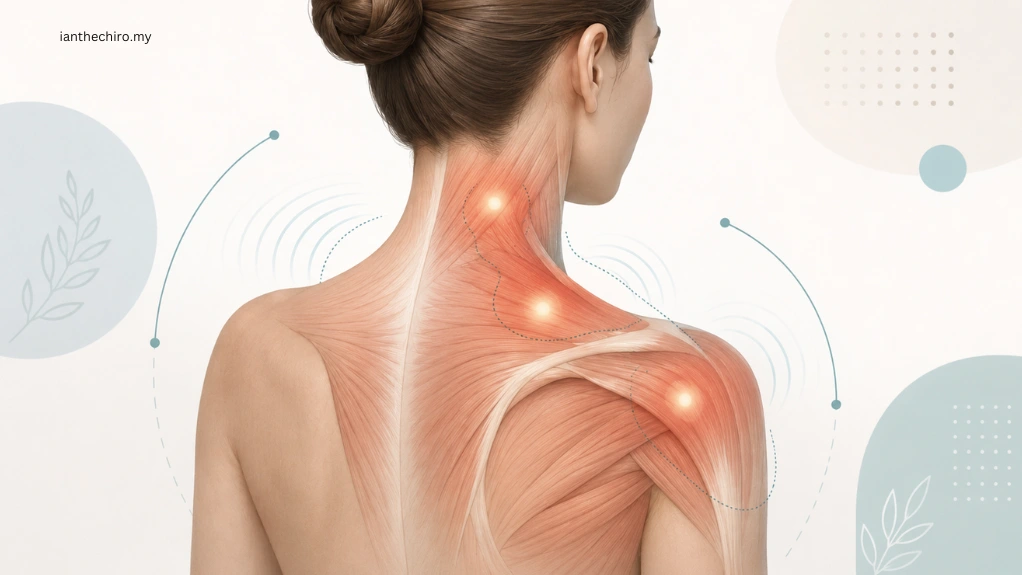
Massage may make sense when the main issue appears to involve muscle tension, soft tissue sensitivity, general soreness, or relaxation.
This may include cases where someone feels:
- tight shoulders
- neck muscle tension
- upper back tightness
- general muscle soreness
- calf tightness
- glute tightness
- muscle fatigue after training
- stress-related tension
- temporary relief after soft tissue work
Massage may also be useful when someone simply wants to relax or reduce general muscle tension.
But massage may not fully address the issue if the tightness keeps returning because of repeated load, joint restriction, nerve sensitivity, posture tolerance, poor recovery, training errors, or work habits.
Can You Need Both Dry Needling and Massage?
Yes, sometimes.
Some people may benefit from both needle-based muscle work and hands-on soft tissue work.
For example, someone with upper back tightness may have general muscle tension and a few specific sensitive muscle areas.
Someone with lower back tightness may have muscle guarding, sitting intolerance, joint irritation, and poor recovery happening together.
Someone with sports-related tightness may need soft tissue work, dry needling, exercise advice, and load management.
In these cases, the goal is not to collect as many treatments as possible.
The goal is to understand what each part is supposed to do.
Hands-on care and dry needling can be useful, but they should fit into a sensible plan.
NICE guidance for low back pain and sciatica recommends considering manual therapy, including spinal manipulation, mobilisation, or soft tissue techniques such as massage, only as part of a treatment package that includes exercise.
When Massage Alone May Not Be Enough
Massage may help reduce muscle tension temporarily.
But massage alone may not be enough if the same symptoms keep returning because of:
- joint restriction
- repeated sitting
- training overload
- poor sleep
- stress
- reduced strength
- movement habits
- recurring irritation
- nerve sensitivity
- poor load tolerance
- lack of activity progression
This is why some people feel better after massage, then notice the same tightness returning a few days later.
That does not mean the massage was useless.
It may mean the massage helped calm the symptom, but the bigger pattern still needs to be addressed.
When Dry Needling Alone May Not Be Enough
Dry needling may help some people feel less tight, less guarded, or more comfortable.
But dry needling alone may not be enough if the problem keeps returning because of:
- repeated work positions
- training load
- stress-related tension
- poor recovery
- weak activity tolerance
- lack of strengthening
- recurring overload
- repeated habits outside the session
- nerve sensitivity
- joint irritation
In these cases, only needling the same muscle again and again may not solve the bigger pattern.
The care plan should ask:
- What keeps irritating the area?
- What gives temporary relief?
- What needs to change outside the session?
- Does the person need movement advice?
- Does the person need strengthening?
- Does the person need load management?
- Does the person need a different type of care?
Pain relief is useful.
But the bigger goal is to understand why the same muscle keeps reacting.
Why Tight Muscles Are Not Always the Main Problem
Many people assume that tight muscles simply need to be released.
Sometimes that is partly true.
But muscle tightness can also be a response.
A muscle may tighten because the area feels irritated, overloaded, unstable, guarded, or not well tolerated.
For example:
- the neck may tighten after long laptop work
- the lower back may guard after repeated bending
- the shoulders may tense during stressful periods
- the glutes may tighten after running overload
- the calves may feel tight because of training load or recovery issues
If the muscle is only being treated as “tight”, the relief may not last.
The better question is:
“Why does this muscle keep tightening in the first place?”
What If You Feel Better After Massage but the Tightness Comes Back?
This is common.
Massage may reduce tension, help you relax, or make the area feel temporarily looser.
But if the same load, posture, training pattern, stress, or movement issue remains, the symptoms may return.
For example:
- neck tension improves after massage, then returns after laptop work
- lower back tightness improves, then returns after long sitting
- shoulder tightness improves, then returns after gym training
- calf tightness improves, then returns after running
This does not mean massage is bad.
It means temporary relief and long-term change are not the same thing.
If the same problem keeps returning, it is worth understanding the pattern properly.
What If You Feel Better After Dry Needling but the Tightness Comes Back?
This can happen too.
Dry needling may help the muscle feel less tight or less sensitive for a period of time.
But if the same habits, loads, or recovery problems remain, the tightness may return.
For example:
- upper back tightness improves, then returns after long desk work
- lower back guarding improves, then returns after driving
- neck tension improves, then returns during stressful weeks
- calf tightness improves, but the same training issue keeps irritating the area
That is why a good care plan should not only ask:
“Did the dry needling help?”
It should also ask:
“What needs to change so the same pattern does not keep repeating?”
When Dry Needling May Not Be Suitable
Dry needling is not suitable for everyone.
⚠️ Dry Needling May Not Be the Right First Step
Dry needling may not be suitable if there is infection around the area, unexplained swelling, significant bleeding risk, severe needle fear, certain medical conditions, worsening neurological symptoms, major trauma, or pain that has not been assessed properly.
You should tell your practitioner if you:
- are taking blood-thinning medication
- bruise or bleed easily
- are pregnant
- have a history of fainting with needles
- have a needle phobia
- have immune system concerns
- have had recent surgery
- have a complex medical history
- feel unwell on the day of treatment
This does not automatically mean dry needling can never be done.
It means the decision needs to be made carefully.
What If You Have Neck and Shoulder Tension?
For neck and shoulder tension, massage may feel helpful when the issue is mainly muscle tension, stress-related tightness, or soft tissue soreness.
Dry needling may be considered if specific muscles seem guarded, tender, sensitive, or involved in the pain pattern.
But neck and shoulder tension can also involve:
- desk work
- phone use
- driving
- sleep position
- stress
- upper back stiffness
- training load
- nerve sensitivity
- posture tolerance
The goal is not simply to decide whether to needle the muscle or massage the shoulders.
The goal is to understand what is safe and appropriate.
What If You Have Lower Back Tightness?
For lower back tightness, massage may feel helpful if the lower back muscles are tense, guarded, or sore.
Dry needling may be considered if muscle guarding or trigger point tenderness appears relevant.
But lower back tightness is not one single condition.
The right care depends on whether the issue is mainly local muscle tension, joint irritation, disc-related sensitivity, sciatica-like nerve symptoms, sitting intolerance, training load, or poor recovery.
If lower back symptoms travel into the leg, cause numbness, tingling, weakness, or affect walking, the case should be assessed more carefully.
What If You Have Sports-Related Tightness?
For sports-related tightness, massage may help some people feel looser or recover better temporarily.
Dry needling may also have a role if specific muscles are guarded, sensitive, or repeatedly tightening.
But sports-related tightness often needs more than passive treatment.
It may involve:
- training load
- strength
- mobility
- recovery
- tendon capacity
- warm-up habits
- technique
- return-to-activity planning
If the tightness keeps returning every time you train, the issue may not only be a “tight muscle”.
It may be a load management problem.
What If You Just Want Fast Relief?
It is understandable to want fast relief.
Pain and tightness are frustrating, and people often want the quickest way to feel better.
Dry needling may provide relief for some people. Massage may also reduce tension and help an area feel more relaxed. Other approaches like chiropractic care, soft tissue work, exercise advice, or activity modification may also help depending on the case.
But fast relief is not the only thing that matters.
If symptoms keep returning, the bigger question is:
“Why does this area keep getting irritated?”
Short-term relief can be useful.
But it should not replace proper assessment and a sensible plan.
How Ian The Chiro Approaches This Decision
At Ian The Chiro, the decision is not made by asking, “Do you want dry needling or massage?”
The first step is to understand the pain pattern.
First, what is the symptom?
This includes where the pain is, how it started, whether it travels, what makes it worse, what eases it, and whether it is changing.
Second, what seems to be contributing?
This may involve muscle guarding, joint restriction, training load, work habits, sleep, stress, nerve sensitivity, posture tolerance, or recovery.
Third, is dry needling suitable?
Some cases may be suitable for dry needling, chiropractic adjustments, soft tissue work, exercise advice, or a combination of care. Others may be better suited to massage, physiotherapy, medical review, imaging discussion, or a different direction first.
Fourth, what is the most practical next step?
The goal is not to prove that one treatment is better than another.
The goal is to decide what makes sense for your case right now.
What Should You Ask Before Choosing?
If you are unsure whether to choose dry needling or massage, it is reasonable to ask questions.
Helpful questions include:
- What do you think is causing the symptoms?
- Is this mainly a muscle, joint, nerve, load, or recovery issue?
- Do I need dry needling, soft tissue work, exercise, or a combination?
- Are there any warning signs?
- What should I avoid for now?
- What can I keep doing safely?
- How will we know if this approach is working?
- When should we consider another option?
- Do I need referral or co-management?
You do not need to choose perfectly before your first visit.
A good assessment should help clarify what direction makes sense.
What Not to Do
Try to avoid:
- choosing care based only on online videos
- assuming every tight muscle needs dry needling
- assuming every tight muscle only needs massage
- chasing short-term relief without understanding the pattern
- ignoring symptoms that travel, worsen, or affect strength
- forcing yourself through painful treatment without speaking up
- hiding medical history or medication use
- comparing treatments without comparing the actual plan
- expecting one session to solve every recurring problem
The title of the treatment is less important than whether the plan fits the case.
Common Questions About Dry Needling vs Massage
Is dry needling the same as massage?
No. Dry needling uses thin needles to target muscles or related soft tissue areas, while massage uses hands-on pressure to work on muscles and soft tissue tension. They may overlap in purpose, but they are not the same treatment.
Is dry needling better than massage?
Not automatically. Dry needling may suit some cases involving specific muscle guarding or trigger point tenderness. Massage may suit general muscle tension, soreness, or relaxation. The better choice depends on the case.
Should I choose dry needling or massage for muscle tightness?
It depends on why the muscle feels tight. If the tightness is general or stress-related, massage may help. If there is a specific sensitive muscle area or recurring guarding pattern, dry needling may be considered after assessment.
Why do I feel better after massage but the tightness comes back?
Massage may reduce tension temporarily, but it may not change the reason the area became tight or irritated. If the same work habits, training load, stress, sleep, or recovery issue remains, symptoms may return.
Why do I feel better after dry needling but the tightness comes back?
Dry needling may reduce muscle sensitivity or guarding temporarily, but tightness may return if the same load, posture, recovery, or movement pattern continues. If symptoms keep returning, the bigger pattern should be assessed.
Does dry needling hurt more than massage?
It can feel more intense for some people because it uses needles and may target sensitive muscle tissue. Massage can also feel uncomfortable if deep pressure is used. Neither treatment should feel like something you are forced to tolerate.
Can dry needling and massage work together?
Yes. Some people may benefit from both dry needling and soft tissue work. The important thing is that each part of the plan has a clear purpose.
Is massage safer than dry needling?
Safety depends on the person, condition, technique, and assessment. Massage and dry needling both need to be suitable for the case. The safest option is the one that matches the person and avoids inappropriate treatment.
Do I need dry needling if massage helps?
Not always. If massage gives enough relief and the issue is improving, dry needling may not be necessary. If the same tightness keeps returning, assessment can help decide whether another approach is worth considering.
Do I need a consultation before choosing dry needling or massage?
Yes. A consultation can help clarify what seems to be contributing to your symptoms and whether dry needling, massage, chiropractic care, exercise advice, referral, or another option makes the most sense.