
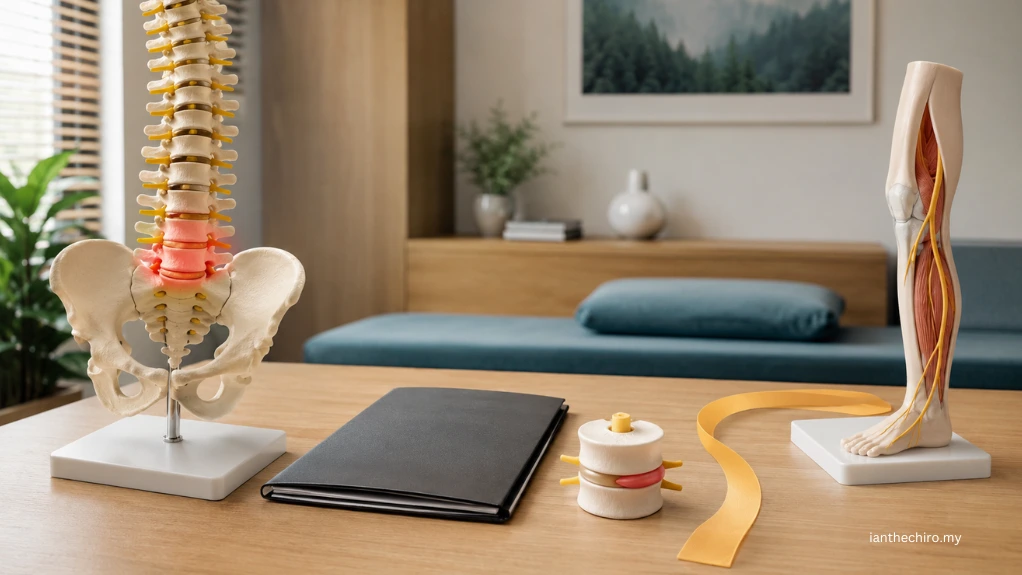
Back pain, slipped disc, and sciatica are often talked about like they are the same thing.
They are related, but they are not exactly the same.
Some people have back pain without a slipped disc. Some have a disc bulge on MRI but no major symptoms. Some have pain travelling down the leg and assume it must be sciatica, even though not every leg symptom is true sciatica.
If you are trying to understand back pain vs slipped disc vs sciatica, the main point is this: the label is useful, but it is not enough by itself. What matters is how your symptoms behave, where the pain travels, what triggers it, what eases it, and whether the pattern matches the diagnosis.
At Ian The Chiro in Cheras, Kuala Lumpur, we often see patients who are unsure whether their lower back pain is “normal back pain”, a slipped disc, sciatica, muscle tightness, or something more serious.
This article is for general education and is not a diagnosis. If you are unsure what applies to your case, start with a proper consultation.
Quick Answer: Back Pain vs Slipped Disc vs Sciatica
Back pain usually refers to pain or discomfort around the lower back. It may stay local or sometimes spread to nearby areas.
A slipped disc usually refers to a disc bulge, disc herniation, or disc-related change that may or may not be causing symptoms.
Sciatica usually refers to pain or nerve-like symptoms travelling from the lower back or buttock into the leg, often following the path of the sciatic nerve.
The tricky part is that these can overlap.
A person can have back pain without sciatica.
A person can have sciatica-like symptoms without a confirmed slipped disc.
A person can have a slipped disc on MRI that does not fully explain their pain.
That is why assessment matters.
Why These Terms Get Confusing
Many people use these terms interchangeably because the symptoms can overlap.
For example, someone may say:
- “I have back pain.”
- “I think I slipped a disc.”
- “My pain is going down my leg, so maybe it is sciatica.”
- “My MRI says disc bulge, so that must be the problem.”
Sometimes those statements are correct. Sometimes they are only partly correct.
The issue is that pain does not always follow simple labels. The same diagnosis can behave differently in different people, and similar symptoms can come from different causes.
That is why it is more useful to ask:
- Where is the pain?
- Does it stay in the back, or travel elsewhere?
- Is there tingling, numbness, burning, or weakness?
- What makes it worse?
- What eases it?
- Is it improving, worsening, or staying the same?
- Does the scan finding match the symptoms?
“The goal is not just to name the condition. The goal is to understand what is actually relevant in your case.”
What Is Back Pain?
Back pain is a broad term. It simply means pain or discomfort around the back.
For this article, we are mostly talking about lower back pain.
Lower back pain may feel like:
- aching
- tightness
- stiffness
- soreness
- pressure
- sharp pain
- pain when bending, sitting, standing, walking, or lifting
Some back pain stays local. Some spreads toward the buttock, hip, or thigh. Some feels worse after long sitting, driving, gym training, lifting, or awkward sleep.
Back pain can involve different structures and factors, such as:
- joints
- muscles
- discs
- nerves
- movement habits
- sitting tolerance
- lifting load
- training volume
- sleep and recovery
- previous injuries
This is why back pain should not automatically be assumed to be a slipped disc.
What Is a Slipped Disc?
“Slipped disc” is a common term, but it can be misleading.
A disc does not usually slip out of place the way the name suggests. More accurately, people may be referring to a:
- disc bulge
- disc protrusion
- disc herniation
- disc irritation
- disc-related nerve irritation
The discs sit between the bones of the spine and help with load distribution and movement. In some cases, the disc can become irritated or change shape. If this affects nearby nerves, symptoms may travel into the buttock or leg.
But here is the important part:
A slipped disc or disc bulge on MRI does not automatically mean it is the main cause of your pain.
Some disc findings may be relevant. Some may be older changes. Some may not fully match what you are feeling right now.
That is why the scan has to be compared with your symptoms, movement, neurological signs, and daily function.
What Is Sciatica?
Sciatica usually refers to pain or nerve-like symptoms that travel along the sciatic nerve pathway.
This often means symptoms that start around the lower back, buttock, or hip and travel down the back of the thigh, calf, foot, or toes.
Sciatica-like symptoms may feel like:
- shooting pain
- burning pain
- electric-like pain
- tingling
- numbness
- heaviness
- weakness
- pain travelling down the leg
Some people feel worse when sitting. Others feel worse when bending, walking, standing, coughing, sneezing, or getting up after being still.
Sciatica can sometimes be linked to disc-related irritation, but not every leg symptom is true sciatica. Some symptoms may come from the lower back, hip, muscles, joints, or other nerve-related patterns.
Again, the pattern matters.
Back Pain vs Slipped Disc vs Sciatica: The Simple Difference
Here is a simple way to separate the terms:
Back pain is the symptom location.
It tells us where you feel pain, but not necessarily why it is happening.
Slipped disc is a possible structural finding.
It may be seen on MRI or suspected based on symptoms, but it must be matched with the clinical picture.
Sciatica is a symptom pattern.
It usually describes nerve-like pain travelling into the leg.
So the difference is:
- Back pain tells us where the pain is.
- Slipped disc describes a possible disc-related issue.
- Sciatica describes pain or symptoms travelling along a nerve pattern.
They can overlap, but they are not the same thing.
Can You Have Back Pain Without a Slipped Disc?
Yes.
Most back pain is not automatically a slipped disc.
Back pain may be related to:
- joint irritation
- muscle guarding
- poor load tolerance
- prolonged sitting
- repeated bending
- lifting habits
- training load
- recovery issues
- sleep
- stress
- movement patterns
- previous injuries
This does not mean discs are never involved. It simply means back pain should not be blamed on a disc without proper assessment.
If every back pain case is treated like a slipped disc, the advice may become too scary, too restrictive, or not specific enough.
Can You Have a Slipped Disc Without Sciatica?
Yes.
A person may have a disc bulge or disc-related finding without obvious leg symptoms.
They may feel mainly lower back pain, stiffness, or discomfort. Some people may not feel much pain at all despite having disc findings on a scan.
This is why MRI findings must be interpreted carefully.
A scan can show structure, but it does not automatically explain pain, sensitivity, movement tolerance, or what should be done next.
A systematic review in AJNR found that disc degeneration, disc bulges, and disc protrusions are common even in people without back pain, so scan findings should be interpreted together with symptoms and assessment findings.
The better question is not just:
“What does the MRI say?”
The better question is:
“Does the MRI finding match the symptoms and assessment findings?”
Can You Have Sciatica Without a Confirmed Slipped Disc?
Yes.
Sciatica-like symptoms can happen even if you have not had an MRI or a confirmed disc diagnosis.
Pain travelling into the leg may be related to:
- disc-related irritation
- nerve sensitivity
- lower back irritation
- muscle guarding
- hip-related contribution
- repeated sitting or bending
- load and recovery issues
Some cases may need imaging or medical review. Others may not need imaging immediately and can begin with assessment first.
The key is to understand the behaviour of the symptoms.
Signs That Symptoms May Be More Nerve-Related
Symptoms may be more nerve-related if you notice:
- pain travelling below the buttock
- pain going into the thigh, calf, foot, or toes
- tingling
- numbness
- burning
- electric-like pain
- weakness
- reduced control
- symptoms that change with sitting, bending, coughing, or sneezing
Nerve-related symptoms do not automatically mean something serious is happening, but they should be assessed properly, especially if they are worsening or affecting daily function.
When Back Pain Should Be Checked Medically First
Most back pain is not an emergency, but some symptoms should be checked medically before starting chiropractic care.
⚠️ Please seek medical attention first if your back pain is linked with:
- major trauma or a serious fall
- sudden severe weakness
- worsening numbness
- loss of bladder or bowel control
- numbness around the groin or saddle area
- unexplained fever
- unexplained weight loss
- pain that feels severe and unusual for you
- symptoms that are rapidly worsening
If you are unsure, you can still WhatsApp the clinic and ask, but urgent or unusual symptoms should be assessed medically first.
Do You Need an X-Ray or MRI?
Not always.
This is consistent with NICE guidance for low back pain and sciatica, which recommends considering imaging in specialist settings only if the result is likely to change management.
Many people think they need imaging before getting assessed. In many cases, the first step can be a consultation, history, movement checks, and relevant physical assessment.
Imaging may be useful if:
- there was trauma
- symptoms are severe or unusual
- symptoms are worsening
- there are significant neurological signs
- there is suspicion of a structural issue that needs checking
- the result would change the next step
If you already have an X-ray, MRI, or medical report, bring it along. It may be useful. But the scan still needs to be compared with your current symptoms.
Do not assume that every back pain, slipped disc, or sciatica case needs imaging before anything else can happen.
How Ian Thinks Through Back Pain, Slipped Disc, and Sciatica

Ian does not treat every back pain case as a slipped disc, and he does not treat every leg symptom as sciatica.
He usually thinks through a few layers.
First, what is the symptom pattern?
This includes where the pain starts, where it travels, what triggers it, what eases it, and whether there are nerve-like symptoms.
Second, does the label match the behaviour?
A scan finding only matters if it makes sense with the person’s symptoms, movement, function, and examination findings.
Third, is chiropractic care suitable?
Some cases may be suitable for chiropractic adjustments, dry needling, advice, movement guidance, or load management. Other cases may need imaging, medical review, or a different direction first.
Fourth, what is the most practical next step?
The aim is not to force treatment, but to decide what makes sense based on the case.
What Care May Involve
Care depends on what is appropriate after assessment.
For suitable cases, care may involve:
- chiropractic adjustments
- dry needling
- soft tissue work
- movement advice
- activity modification
- load management
- recovery guidance
- referral or medical co-management if needed
Not every back pain case needs adjustments. Not every slipped disc concern needs the same plan. Not every sciatica-like symptom should be treated the same way.
The care should fit the case.
What You Should Pay Attention To Before Booking
Before booking, it helps to notice the pattern.
You do not need to diagnose yourself. Just pay attention to:
- where the pain starts
- whether it travels into the buttock, hip, leg, calf, foot, or toes
- whether there is tingling, numbness, burning, or weakness
- what makes it worse
- what eases it
- whether sitting, bending, walking, or standing affects it
- whether it is improving, worsening, or staying the same
- what you have already tried
- whether you already have scan results or medical reports
These details help make the consultation more useful.
Common Questions
Is back pain always caused by a slipped disc?
No. Back pain can come from many different factors, including joints, muscles, discs, nerves, movement habits, sitting tolerance, training load, recovery, and previous injuries. A slipped disc is one possible explanation, not the only one.
Is sciatica the same as a slipped disc?
No. Sciatica describes a symptom pattern where pain or nerve-like symptoms travel down the leg. A slipped disc may be one possible cause, but not every sciatica-like symptom is caused by a slipped disc.
Can a slipped disc heal?
Some disc-related symptoms can improve with time and suitable care, depending on the case. The important thing is to assess the symptom pattern, irritability, neurological signs, and whether conservative care is appropriate.
Do I need an MRI if I have sciatica?
Not always. Imaging may be useful if symptoms are severe, worsening, linked with neurological changes, or if the result would change management. Many cases can start with assessment first.
Why does my back pain go down my leg?
Pain travelling down the leg may involve nerve irritation, disc-related sensitivity, muscle guarding, lower back irritation, or other patterns. It should be assessed properly, especially if there is numbness, tingling, weakness, or worsening symptoms.
Can chiropractic care help slipped disc or sciatica?
It depends on the case. Some back pain, disc-related, or sciatica-like symptoms may be suitable for chiropractic care. Others may need medical review, imaging, or a different care pathway first.
Should I rest if I have back pain or sciatica?
Short-term rest may help when symptoms are very irritated, but complete rest for too long is not always helpful. The better approach is usually to understand what movements and activities your body can currently tolerate.
When should I get checked?
You should get checked if pain keeps returning, travels into the leg, affects walking or sleep, causes numbness or tingling, or leaves you unsure what is safe to do next.