
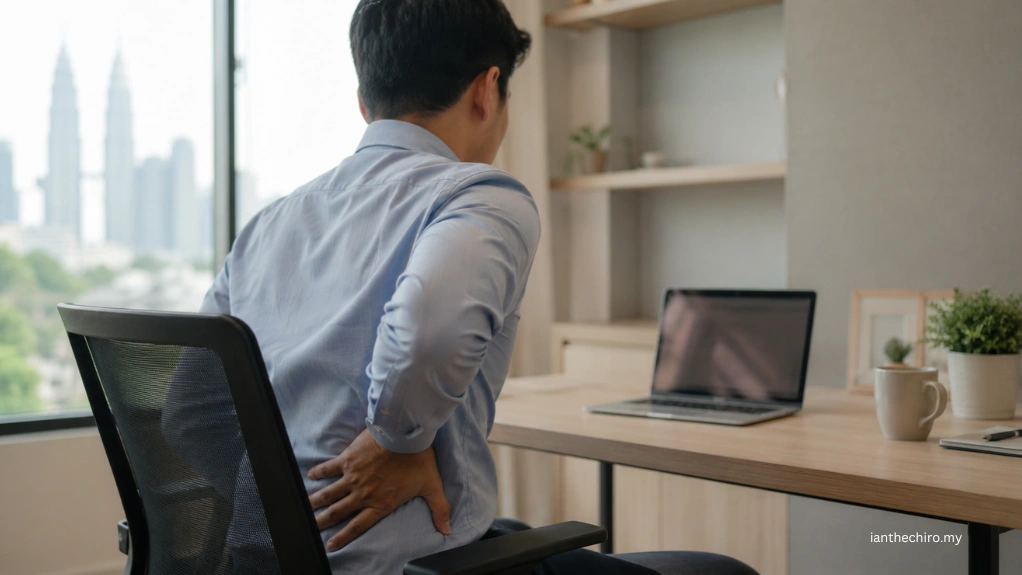
Lower back pain after sitting is very common.
Some people feel okay when they are standing or walking, but the pain starts building after sitting for work, driving, studying, or watching something for too long. Others feel stiff when they first stand up, then need a few steps before the back starts to loosen.
If you have been wondering, “why does lower back pain feel worse after sitting?”, the answer is not always as simple as “bad posture”.
Sitting can affect the lower back in different ways. It may involve load, stiffness, muscle guarding, disc sensitivity, hip position, lack of movement, stress, or how long your body can currently tolerate one position.
At Ian The Chiro in Cheras, Kuala Lumpur, we often see patients who are not dealing with one sudden injury, but a repeated sitting-related pattern that keeps irritating the lower back.
This article is for general education and is not a diagnosis. If your lower back pain keeps returning, travels into the leg, worsens, or affects daily life, start with a proper consultation.
Quick Answer: Why Does Lower Back Pain Feel Worse After Sitting?
Lower back pain may feel worse after sitting because the back is staying in one position for longer than it currently tolerates.
That may involve:
- prolonged pressure through the lower back
- reduced movement
- hip stiffness
- muscle guarding
- disc-related sensitivity
- poor load tolerance
- slouched or unsupported sitting
- long driving
- weak recovery between long sitting periods
- returning to movement too suddenly after being still
“Sitting is not automatically bad. But if your lower back is already irritated, stiff, sensitive, or overloaded, sitting for too long can make the symptoms more noticeable.”
Sitting Is Not Automatically the Enemy
A lot of people blame sitting itself.
But sitting is not always the problem by itself. The bigger issue is often the amount of time spent sitting, the position you stay in, and whether your body has enough movement variety throughout the day.
For example, sitting for 20 minutes may feel fine.
Sitting for 2 hours without moving may feel different.
Sitting all day at work, then driving home, then sitting again at night may be more than your lower back currently tolerates.
The goal is not to fear sitting forever. The goal is to understand why your lower back is reacting to it.
A 2025 scoping review on sitting time, posture and behaviour in office workers found that longer sitting time, fewer breaks, poorer sitting posture, and more static sitting behaviour were associated with low back pain.
Reason 1: Your Back May Not Tolerate Staying Still for Too Long
The spine generally responds well to regular movement.
When you sit for a long time, the lower back, hips, and surrounding muscles stay in a relatively fixed position. For some people, that stillness can make the back feel stiff, compressed, or irritated.
This is why lower back pain after sitting often improves after walking around for a while.
Movement may help because it changes the load, reduces time in one position, and gives the muscles and joints a chance to stop guarding.
If your back feels worse the longer you sit, but better once you move, the issue may be less about one “wrong” posture and more about staying in one position for too long.
Reason 2: Your Sitting Position May Be Loading the Same Area Repeatedly
Posture is not everything, but it can still matter.
If you sit in the same rounded, twisted, collapsed, or unsupported position for long periods, the same tissues may keep getting loaded again and again.
This may happen when you:
- slouch into the chair
- sit with one hip higher than the other
- cross one leg repeatedly
- lean to one side
- work from a laptop that is too low
- drive for long periods
- sit at a desk without changing position
- sit on a soft sofa for too long
None of these positions are automatically “bad” for everyone.
But if your lower back is already sensitive, repeated loading in the same position may keep irritating it.
Reason 3: Your Hips May Be Contributing
Sometimes sitting-related back pain is not only about the lower back.
The hips are flexed when you sit. If your hips are stiff, tight, weak, or not moving well, the lower back may have to compensate when you stand, walk, bend, squat, or train.
This does not mean every case is a “hip problem”. It means the hips may need to be assessed together with the lower back.
For example, some people feel:
- tightness in the hip flexors
- stiffness in the glutes
- discomfort around the buttock
- pain when standing up after sitting
- lower back stiffness after driving
- difficulty straightening up after long sitting
If the hip and lower back are not sharing movement well, sitting can make the whole area feel more locked up.
Reason 4: The Back May Be Guarding Because It Feels Irritated
Muscle tightness around the lower back is common after sitting.
But tightness is not always the main problem.
Sometimes muscles tighten because the area feels irritated, sensitive, overloaded, or not well supported. In that case, stretching or massage may give short-term relief, but the tightness may return if the reason for the guarding is still there.
This is why some people feel better after stretching, then feel stiff again after another long workday.
The better question is not only:
“Which muscle is tight?”
The better question is:
“Why does this area keep tightening after sitting?”
Reason 5: It Could Be Disc-Related Sensitivity

Some lower back pain that worsens with sitting may involve disc-related sensitivity.
This does not automatically mean you have a serious slipped disc. It also does not mean you need to panic if sitting is uncomfortable.
But sitting can sometimes increase symptoms in disc-sensitive cases, especially if the pain also worsens with bending, coughing, sneezing, or if symptoms travel into the buttock or leg.
Disc-related symptoms may include:
- lower back pain after sitting
- pain when bending forward
- pain travelling into the buttock or leg
- tingling, numbness, or nerve-like symptoms
- pain that feels worse when getting up from sitting
- symptoms that improve with walking or changing position
The important thing is not to assume based on one symptom alone.
The pattern needs to be assessed.
Reason 6: Your Back May Be Tolerating Less Load Than Before
Sometimes lower back pain after sitting becomes worse because your back is not tolerating daily load as well as before.
This may happen after:
- a previous injury
- a period of inactivity
- sudden increase in gym training
- long work hours
- poor sleep
- stress
- long driving
- repeated bending or lifting
- returning to exercise too quickly
Your back may not be “weak” in a permanent sense. It may simply be dealing with more total demand than it can currently recover from.
When that happens, sitting may become one of the positions where the irritation shows up.
Reason 7: You May Be Sitting Too Long, Then Moving Too Suddenly
Some people sit for hours, then immediately stand, bend, lift, train, or rush into movement.
The body may not like that sudden transition.
For example:
- sitting at work for 3 hours, then rushing to lift something
- driving for a long time, then carrying bags immediately
- sitting all day, then going straight into heavy gym training
- studying for hours, then bending forward repeatedly
If the back has been still for a long time, it may need a gradual return to movement before heavier activity.
This does not mean sitting causes damage. It means the transition from stillness to load may matter.
What If the Pain Goes Down the Leg?
If lower back pain travels into the buttock, thigh, calf, foot, or toes, it should be assessed more carefully.
Leg symptoms may involve nerve irritation, disc-related sensitivity, muscle guarding, hip contribution, or other patterns.
Pay attention if you notice:
- pain travelling below the buttock
- tingling
- numbness
- burning
- electric-like pain
- weakness
- symptoms that worsen with sitting
- symptoms that affect walking or control
Travelling pain does not automatically mean something serious is happening, but it should not be ignored if it is worsening or affecting daily function.
When Lower Back Pain After Sitting Should Be Checked Medically First
Most lower back pain after sitting is not an emergency, but some symptoms should be checked medically before starting chiropractic care.
Please seek medical attention first if your lower back pain is linked with:
- major trauma or a serious fall
- sudden severe weakness
- worsening numbness
- loss of bladder or bowel control
- numbness around the groin or saddle area
- unexplained fever
- unexplained weight loss
- pain that feels severe and unusual for you
- symptoms that are rapidly worsening
If you are unsure, you can still WhatsApp the clinic and ask, but urgent or unusual symptoms should be assessed medically first.
Do You Need an X-Ray or MRI?
Not always.
Many people think they need an X-ray or MRI if their lower back pain gets worse after sitting. In many cases, the first step can be a proper consultation, history, movement checks, and relevant physical assessment.
Imaging may be useful if:
- there was trauma
- symptoms are severe or unusual
- symptoms are worsening
- there are significant neurological signs
- there is suspicion of a structural issue that needs checking
- the result would change the next step
If you already have an X-ray, MRI, or medical report, bring it along. It may be useful. But the scan still needs to be compared with your current symptoms and examination findings.
What You Can Try First
If your lower back pain after sitting is mild and not linked with worrying symptoms, you can start by changing the sitting pattern.
This may include:
- standing up every 30-45 minutes
- taking short walking breaks
- changing sitting positions throughout the day
- using a chair that supports you better
- raising your laptop or screen
- avoiding very soft sofas for long periods
- warming up gently before training after long sitting
- reducing sudden bending or lifting right after sitting
- noticing whether symptoms respond better to walking, stretching, or rest
The aim is not to find the perfect posture.
The aim is to reduce repeated irritation and give your back more movement variety.
A 2024 global comparison of low back pain guidelines found that recent guidelines commonly emphasise active approaches such as education, exercise, staying active, avoiding bed rest, and self-management.
What Not to Do
⚠️ Try To Avoid:
- sitting through worsening pain just to finish work
- aggressively stretching the lower back every time it hurts
- self-cracking repeatedly for temporary relief
- resting completely for days without a plan
- jumping straight into heavy lifting after sitting for hours
- assuming every sitting-related back pain is a slipped disc
- ignoring pain that travels, worsens, or affects strength and control
Small changes can help, but if the pattern keeps repeating, it is worth getting assessed.
How Ian The Chiro Approaches Lower Back Pain After Sitting
At Ian The Chiro, sitting-related lower back pain is not assessed by only asking whether your posture is “good” or “bad”.
The first step is to understand the pattern clearly.
First, what is the pain pattern?
This includes when the pain starts, how long you can sit before it appears, whether it travels, what eases it, and what makes it worse.
Second, what does sitting seem to trigger?
Some people feel stiffness. Some feel sharp pain. Some feel symptoms travelling into the leg. Some feel fine while sitting but worse when standing up.
Third, what else may be contributing?
This may involve hip movement, lower back sensitivity, muscle guarding, disc-related irritation, work setup, driving, gym load, sleep, stress, or recovery.
Fourth, what is the most practical next step?
Some cases may be suitable for chiropractic care. Others may need activity changes, movement advice, imaging discussion, medical review, or a different direction first.
The aim is not to blame sitting or posture alone. The aim is to understand why your lower back is not tolerating sitting well right now, then decide what next step makes sense.
When You Should Get Properly Assessed
You should consider getting assessed if:
- lower back pain keeps returning after sitting
- pain affects work, sleep, driving, gym, or daily movement
- pain travels into the buttock or leg
- there is numbness, tingling, weakness, or nerve-like pain
- you feel unsure what is safe to do
- you keep needing painkillers just to get through the day
- symptoms are worsening instead of improving
- walking, standing, or changing position no longer helps
- the same pattern keeps repeating despite stretching or rest
You do not need to wait until the pain is unbearable. If sitting keeps triggering the same pain pattern, it is reasonable to understand it earlier.
Common Questions About Why Lower Back Pain Feels Worse After Sitting
Why does my lower back hurt after sitting?
Lower back pain may feel worse after sitting because the area is staying in one position longer than it currently tolerates. It may involve stiffness, muscle guarding, disc-related sensitivity, hip contribution, work setup, or poor recovery between long sitting periods.
Is sitting bad for lower back pain?
Sitting is not automatically bad, but sitting for too long in one position can make lower back pain more noticeable. The issue is usually the dose, position, lack of movement variety, and how sensitive the lower back already is.
Why does my back feel stiff when I stand up after sitting?
Your back may feel stiff because the lower back and hips have been still for a long time. If the area is already irritated or guarded, standing up can make the stiffness more obvious at first.
Should I stretch my lower back if sitting makes it hurt?
Gentle movement may help some people, but aggressive stretching is not always the answer. If stretching gives temporary relief but the pain keeps returning after sitting, the bigger pattern should be assessed.
Is lower back pain after sitting a slipped disc?
Not always. Some sitting-related back pain may involve disc sensitivity, but many cases are not purely disc-related. The symptom pattern, leg symptoms, neurological signs, and assessment findings matter.
Why does my back pain improve when I walk?
Walking changes the load on your lower back and gives the joints, muscles, and hips more movement. Some people feel better with walking because the back does not tolerate staying still for too long.
Do I need an MRI for lower back pain after sitting?
Not always. Imaging may be useful if symptoms are severe, worsening, linked with neurological changes, or if the result would change management. Many cases can start with assessment first.
Can chiropractic care help lower back pain after sitting?
It depends on the case. Chiropractic care may help if the pain pattern is suitable and the assessment suggests that joints, muscles, movement habits, load, or related factors are contributing. The first step is to understand the pattern properly.
When should I get assessed?
Get assessed if your lower back pain keeps returning after sitting, travels into the leg, affects work or daily life, or leaves you unsure what is safe to do next.
Why does lower back pain after sitting go down my leg?
Lower back pain that travels into the buttock, thigh, calf, foot, or toes may involve nerve irritation, disc-related sensitivity, muscle guarding, or another pattern that should be assessed properly. If the pain is worsening, spreading, or linked with numbness, tingling, or weakness, it is better to get checked instead of guessing.